.

Category: writing

An Intelligent Designer on the Cow

By DAVID NG

Today, I feel like doing a plant – no, an animal. Yes, today, I am going to make an animal. And it will be a masterpiece. I shall call it the…. No wait! Maybe I should think of the name later. Yes, you should always name your pieces after you have completed them. Better that way.

OK then. An animal it is. More specifically, a vertebrate. Large body, four legs, one tail, one head, usual stuff on the head – i.e., let’s just follow the standard animalia rubric. Nothing exciting there. Not yet anyway. So let’s give it an armored tail, with poisonous tendrils and a stink that can kill. Oooh, I like that – but maybe it’s too much. Why such a fancy tail? Maybe the tendrils can come out of its nostrils (note to self: Have I designed nostrils yet?). And the stink can come from the body itself.

But it doesn’t quite feel right. Feels forced. No matter, I suppose I can simply start over. Besides, I did the poisonous tendrils last week. But keep the stink? Yes, let’s keep that.

I know. How about we give it three, no eleven, no four stomachs! Four stomachs! For the efficient eating, of the grass. I am truly inspired! Don’t stop there. How’s this? This animal should urinate milk. From its groin, no less. From little appendages which I will humbly call teats that collectively, communally, reside on a mound of tissue I will call a brother.

Now I am on a roll. Milk will flow from the teats of this animal’s brother.

No wait, I cannot call it a brother. This animal has no lips – don’t want it to have lips – too common a thing for a masterpiece. Seen that, done that, yesterday’s news. But you can’t say the word “brother” without lips. Poor animal, that would be cruel. Instead, let’s call it an udder. Yes, an udder – that’s much better.

Now, of course, I need to work in a clown somehow. I love clowns. In truth, clowns are my all-time favorite design. How will I do this? Perhaps give the animal a raucous and overt sense of humor? Make it wear funny shoes? Make it scare the shit out of young children? No, not subtle enough – I want this animal to be so much deeper than that.

What if, and I’m just saying things as they come to me, this animal-can-be-ground-and-shaped-into-a-meat-patty- which-can-be-mass-produced-and-fried-on-heating-elements, and-then-sold-by-a-corporate-entity-bent-on-feeding-the-obesity-line-to-young-children -by-using-as-their-public-representation-and-symbol, a-clown, whom-we-shall-call-Jesus (no-wait,-let’s-save-that-one-for-later), whom-we-shall-call-Ronald-McDonald, and-these-meat-patties, which-will-be-inexplicably-and-mysteriously-called-hamburgers -after-a-completely-different-animal-I-haven’t-created-yet, will-also-be-considered-sacrilegious-by-fully-one-sixth-of-the-world’s-population, and-oh-oh-why-is-it-that-the-numbers-0157-cry-out-to-me? because-OH-MY-GOODNESS-I-can’t-believe-it, but-this-stuff-is-just-so-brilliant!

Take a breath. WHheeeew-hooooooo. Calm down. That’s pretty good. But maybe just think about some of the simple things now. Like color. Yes, color is good. And easy – let’s go with the rustic look, plus spots. Et voilà. We have finished yet another creation, which for some reason, I feel inclined to call a cow. Hold on, one last thing. It shall go “moo” when it speaks. Yes, that’s a nice touch, even if I do say so myself. People are sure to talk about that one, maybe even create a song or two.

Originally published at Inkling Magazine.

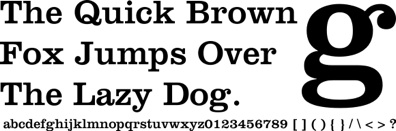
For Font Lovers: A Short History of Clarendon.

By DAVID NG

wiki entry | thesis essay from Mitja Miklavcic, 2006 (pdf)

So, it seems that having a name like popperfont, suggests the need to discuss typeset. This, I think, is a reasonable request, and one that I’m game to explore. Note, that I know very little about the jargon and history behind such matters, but I do enjoy a good font.

– – –

O.K… so this font (which happens to be one of my favourites), has an interesting history. First up, if you want all the gory details, the pdf linked to above makes interesting reading – it’s a dissertation paper on the Clarendon font, detailing its history.  This post, if anything, is a layman treatment of the paper.

Anyway, the Clarendon font appears to have started off as a design exercise to create a font that could highlight text within normal type. Apparently, until a certain point in history, this was almost always done by using italics, and Clarendon is nominally associated as the first “related” bold face – as in it was designed to look nice along with standard Times fonts.

Although, there were other typefaces with a similar “look” appearing at earlier dates, the Clarendon font seems to be most appropriately associated with an origin date of 1845, and by a Robert Besley of Fann St. Foundary. Although, from general internet perusal, the circumstances are a little vague, it would appear that Besley went on to gain further fame in later years as a Mayor of London (here is what he looked like, but if you visit the link and check out the other images, you’ll also see him immortalized in cartoon form).

Anyway, he even went on to patent the font, although this particular hold lasted for only 3 years. But during this short time frame, the Clarendon font became very popular, and once the property hold was released, many a copycat font were produced much to the chagrin of Besley himself (see below image, 1852).

It’s also interesting to note that this particular font entered pop-culture history in terms of the type of font used in in certain noted environments. One being the wild western in North America (i.e. “wanted” or “reward” signs), and other, where Clarendon variants (specifically “French Clarendon“) took on a circus look (it’s even known as “Circus Letters” in some texts).

Anyway, it wasn’t until the 1920s when Clarendon, once again, experienced a resurgence of sorts, and like before, this was primarily due to pragmatic reasons. You see, at this point in history, newspaper production rocketed to new heights, and as a result, the printing technology became a lot more efficient as well as a lot faster and rigorous. However, a downside to this, was the fact that many of the type sets used were taking a physical beating resulting in the plates being damaged (especially when the lines were especially thin).

Consequently, a number of companies attempted to produce new fonts that would still look good, but could also function in the wear and tear realities of the new printing demands. Here, the Clarendon font stepped in.

“One of the first companies that began to experiment in this way was Mergenthaler Linotype Company. After four trials they finally issued a typeface that was based on a clarendon/ionic model from the 1850s. The name of the typeface was Ionic No. 5…. The typeface was very successful…”Within a year, the typeface had been adopted by some 3,000 newspapers all over the world.” (Miklavcic, 2006)”

Finally, Clarendon-like fonts experienced another boost during the 1950’s. This, just after the World War 2, coincided with a general increase in advertisement productions (the economic boom right after the war). Typography as a whole was caught in an intensive move to design new and innovative typefaces.

Anyway, this led to a large number of fonts which many feel fit within the Clarendon look. Including the current incarnation of the font, which was revised by Hermann Eidenbenz in 1953.

So, there you have it – it’s funny, but it’s almost like these fonts “evolve” over time. There’s got to be a good analogy there somewhere…


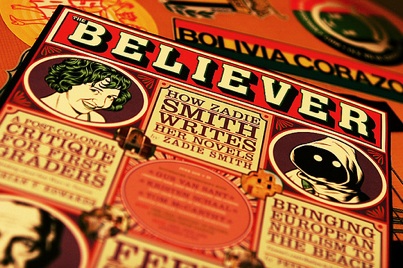
The Believer, one of my favourite magazines seems to appreciate the Clarendon look – image by Gabo/Quadrupede’s

Awkward Beauty: Musing on the relationship between science and art.

By DAVID NG

Often I get asked to attend artistic events because apparently word has gotten out that my lab does a fair amount of work within the creative arts. Whilst this is true (my lab does have a number of projects that interact with the creative writing and visual art community), and I am always honored to be included, the reality is that I often feel very out of place when I go to these things. The cultures embedded within these scenes—a poetry reading, an art exhibition, or a theatrical production—are just so very different from my own scientific setting. It’s as if I know there is beauty in what I am experiencing, but still I can’t help but feel a certain sense of awkwardness. That maybe I shouldn’t be there in the first place, at this strange intersection between the arts and the sciences.

Of course, this interplay is awkward, and I say awkward out of courtesy. Sometimes, it can feel downright foreign. Which is understandable since, as we’ve all been told, beauty is in the eye of the beholder, and at last count, there are almost 7 billion beholders out there on this planet, most of them foreigners to us.

We all see things differently. Take viruses as an example: Objects that serve as a baseline for subsistence, almost cheating their way into the world of the living. Most scientists see beauty in these forms, not necessarily because they are aesthetically pretty to look at, but because there is elegance in the way they function with so little, in the way they survive, in the way they be. To people like me, it feels like a small miracle that they can even exist in the first place.

But when I take a look at Luke Jerram’s marvelous virus sculptures, it shows a different perspective. (See Seed’sprofile of Jerram’s work.) Not only it is intriguing to view these structures, but there is a new appreciation for the subject. They appear intricate, venerated, and yes, even pretty. Best of all, these sculptures make viruses feel strangely more real. This, I’ll warrant, is a form of beauty that will register better to certain beholders, more so than genetic sequences and infection processes.

And this is nice. It allows a wider audience to immerse themselves in a topic. It gives others a chance to provide an opinion, contribute a perspective. It provides a place for the artist and the scientist to come together, to dialogue, and by doing so, to break the awkwardness a little. I can speak from my own experience. When I do go to an artistic event, I’ve discovered that it’s always better to wear my scientist label—in fact, it gives me a stronger voice. People are curious about my views, and the conversation in my mind becomes less about me versus them, but more about “what do you see?”

It’s when I go to these events, or when I explore pieces by artists such as Jerram, that I quickly realize that it’s not really about two cultures, those two distance columns of knowledge representing art and science. It’s just about “people liking different things:” Many people are frustrated by this, but many people celebrate it. Perhaps most importantly, everybody knows this to be true already. Consequently, I think there’s a lot of bottled wisdom in that old saying, especially when it comes to bridging disciplines, fostering respect for artistic and scientific literacy. It’s something worth holding onto when you go outside your comfortable setting or when you share your perspective, your opinion, your knowledge to others. It makes you realize that maybe there should be more opportunities for the artist and the scientist to converge. In this light, awkwardness seems rather natural, and maybe is not such a bad first step after all.

Originally published at Seed, October 15, 2009

An Open Letter to the Human Resources Department of the Superfriends

(Another old humour piece of mine – this one you can find at McSweeney’s)

By DAVID NG

Dear Mr. Superman, Mr. Batman, Ms. Wonder Woman, and other esteemed do-gooders,

Although I have been waiting patiently for a few years in the hope that an advertisement would appear, I feel for the sake of my career that now is a good time to approach you. In essence, I am wondering whether you are, or will be, accepting any new members into your fine organization. More specifically, I am inquiring as to whether you need the services of a geneticist, since that is my particular field of expertise.

Part of the reason I am contacting you now is that I suspect you are possibly hurt by the unwarranted waning in public interest associated with your group, a symptom that likely correlates to the soaring popularity of some of your competitors—the X-Men and Spider-Man, to name two.

Anyway, this is why I think I can help—as a geneticist, I can bring a lot to the table. To me, it’s no coincidence that the X-Men, Spider-Man, and the like are mostly a consequence of fortuitous genetic modification.

More specifically, my knowledge in genetics can directly tackle your weaknesses. For instance, current genetic technologies could be utilized to offset Mr. Superman’s annoying kryptonite problem. Whether it’s the result of something specific in his genetic makeup or the result of the rest of society having some sort of innate immunity, the issue at stake is a difference in biological makeup. This, of course, makes it a perfect candidate for targeted gene therapy.

Mr. Batman could also benefit greatly from a genetic analysis. I would not be surprised if his manic-depressive tendencies are hard to manage and counterproductive to the group as a whole. Here we can perform a few diagnostic genetic tests, which can then go to great lengths to effectively pinpoint and manage these potentially bothersome tendencies.

Even Ms. Wonder Woman could stand to gain from my genetic expertise. Clearly, engaging in intensive hand-to-hand combat with her sizable chest is problematic. But how exactly would you perform breast-reduction surgery—or any surgery, for that matter—when an individual’s magic bracelets are constantly maneuvering to defend against an incoming scalpel? My point is that you don’t have to—I may be able to do something about this by using current genetic-manipulation methodologies.

And just imagine what could be done with cloning. The mind reels, does it not?

Now, with respect to fighting crime, I think that, overall, it wouldn’t take much effort to transform me into a fully functional Superfriend. I already have a well-equipped laboratory facility, which, with your help, could easily be relocated to the appropriate underground cave, glacier, secret island, or space station.

As for a costume, I own several lab coats, which, when worn with a good pair of spandex pants, will, I’m sure, sufficiently instill some semblance of fear into those who choose to do battle with me. I would offer to wear some retro-looking goggles as well, but, unfortunately, I need my prescription glasses, and, well, contacts tend to make my eyes itch.

Although I can’t fly, and I don’t own anything close to resembling a Batmobile or an invisible jet, I do drive around in one of those stylish yet practical Mazda MPVs. If you recall, this is Mazda’s very popular minivan model (you know—zoom zoom!), which would probably look quite superheroish were I to paint some lightning bolts or DNA strands on its sides.

Also, if it helps, I know quite a few physicists who may be able to lend a hand with Ms. Wonder Woman’s embarrassing “the jet is invisible but I’m clearly not” situation.

Yours sincerely,

Dr. David Ng
University of British Columbia
Vancouver, BC, Canada

Sciencegeek Fundamentals #1: An Introduction to the Scientific Method, by way of Chewbacca

A TANGENTIAL SCIENTIFIC METHOD:
ON THE NATURE OF SCIENCE WITH REFERENCES TO CHEWBACCA, STORK EATING ALIENS, A FEW STEVES, ONE INSTANCE OF THE WORD “FUCK,” AND (QUITE POSSIBLY) TWO VERY LARGE CHILDREN.

By DAVID NG

(Fancy pdf of this piece in its entirety also available here)

Section No. 1 | 2 | 3 | 4 | 5

For the last couple of years, when I’m speaking or lecturing to a larger audience, I would sometimes throw out the following question: “Who is Chewbacca?

I do this because I’m curious on whether there are actually people in this world who have never heard of Chewbacca. Which, as a big fan of Star Wars, is a possibility that escapes me. Still, without fail, there are always a few. In fact, if I were to plot graphs around this question, I would notice that “Ignorance of Chewbacca” has been going up in a slow but steady fashion over the last few years. Furthermore, my small and caveat laden sample of data currently suggests that at least 5% of the world has no clue what this Chewbacca thing is [1].

Then, of course, things would get strange. Because usually at this point, I might ask those knowledgeable in the audience, to describe “Chewbacca” to those who are not. Here, the references to Star Wars specifically and science fiction in general come out. This includes discussions about co-piloting space ships, ripping arms off, and descriptions of a weapon that is a cross between a laser and a crossbow. The word “wookie” will inevitably surface, and then, remarkably you might say, someone will begin to make Chewbacca sounds – something best described as a long vibrating groan suggestive of yearning [2]. Indeed, if I give it a chance, the whole lecture hall might even begin making Chewbacca sounds, which is something that is both uniformly glorious and bizarre at the same time. Interestingly, none of this really seems to help the 5% who confessed to being Chewbacca ignorant. If anything, the 5%, looking at the strange proceedings around them, tend to look confused if not a little frightened.

I bring this up, because this silly idea of Chewbacca ignorance is a bit like asking people, “What is science?” It’s one of those things where a proper answer is actually very rich in detail, and nuanced in ways that can be surprising. Furthermore, these details and nuances tend to be only obvious to those firmly embedded within science culture itself. And much like the Chewbacca example, if you explain this to a person who is not part of this culture, it would probably sound a little bewildering and frightening too.

To illustrate this, let’s try something right now. Find someone you know who isn’t into science.

This is probably pretty easy, since this is likely most people. Now ask them point blank, “What is science?” Undoubtedly, you will get all manner of responses – many of which will reference graphs, measurements and technology, perhaps with nods to things like physics, chemistry and biology. But if you listen carefully, I would bet that the responses are vague at best, and certainly not a reflection of the richness involved in what I consider a proper answer. Sort of like the injustice that goes with describing Chewbacca as simply, “a character in a science fiction movie.”

To me, this is a shame. Not the Chewbacca part (which is a different kind of shame), but the bit about science. To me, the idea of the general public reacting to the fundamentals of science literacy, in a way that the aforementioned 5% might react to a wookie sound, is a very bad thing. In fact, I would suggest that this confusion or lack of familiarity over science is actually a dangerous thing. This is because, unlike wookies, science has an increasingly active and prominent role in real life.

As well, this lack of clarity is not about science literacy in the sense that we worry about citizens who do not know about greenhouse gases, or how DNA is replicated, or how differential calculus is done – in other words, it’s not really about specific technical details (although this is important too). But rather, it is mostly about whether a person is literate of the process; whether they appreciate the steps and parameters which define how science is done. It is mostly about these points because they represent a framework that provides the world with a very powerful way of knowing things (epistemology for those who prefer big words).

Such parameters, of course, are often neatly laid out in what many would call “The Scientific Method.” Almost everyone will hear about this at some point in their lives, although it appears to be a topic that mostly presents itself at younger ages, at the elementary school levels for instance. However, one also finds that as the student gets older, its premise will be continually diluted by an increasing glut of science technical detail. This is an unfortunate reality of how science is taught in schools – there are information hierarchies that must be covered in order to get to the next level, and because the volume of that information is intense, there is simply little time for students to reexamine the basic principles of the scientific method and of science culture itself. Furthermore, this does not even include those young students who decide to avoid the sciences altogether.

Which brings us back to aforementioned mention of shame. After all, shouldn’t we encourage all students and citizens to continually reassess the scientific method: more so, since an elementary student is hardly in the best position to fully appreciate its complexity? Isn’t the scientific method an icon of rationality – something that you hope all decision makers, from individuals making small choices to leaders making large ones, would take time to appreciate fully?

Unfortunately, this isn’t how the world currently works. Which is disappointing: because regardless of all this talk about society and danger and decisions, it would do us well to be reminded that through it all, the Scientific Method (and what it has produced) is, quite frankly, awesome.

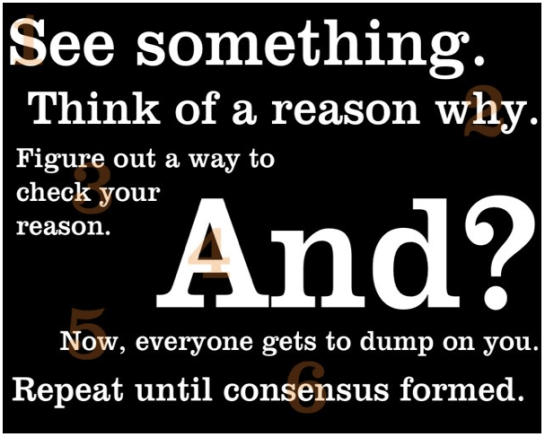
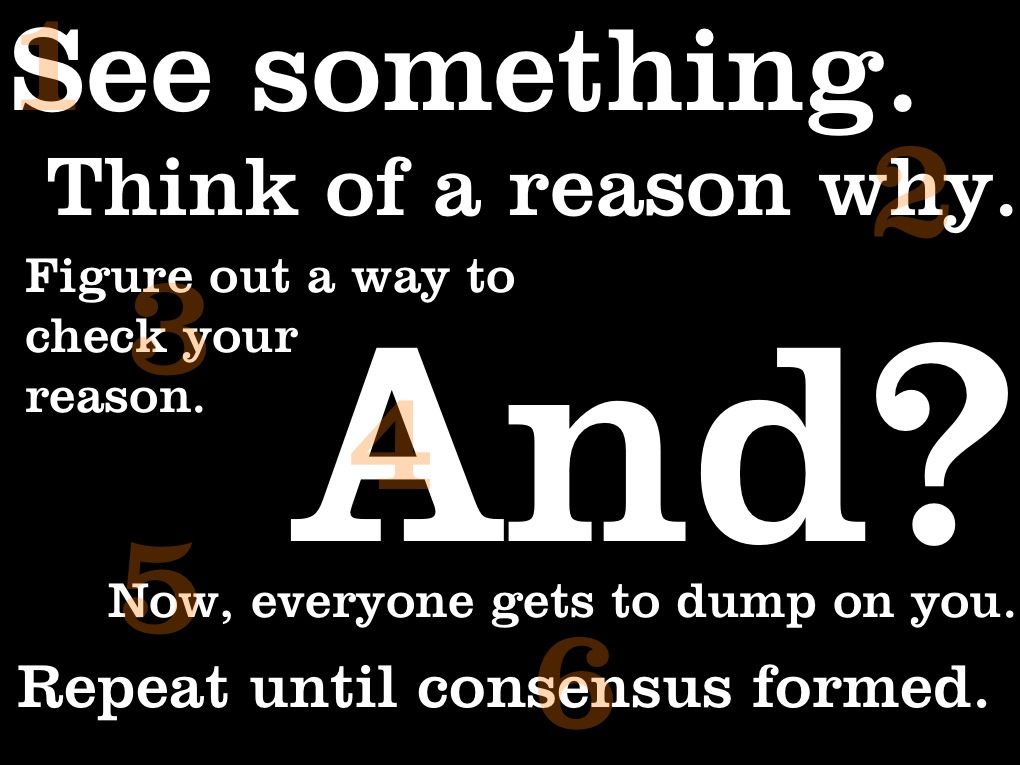
So for now, we’ll end this section with something basic. We’ll end it with a flowchart depicting the scientific method. Perhaps something with steps like the below:

1. See something.
2. Think of a reason why.
3. Figure out a way to check your reason.
4. And?
5. Now, everyone gets to dump on you.
6. Repeat, until a consensus is formed.

But don’t forget: this representation is, by no means, a complete picture or even necessarily a correct picture. Indeed, Sir Francis Bacon himself, a man often considered to be the “Father of Scientific Method,” [3] may disapprove with the simplicity of this flowchart.

It is, however, as good a place to start as any: and hopefully sufficient to at least utter the sentiment, “Punch it Chewie.”

Notes
[1] If you happen to be part of this 5%, please refer to this link for more on Chewbacca.

[2] The Chewbacca Soundboard.

[3] Sir Francis Bacon (1561 – 1626) was incredibly influential in highlighting the importance of “inductive reasoning” through the accumulation of data (also sometimes called the Baconian Method). he was also buddies with the British Monarchy, and there exists many a hypotheses that suggests he may have written some of the works of Shakespeare.

(3rd draft)

The N.I.H. rejects Dr. Phil

By DAVID NG

Dear Dr. Phil,

Thank you for submitting your application for the director’s position at the National Institutes of Health. As the N.I.H. is the principal force guiding America’s efforts in medical research, we have strived to consider every candidate’s application seriously.

Our first impression was not a good one. You have a loud and exuberant manner that is an oddity in our network of colleagues, and for the duration of the interview process, you were physically sitting on top of Dr. James Watson (a man considerably smaller than you), oblivious to his muffled and strained murmurs beneath you. We found this quite distracting and wonder what this reflects of your character. Furthermore, although he has only a minor role in the selection process, the Nobel laureate was quite put out. As the conversation continued, we found other characteristics that troubled us. Your commitment to, as you call it, “big ideas,” whilst commendable, seemed a tad impetuous. Your mention of using your television program or perhaps “your good friend” Oprah’s television program to (in your own words) “GIVE FREE GENE THERAPY TO EACH AND EVERY MEMBER OF THE AUDIENCE!” is frankly very unsettling to us.

In truth, we fear that your celebrity status may ultimately impede our principal mandate of excellence in health research. Although some of our members thought it wonderful that you have a Muppet in your likeness on “Sesame Street,” your list of other references (e.g., “I drink scotch with Kelsey Grammer on a regular basis”) hardly elicits confidence. To be blunt, your scientific C.V. is poor and your repeated attempts to demonstrate your scientific prowess were laughable at best. (Adjusting the pH in your hot tub does not count, nor does your vasectomy.)

Finally, we found your tendency to talk in meaningless, corny phrases very irritating. Responses like “Sometimes you just got to give yourself what you wish someone else would give you” or “You’re only lonely if you’re not there for you” are very confusing, to say the least. In fact, our members felt that overall you were even more irritating than the applicant who used the word “testicular” 67 times in his interview. One member of our hiring committee actually wrote the comment “Who the [expletive] is this guy—Foghorn Leghorn doing Yoda?”

Consequently, the hiring committee regrets to inform you that your application has not been shortlisted for further consideration at this time. Please tell Ms. Winfrey to stop bothering us.

Yours sincerely,

Dr. Paul Batley Johnson
Hiring Committee
National Institutes of Health

(One of my older humour pieces – original link here)

Breakfast of Champions does Replication

By DAVID NG

To begin with, we’ll start with a chicken scratch drawing of a DNA molecule, which you know is double stranded. My poor pathetic attempt at illustration is therefore going to look like this:

You also know that each strand of DNA is composed of building blocks called nucleotides, and that these nucleotides are always interacting in a complementary manner. For example, A’s are always with T’s, C’s are always with G’s, Beavis is always with Butthead, etc etc etc. Let’s draw them in like so:


Read the rest of this entry »

The tenured track job ad you’ve had nightmares about.

A UNIVERSITY JOB POSTING (OR BECOMING A PROFESSOR IS HARD THESE DAYS)

By DAVID NG

This is a call for outstanding candidates to apply for a tenure track assistant professor position within the context of the Michael Smith Laboratories at the University of British Columbia. The successful applicant is expected to work in areas of interest to current faculty members, to interact with related groups within our network and to have demonstrated ability in producing research material of excellent quality and interest.

Due to the competitive nature of this process, we ask that all candidates at the very least meet the following criteria:

The candidate’s current area of specialty must contain at least fourteen syllables.

The candidate’s expertise must speak naturally to collaborations with the disciplines of science history, Jungian philosophy, international peacekeeping, French Canadian politics, molecular genetics, early 80s pop music criticism, and West African cuisine.

The candidate must be able to “flex arm hang” for a minimum of twelve minutes.

The candidate must exhibit no more than two degrees of separation from Kevin Bacon.

The candidate must be able to rub their tummy and pat their head at the same time.

The candidate must be, in no uncertain terms, hot.

In addition, short listed candidates will be subjected to a rigorous interview process that will likely involve puppetry, ultimate fighting, and some interpretative dance techniques. This, of course, might be televised nationally on CBS, so it is advisable that all applicants prepare in advance for these skill sets.

The successful applicant will covet a salary that will commensurate with experience and research record, but realistically is dependant on an obligation to play as the principle string in the University’s Chinese Orchestra during the first three years of his/her track.

We will also endeavor to provide the applicant with reasonable research space, and note that we have one of the country’s best supply of camping gear, should this be an issue. We do however ask that successful candidates will themselves provide start up funds to the sum of $1000, which must be used within 48 hours. During that period, you will, of course, be wearing brightly covered overalls and have access to a skilled carpenter who will almost certainly be just as hot as you.

Our university is one of the leaders in North America with strong connections with many well regarded institutes, and we look forward to continuing this tradition with this placement. We hire on the basis of merit and are committed to employment equity. We encourage all qualified persons to apply; however citizens and permanent residents will be given priority. No losers please.

Stupid science writing tips.

By DAVID NG

In your story, it is good to insert either the line “Now, at last, we can save the world!,” or “Dear God. What have I done?” For extra conflict, insert both.

Be aware that the majority of the Elements in the Periodical Table end in “ium.” This makes rhyming really easy.

Sex, drugs, blood and guts – really now, this is just an invitation to write about mate selection, pharmaceuticals, and anatomy.

When in doubt, chemists are the bad guys, physicists are the good guys, and biologists are generally the ones with the best hair.

Bacteria make good antagonists. Plus, they are literally everywhere – this only adds to their aura as an awesome force to be reckon with.

If you plan on using the “=” symbol, please be certain that the two sides are indeed equivalent. If they’re not, mathematicians will be irked.

Go out on a limb. Don’t be afraid to use the words, “Uranus”, “friction” and/or “sperm” vicariously.

Try using Boolean logic in your plot lines. Bonus marks if you can also use the word Boolean in your plot line. Extra extra bonus marks if your plot line can be express as a y=mx+b equation.

And finally, for the love of all that is good, please no articles on Scientology.

A Biologist in Nigeria

This is the unedited version of “DNA and Nigeria: Survivor for Science Geeks” first published in the June/July 2004 edition of Maisonneuve.

– – – – –

By DAVID NG

Dr. Oyekanmi Nashiri is a busy individual who exudes enthusiasm, embraces optimism, and covets high expectations. Then again, as the principle organizer of a somewhat curious scientific program, he would have to be all that and more – some would even say that his good intentions place him squarely in the category of certified nutbar. Nash (as he prefers to be called) has spent the better part of his scientific career developing and implementing the West African Biotechnology Workshops, a focused attempt on bringing scientific expertise and potential research collaborations to his homeland, Nigeria. Which is to say, he is intent on bringing the realm of high technology into an otherwise struggling country.
Read the rest of this entry »

The scientist as mad artist – an example using DNA for musical composition

By DAVID NG

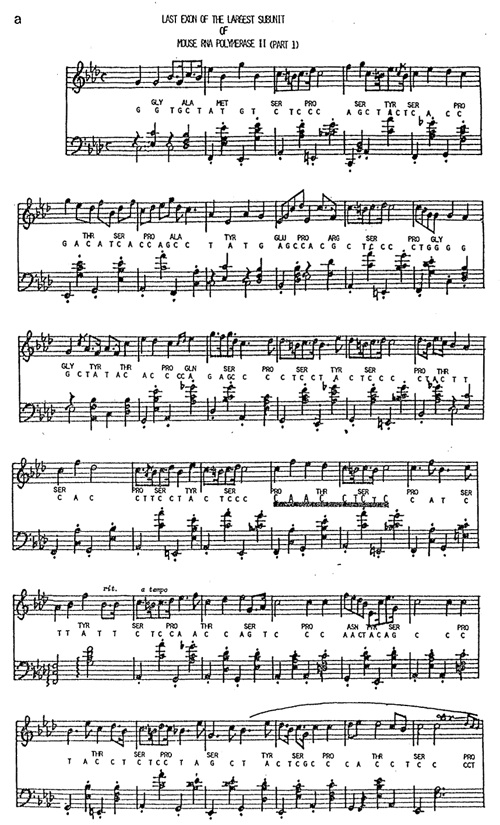
This lovely piece of music is actually reprinted from a wonderful paper entitled “The all pervasive principle of repetitious recurrence governs not only coding sequence construction but also human endeavor in musical composition” (link to pubmed abstract page) and the above image is a figure depicting musical notation as translated from the last exon of the largest subunit of mouse RNA polymerase II. As if this isn’t delicious enough, the article goes on to show that the musical piece shows strong similarities to Chopin’s Noturne OP55. No. 1.

The principle author* Sosumu Ohno begins the paper with an awesome beginning. He writes:

“Whereas ordinary mortals are content to mimic others, creative geniuses are condemned to plagiarize themselves” is my shorter, albeit inarticulate, version of what Van Veen said in Ada by Vladimir Nobokov. Indeed, it seems that vaunted geniuses seldom invented more than one modus operandi during their lifetimes, and even civilization has largely been dependant upon plagiarizing a small number of creative works; e.g. the multitudes of Gothic churches can be viewed as pan European plagiarism of the abbey church of St. Denis and/or the cathedral at Sens. This is not surprising for new genes sensu stricto hae seldom been invented. Evolution rather relies on plagiarizing an old and tested theme…”

And then continues to make a case for great works (musical composition) to be inherently derived from DNA coding sequence.

I often use this paper in a little game I play in class called “Is this real?” and this paper in particular has been the cause of much controversy over the years. Ohno, himself, was a celebrated geneticist with many accomplishments, perhaps the most famous of which was being one of the first to notice that one of the two X chromosomes, in females, existed in a heterochromatin (silenced) form. He was also one of the first geneticists to look into the potential importance of repetitive genetic elements in a genome.

It was from this (and influenced heavily by his wife, Midori) that he developed an interest in expressing DNA code as musical pieces – the obvious advantage being that repetitive elements are likely easier to “hear” than to “see.”

Anyway, a few years back a number of high profile clients cried foul when I had to correct them and tell them that the paper was real, and so I made the additional effort to contact him. Unfortunately, he had just passed away, but the office that looked after his trust wrote back saying “it’s real.” Nice.

For more on Sosumu Ohno, click here for his wiki entry.

*The second author is his wife, the more musically proficient one.

Words I See When I Read The Phrase “Intelligent Design” While Squinting

By DAVID NG

Interior Design

Bullshit

– – –
(Originally published at McSweeney’s)

Where are all the awesome “Scientific Method” slides?

I said it before – the scientific method is awesome: but where are the cool visuals for it? You do a Google image search for the term “scientific method” and you’re awash with pretty basic and frankly uncool flowcharts. There’s even a weird acrostic involving slow rabbits, which is kind of funny, but hardly something that exudes awesomeness.

The one below is the one that I’ve made for my lectures, but unfortunately, my artistic talent is pretty much limited to “using a pretty font.”

(Large slide img link here)

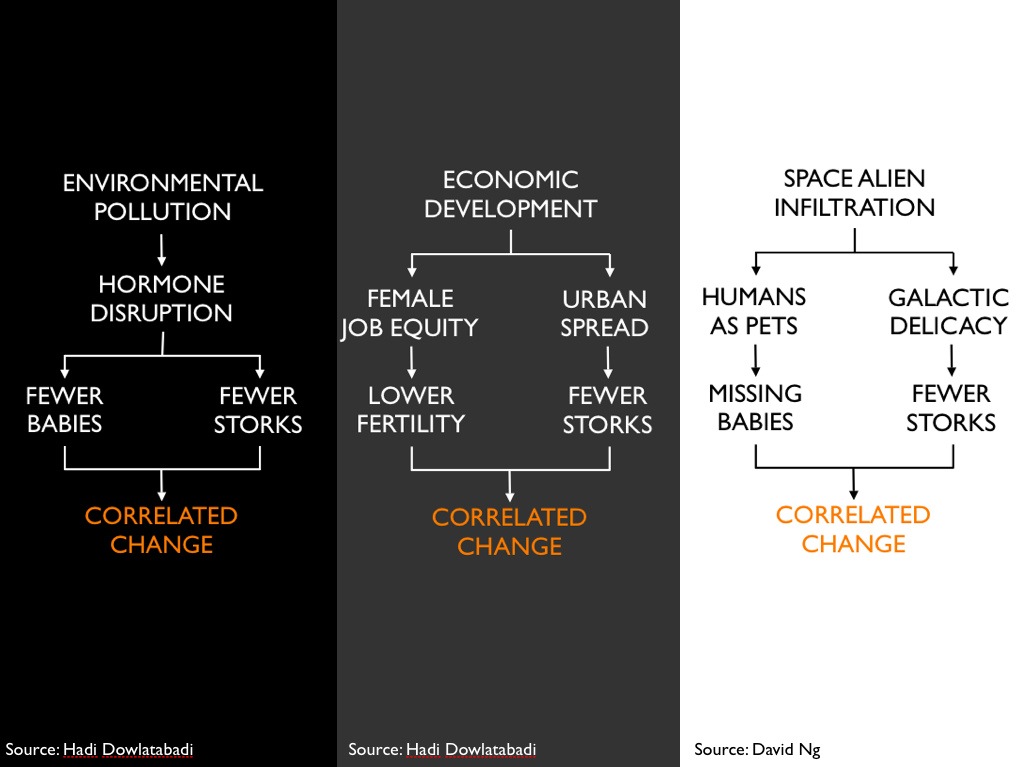
Here’s another I use for making hypotheses, with the scenario being a decline in birth rate and a decline in stork population occurring at the same time. Still, this is just using my other artistic talent which equates to “use the other pretty font you like.”

(Large slide img link here)

Would be wonderful though, if there are some out there that use cool illustrations or just nail it in the visual information department. If you know of any do pass them on in the comments.

(Originally posted at Boingboing.net)