
.
Tag: science literacy

November 20, 2012
Another example of why you sometimes can’t trust your first impressions. The Leaning Tower Illusion. #whoa

“These images are identical, yet the tower on the right appears to lean more. Why?
Frederick Kingdom, Ali Yoonessi, and Elena Gheorghiu of McGill University discovered this effect in 2007. Normally parallel towers viewed from below appear to converge with distance; because that doesn’t happen here, the brain infers that the towers are diverging.”
Text via Futility Closet, image from Wikipedia.
November 19, 2012
Here’s another song I wrote: This one is about climate change, the first law of thermodynamics, and the awesomeness of science.
I don’t know what it is about marking papers, but my brand of procrastination seems to lead to silly creative science pursuits.
And so, here is a song I quickly wrote and laid down some tracks last night. It’s kind of amazing what you can do with the average computer and a decent microphone these days. Hope you enjoy!
Lyrics:
10/3/5/Em
Listen, things are getting warmer
You can call it climate, climate that is changing
Simple in that science, science is the reason
We should take a stand, come up with a plan, listen to
It’s like this, living in a greenhouse
throwing in the air now, burning in the air now
warmer radiation, holding at the station
models add it up, heat is going up.
G A Dm G
CHORUS
Don’t you know It’s science, showing us the numbers
showing us a truth, something we can trust,
Something that we must take hold and move on forward
10/5/7/3
BRIDGE
It’s like this, following the first law
Which is all to say that, that everything is bookkept
Counted and accounted. Following the heat
Following the work, following the state of things
Heat up, means it getting warmer
And with work a storming, moving air and water
Also changing states, melting ice to liquid
Averaging it out, causing thing to shout
CHORUS
Don’t you know…
BRIDGE
Science: it’s not opinion, it’s not like fiction, and not religion. It’s rational, and looks at facts, mistakes are tracked, it looks at evidence.

October 23, 2012
Remember the Candy Hierarchy? It sure did make a lot of folks angry! Ben and I are working on the 2012 edition right now…
Here is the 2011 version (see original 2011 link for footnotes here).

Had a chance to read over 500 comments (from various places where the ranking was reposted, etc), and we’re working hard to change things accordingly (i.e. the power of peer review in action!) Stay tuned…
October 23, 2012
Here is a song I wrote about that buzz you get when you meet folks who speak your (scientific) language, jargon and all. #scio13
Just an old demo, but kind of nice.
Essentially, it started with a challenge of giving me strange technical terms that I would have to incorporate into a song. The words that immediately came back included Epiglottis, Flagella, Dictyostelium, Homo erectus, and Phthalates.
And so, I went ahead and wrote something pretty quick about how sometimes it’s kind of wonderful to revel in jargon, especially when you’re nattering on with your scientific peers. In some ways, I kind of feel like it’s my own unofficial theme song to the ScienceOnline2013 conference coming up in January. This is my tribe – we talk science, and we love it.
Play above or here is the mp3 to check out, and lyrics reprinted below.
One of these days, I’ll have to re-record a second take (sound levels are very low), and maybe with a capo on the second fret to move it up vocally a bit. Also, you may notice that the word Phthalate didn’t make the song – that was more because I didn’t know how to pronounce it! If you let me know how to say it properly, maybe I’ll write a song just about that.
JARGON FUELED WAYS
I notice something today
About the way you talk in jargon fueled ways
It’s those crazy words that you say
That make me realize about your jargon fueled ways
BRIDGE
Those things you sing to me acapella
Like dictyostelium and flagella
You shout out stuff like homo erectus
Always great to hear epiglottis
So when you think you will say
The sort of things in your own jargon fueled way
And let’s just say it’s o.k.
That I kind of love your jargon fueled ways.
END








September 12, 2012
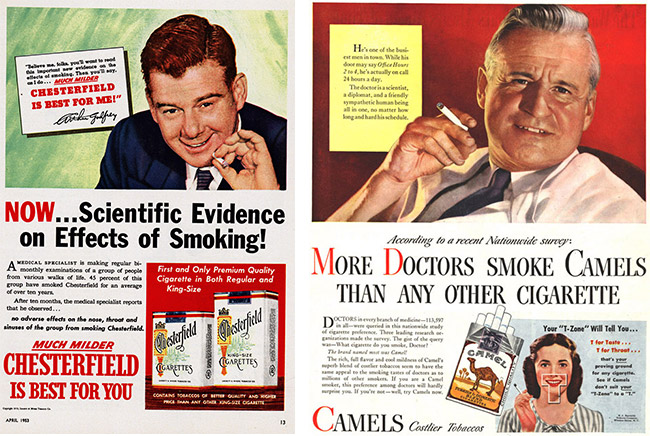
O.K. rate the validity of this: There are only three reasons why a man carries flowers.

I’m seeing this as a potential visual to talk about obvious and non-obvious facets of making claims, generating hypoetheses, and things you can do to test them.
By dont fret, via Hey Oscar Wilde!
August 24, 2012
Raccoon versus Pikachu: Who would win?
(Procrastinating again)

Available here as a tshirt, and an obvious nod to phylogame.org
Comments below on who you think would win…



August 22, 2012
Some writing (with a nod to thermodynamics) that didn’t make the cut in my book proposal.
So, I’m just finishing up a non-fiction book proposal for my agent and initially I had the below text as an entry point. In the end, I ditched it because I decided to instead use a personal anecdote about a child and her unicorn questions. Anyway, I still kind of like the below, so it seemed a shame not to show it off somewhere.
– – –
By DAVID NG
THIS IS NO (AN) ORDINARY BOOK
1
The book you are holding in your hands follows the laws of thermodynamics. This is possibly something you take for granted, or more likely, it is something you are not familiar with – maybe because of the use of terminology foreign to you. Nevertheless, it is a reality that informs some of your expectations of this book. You assume, for instance, that the book will not spontaneously turn into an elephant – no matter how fond you might be of elephants. You also assume that the book will not leap away from your hands, unless, of course: (1) you hurl it away yourself; or (2) you are surprised by an errant gust of wind; or (3) you are accosted by an excitable neighbour (perhaps an elephant?) who physically snatches it from your hands and throws it across the room. Although all of these silly assumptions sound obvious, it is the laws of thermodynamics that encapsulate some fundamental science necessary to translate them into elegant conceptual and mathematical descriptions. Furthermore, these elegant laws work everywhere. More importantly, the moral of our fable (and we can call it a fable because of the involvement of our elephant) is that often we find that obvious assumptions can also be obviously explained by robust scientific concepts.
2
But what if the assumptions are not so obvious; what if they are confusing even? What if you are getting information from a variety of conflicting places? What if someone you trust told you that there is value in eating this book. They tell you that ingestion of this book will cure cancer, or that it will make you rich, or that it might even earn you a pet elephant. What if they tell you that they know this to be true, because they have “seen it with their own eyes?” At this point, a person might use a variety of different criteria to judge this assumption. How much do I trust this individual? Is the individual knowledgable? What is the evidence involved? How good is the evidence? How badly do people want the assumption to be true? Should this matter?
All of these criteria sound reasonable, and presumably if you use them, you would come to the conclusion that maybe eating this book isn’t such a good idea. Yet, interestingly, when people are poised with numerous day to day claims about the world, they don’t always think to use all of these criteria. In fact, sometimes decisions are often made by quickly skimming through these criteria, or focusing on only one of them. In particular, many people evaluate these assumptions without looking deeply at things like the expertise of the source, or the soundness of the evidence. Which is unfortunate, since this is really an ignorance of the scientific process, a way of obtaining knowledge that has fundamentally changed the course of human history, and has provided us with information to make sense of the physical world around us. This process isn’t always the best way to evaluate claims – religion and philosophy may have more pertinent roles in questions about how the book might move your soul, or what the purpose of this book is – but for many scenarios, where there are empirical things you can measure and see, it’s a pretty decent way to evaluate your options and make good important decisions.
3
Then, of course, there is the issue of forgetting the roles that science plays in almost everything you do and everything you have. This is something you already know, but don’t really think about: that the vast majority of your activities and objects past have been historically informed by both scientific concepts and the scientific process; and that the vast majority of your activities and objects future will be informed by new scientific concepts and society’s continued participation in the scientific process. This book, for instance, didn’t materialized magically. Intellectually, the words were recorded on a computer, and an author’s health is maintained by medical research. Physically, there were players from biodiversity (the pulp from the trees, the dyes to create the ink) and advances in publishing technology involved (the printing press, distribution mechanisms). But these science-centric things are, in the best case scenario, often forgotten, and in the worst case scenario, are deliberately hidden from us. It’s as if science literacy isn’t worth acknowledging. The scientific way of thinking is being ignored. The world is crying, “Sciencegeek down” without an afterthought.
This book’s assumption is that this isn’t a good thing. And that, dear reader, is the real elephant in this room.
August 14, 2012
Teaching intro biology is harder than teaching intro history.

By Saturday Morning Breakfast Cereal. Thanks for the tip Dave!
July 30, 2012
SCIENCE IS AWESOME, THAT IS ALL: The tshirt.
Sometimes also referred to as the “I’m procrastinating, so let’s design a t-shirt” t-shirt.

Available for purchase here.
July 17, 2012
I bet we could go explore the galaxy if we could stop being dicks for like five minutes.
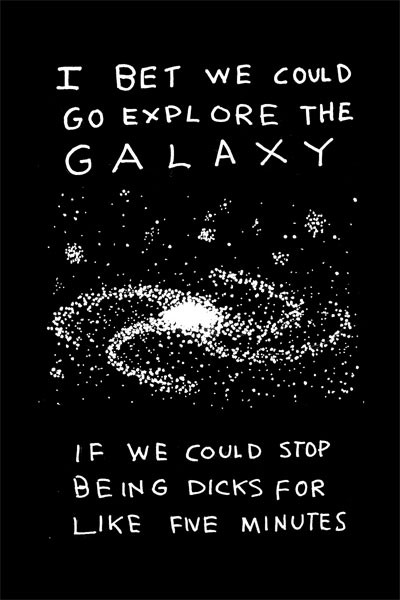
All over the internet, via Imgur.
July 13, 2012
Ways Politicians and Robots are Alike
By DAVID NG
Their eyes.
A politician’s eyes appear to be fully capable of eliciting an empty yet intense robot gaze. Intriguing because this look is reminiscent of the kind that any human might make when solving difficult math problems in their heads, and which, coincidentally, is also an activity that robots are notorious for doing all the time. On the other hand, maybe they look that way (the politicians) because their eyeballs are also recharging and getting ready to shoot out laser beams.
Their focus.
Politicians are always super focused and always “on message,” sometimes to the point of “muzzling” individuals who might veer away from their specific agenda. This, of course, is indicative of algorithmic behavior and also of spyware filtering, which when taken to certain extremes is closely associated with “programming” for robots of the evil genius ilk. Indeed, this observation is quite striking: there is an eerie similarity between most Democrats and Dave from 2001, as well as most Republicans and Megatron from The Transformers.
Their message.
Robots, like computers, are often relentless in producing endless streams of spam. As well, this spam almost always fits in one of two categories: (1) either promises for financial wealth and economic prosperity; or (2) pornographic photos of genitalia. Sound familiar?
Their apathy towards unusual climate patterns.
Typically, politicians have a poor record on climate change policy. It is almost as if they don’t care that it’s happening. Which begs the question: why the nonchalance attitude? Wouldn’t most leaders in our society be wary of what is arguably the single greatest challenge facing humanity today? Is it because they know that they as robots are generally impervious to temperature and weather extremes?
Their wariness of appearing too robot-like.
This particular attribute is most likely to manifest itself as a collection of exaggerated attempts to draw attention away from their robot ways. For example – Possible exaggerated attempt #1: kissing babies. Possible exaggerated attempt #2: serving customers at a small local business. Possible exaggerated attempt #3: saying something very very stupid. Interesting to note that the combined symbolic aesthetic of baby kissing plus humbly serving customers plus saying very very stupid things is widely recognized as the perfect antonym to the “essence of robotness.”
Their hearts.
There are some politicians who seem programmed to care little for social programs and/or initiatives that aim to help the less fortunate. This suggests that the concept of inequity is perhaps too difficult to compute. If so, that’s a little cold… maybe even robot cold.


 popperfont.net
