
.
September 1, 2011
“The good thing about science is that it’s true whether or not you believe in it.”

Great quote from astrophysicist Neil deGrasse Tyson. Via chrispiascik.com. Also available as a t-shirt.
September 1, 2011
Eerie bubble and ferrofluid movie.
“I combined everyday soap bubbles with exotic ferrofluid liquid to create an eerie tale, using macro lenses and time lapse techniques. Black ferrofluid and dye race through bubble structures, drawn through by the invisible forces of capillary action and magnetism.”
Mesmorizing to watch: kind of want to get some ferrofluid now to play with. Especially after you read a little more on the properties of this strange material (see wiki entry).
September 1, 2011
Not exactly what to think of this: Growing sphincters in petri dishes.
“Eyes, sperm, you name it: these days, chances are someone’s cooking it up on a little slab of agar and gearing up to graft/sew/implant it in anything that comes near. Today’s body part is the anal sphincter, that handy little ring of muscle that maintains the separation between your insides and your outsides. Researchers grew them from cells, implanted them in mice, and compared the new sphincters’ function with the animals’, ah, native orifices. And apparently, they were quite satisfactory.”
(via Discover)
August 31, 2011
Animal Kingdom (slide depository)
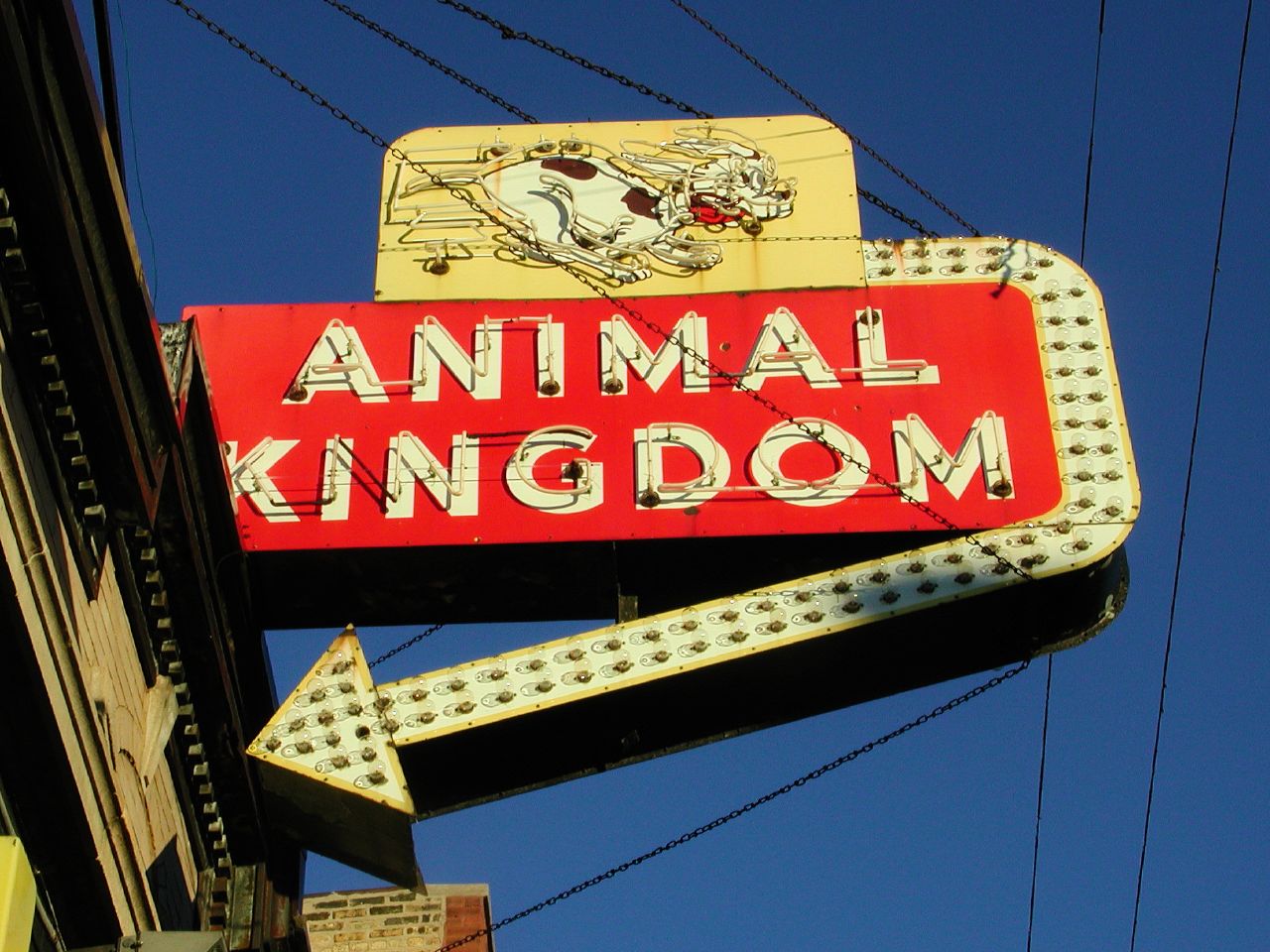
keywords: biodiversity | ecosystem assessment
(Image: Animal Kingdom Sign, a Creative Commons Attribution Share-Alike (2.0) image from pixeljones’s photostream)
August 31, 2011
Harry Potter fans take note: You’ll enjoy this tribute art exhibition website.
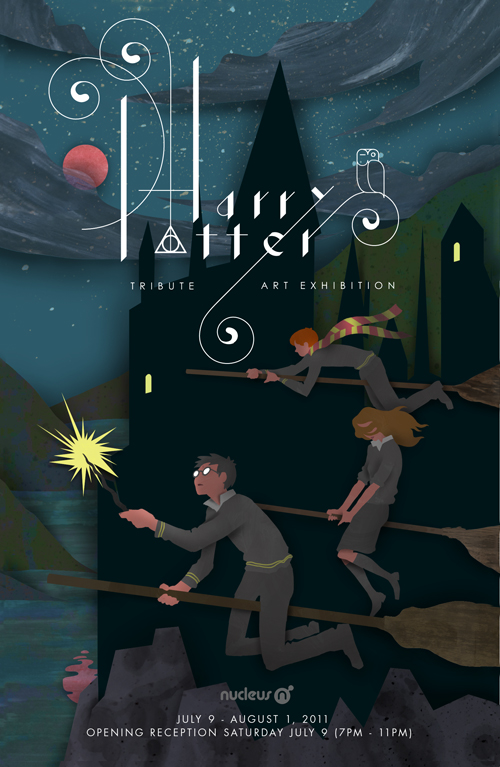
If you’re a Harry Potter fan, you’re going to freak a little when you see all the great artwork on display at this site.
August 31, 2011
The tenured track job ad you’ve had nightmares about.
A UNIVERSITY JOB POSTING (OR BECOMING A PROFESSOR IS HARD THESE DAYS)
By DAVID NG
This is a call for outstanding candidates to apply for a tenure track assistant professor position within the context of the Michael Smith Laboratories at the University of British Columbia. The successful applicant is expected to work in areas of interest to current faculty members, to interact with related groups within our network and to have demonstrated ability in producing research material of excellent quality and interest.
Due to the competitive nature of this process, we ask that all candidates at the very least meet the following criteria:
The candidate’s current area of specialty must contain at least fourteen syllables.
The candidate’s expertise must speak naturally to collaborations with the disciplines of science history, Jungian philosophy, international peacekeeping, French Canadian politics, molecular genetics, early 80s pop music criticism, and West African cuisine.
The candidate must be able to “flex arm hang” for a minimum of twelve minutes.
The candidate must exhibit no more than two degrees of separation from Kevin Bacon.
The candidate must be able to rub their tummy and pat their head at the same time.
The candidate must be, in no uncertain terms, hot.
In addition, short listed candidates will be subjected to a rigorous interview process that will likely involve puppetry, ultimate fighting, and some interpretative dance techniques. This, of course, might be televised nationally on CBS, so it is advisable that all applicants prepare in advance for these skill sets.
The successful applicant will covet a salary that will commensurate with experience and research record, but realistically is dependant on an obligation to play as the principle string in the University’s Chinese Orchestra during the first three years of his/her track.
We will also endeavor to provide the applicant with reasonable research space, and note that we have one of the country’s best supply of camping gear, should this be an issue. We do however ask that successful candidates will themselves provide start up funds to the sum of $1000, which must be used within 48 hours. During that period, you will, of course, be wearing brightly covered overalls and have access to a skilled carpenter who will almost certainly be just as hot as you.
Our university is one of the leaders in North America with strong connections with many well regarded institutes, and we look forward to continuing this tradition with this placement. We hire on the basis of merit and are committed to employment equity. We encourage all qualified persons to apply; however citizens and permanent residents will be given priority. No losers please.
August 22, 2011
Food prices and riots. Causation, correlation? …
“Today, the food price index remains above the threshold but the long term trend is still below. But it is rising. Lagi and co say that if the trend continues, the index is likely to cross the threshold in August 2013.”

Interesting observation from the New England Complex Systems Institute. The graph above is pretty striking, but it would be interesting to look a little deeper. In any event, more info can be found here.
August 22, 2011
Star Wars characters sculpted out of Plasticine.
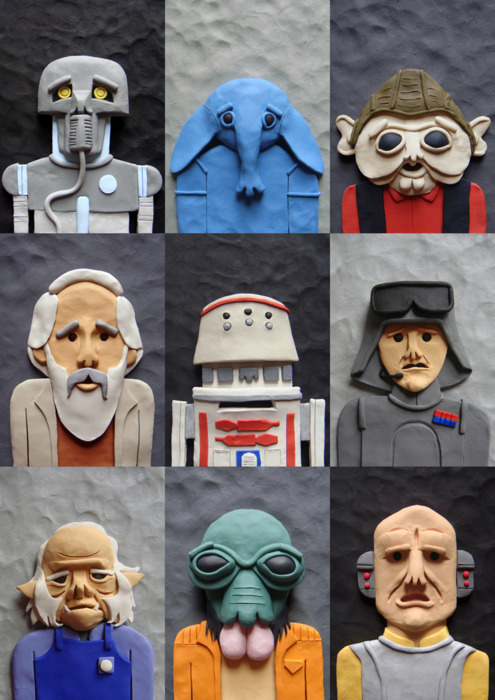
Great plasticine work by Elliott Quince (reminds me of Barbara Reid). Check out the book!

August 18, 2011
Stupid science writing tips.
By DAVID NG
In your story, it is good to insert either the line “Now, at last, we can save the world!,” or “Dear God. What have I done?” For extra conflict, insert both.
Be aware that the majority of the Elements in the Periodical Table end in “ium.” This makes rhyming really easy.
Sex, drugs, blood and guts – really now, this is just an invitation to write about mate selection, pharmaceuticals, and anatomy.
When in doubt, chemists are the bad guys, physicists are the good guys, and biologists are generally the ones with the best hair.
Bacteria make good antagonists. Plus, they are literally everywhere – this only adds to their aura as an awesome force to be reckon with.
If you plan on using the “=” symbol, please be certain that the two sides are indeed equivalent. If they’re not, mathematicians will be irked.
Go out on a limb. Don’t be afraid to use the words, “Uranus”, “friction” and/or “sperm” vicariously.
Try using Boolean logic in your plot lines. Bonus marks if you can also use the word Boolean in your plot line. Extra extra bonus marks if your plot line can be express as a y=mx+b equation.
And finally, for the love of all that is good, please no articles on Scientology.
August 17, 2011
Polio: The Graphic Novella
Normally, I don’t feel sorry for viruses (sic?), but this little comic does cry for a little empathy. Plus, it’s pretty funny…
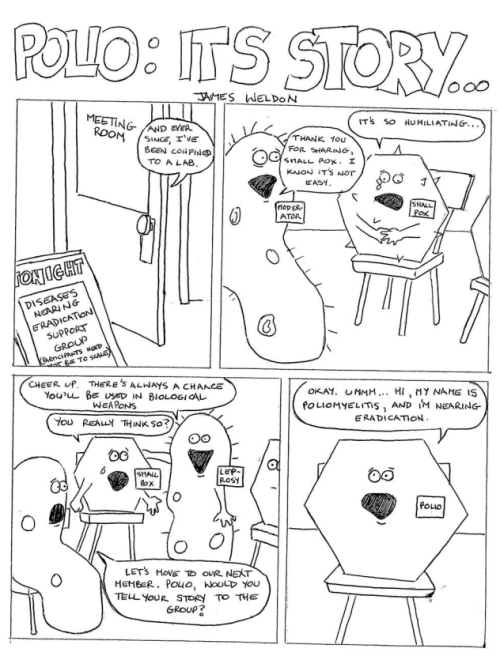
Read the whole thing at the SCQ.
August 17, 2011
My first piece
O.K. it looks like I’m going to use this site as a repository of my various science writings. In truth, I still consider myself a bit of a neophyte in this matter, but nevertheless, I’ve been lucky enough to publish the odd thing here and there.
In this vein, below is a copy of my first successful query letter written to that wonder of a wonderful magazine, Maisonneuve (sent on Jan 29th, 2004).
Dear Editors
MAISONNEUVE
It’s like this…
Science geeks like myself can also be of the adventurous fold. And from this unwieldy mix, we can produce some pretty interesting dialogue on any number of science influenced topics. From this train of thought, I’d like to showcase a possible feature article that fits with the eclectic philosophy behind your magazine. If we were to assume that the literary world secretly prefers to not be verbose, and would much rather follow a Sesame Street type pitch, then I can simply say that my article is sponsored by the words “DNA” and “Nigeria.”
DNA, of course, will be (and arguably has been) done to death, and this is especially so in the subsequent months with the anniversary of the double helix, and the simultaneous announcement of the fully completed sequence of the human genome project. Its relationship to Nigeria, on the other hand, is what makes this particular piece interesting, and not necessarily due to its oil deposits or its near hosting of the Miss World pageant.
Rather, in the summer of 2002, I was fortunate enough to travel to Lagos, Nigeria to partake in the teaching of a scientific workshop that covered the theoretical and practical aspects of Molecular Genetics. Attended by senior graduate students, this particular workshop was unique in that it provided an interesting look into the scientific culture of a developing country. Furthermore, I think the essay would be enjoyable to your readers given that the narrative covers several diverse themes – from the challenge of facilitating a high technology workshop in an otherwise struggling country, to the cultural disparity between our own way of life and that of a nation clearly in the need. At times, I felt that the workshop would have fitted right at home in any episode of The Amazing Race, MacGyver, or even Survivor (if only UNESCO had given us $1500 and 48 hours to renovate the laboratory facilities, then we could have also included Trading Spaces).
Anyway, let me know if you want more and thanks for listening.
cheers
dave ng
You know, it’s oddly embarrassing to re-read this letter, and I’m definitely of the opinion that the acceptance was largely due to good timing (Maisonneuve was preparing for a “travel” issue). Anyway, the piece was eventually published in the May 2004 issue of the magazine.
READ the unedited version of DNA and Nigeria.
August 17, 2011
A Biologist in Nigeria
This is the unedited version of “DNA and Nigeria: Survivor for Science Geeks” first published in the June/July 2004 edition of Maisonneuve.
– – – – –
By DAVID NG

Dr. Oyekanmi Nashiri is a busy individual who exudes enthusiasm, embraces optimism, and covets high expectations. Then again, as the principle organizer of a somewhat curious scientific program, he would have to be all that and more – some would even say that his good intentions place him squarely in the category of certified nutbar. Nash (as he prefers to be called) has spent the better part of his scientific career developing and implementing the West African Biotechnology Workshops, a focused attempt on bringing scientific expertise and potential research collaborations to his homeland, Nigeria. Which is to say, he is intent on bringing the realm of high technology into an otherwise struggling country.
Read the rest of this entry »
August 16, 2011
The questionable Periodical Table of Elements.

Definitely click on the image for larger more readable version. Courtesy of the talented Adam Koford.
August 16, 2011
The scientist as mad artist – an example using DNA for musical composition
By DAVID NG
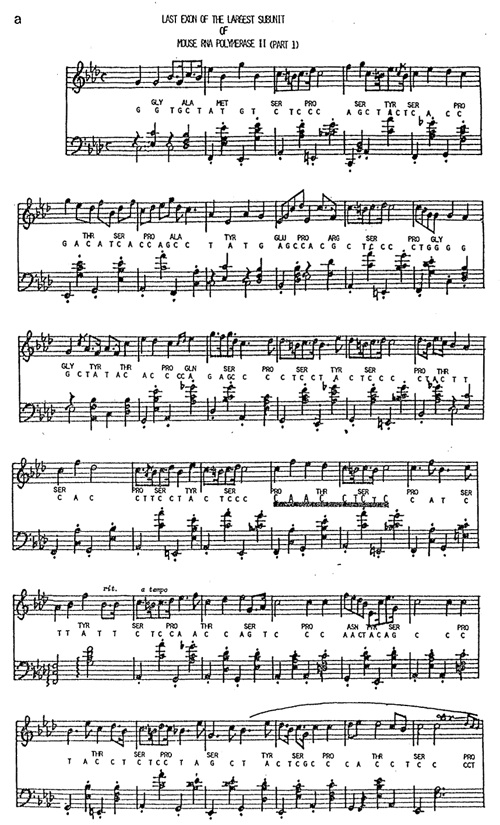
This lovely piece of music is actually reprinted from a wonderful paper entitled “The all pervasive principle of repetitious recurrence governs not only coding sequence construction but also human endeavor in musical composition” (link to pubmed abstract page) and the above image is a figure depicting musical notation as translated from the last exon of the largest subunit of mouse RNA polymerase II. As if this isn’t delicious enough, the article goes on to show that the musical piece shows strong similarities to Chopin’s Noturne OP55. No. 1.
The principle author* Sosumu Ohno begins the paper with an awesome beginning. He writes:
“Whereas ordinary mortals are content to mimic others, creative geniuses are condemned to plagiarize themselves” is my shorter, albeit inarticulate, version of what Van Veen said in Ada by Vladimir Nobokov. Indeed, it seems that vaunted geniuses seldom invented more than one modus operandi during their lifetimes, and even civilization has largely been dependant upon plagiarizing a small number of creative works; e.g. the multitudes of Gothic churches can be viewed as pan European plagiarism of the abbey church of St. Denis and/or the cathedral at Sens. This is not surprising for new genes sensu stricto hae seldom been invented. Evolution rather relies on plagiarizing an old and tested theme…”
And then continues to make a case for great works (musical composition) to be inherently derived from DNA coding sequence.
I often use this paper in a little game I play in class called “Is this real?” and this paper in particular has been the cause of much controversy over the years. Ohno, himself, was a celebrated geneticist with many accomplishments, perhaps the most famous of which was being one of the first to notice that one of the two X chromosomes, in females, existed in a heterochromatin (silenced) form. He was also one of the first geneticists to look into the potential importance of repetitive genetic elements in a genome.
It was from this (and influenced heavily by his wife, Midori) that he developed an interest in expressing DNA code as musical pieces – the obvious advantage being that repetitive elements are likely easier to “hear” than to “see.”
Anyway, a few years back a number of high profile clients cried foul when I had to correct them and tell them that the paper was real, and so I made the additional effort to contact him. Unfortunately, he had just passed away, but the office that looked after his trust wrote back saying “it’s real.” Nice.
For more on Sosumu Ohno, click here for his wiki entry.
*The second author is his wife, the more musically proficient one.

August 15, 2011
Building up Societies and Global Dominance: The Difference Between Us and the Neanderthal.
Svante Pääbo on the Neanderthal Genome Project.
“I want to know what changed in fully modern humans, compared with Neanderthals, that made a difference. What made it possible for us to build up these enormous societies, and spread around the globe.”
This article in the New Yorker by (usually) environmental writer, Elizabeth Kolbert, does a wonderful job of discussing the implications of the Neanderthal Genome project (although it’s unfortunately behind a paywall).
In other words, the basic idea is that two key differences that put Homo sapiens apart from the other primates (and really the rest of biodiversity) is the fact that we excel at acts of teamwork (simple example: how often do other creatures team-up to lift something heavy); and we’re also much more inclined to explore the unknown (evident in geographical migration, but I guess also from a philosophical epistemology view as well).
Bring into this narrative is the fact that Neanderthals are our closest biological relative where: (1) DNA samples are obtainable, and (2) the two aforemention traits don’t seem to apply. Therefore, sequencing the Neanderthal genome and comparing it to ours, may provide some insight into the genetic basis of such things.
 popperfont.net