.

Tag: space

Dan Winters’ amazing photos of a space shuttle launch

“The work begins the day before launch, when he [Dan Winters] positions up to nine cameras as little as 700 ft. (213 m) away from the pad. Each camera is manually focused and set for the particular shot it is meant to capture, and the wheels of the lens are then taped into position so that they can’t be shaken out of focus when the engines are lit. Electronic triggers—of Winters’ own devising—that do react to the vibrations are attached to the cameras so that the shutter will start snapping the instant ignition occurs.

To prevent the cameras from tipping over on their tripods, Winters drills anchoring posts deep into the soil and attaches the tripods to them with the same tie-down straps truckers use to secure their loads. He also braces each leg of the tripod with 50-lb. (23 kg) sandbags to minimize vibration. Waterproof tarps protect the whole assembly until launch day, when they are removed and the cameras are armed. Throughout the launch, they fire at up to five frames per second. Only after the vehicle has vanished into the sky and the pad crew has inspected the area for brushfires, toxic residue and other dangers, are the photographers allowed to recover their equipment. (Text from Time)

Photos by Dan Winters, also soon available in book form. (Via My Modern Met)

Awesome illustration of Mars’ Curiosity

By Ciaran Duffy (who incidentally, also drew the awesome whale image for this)

The NASA logo that never was.

“In 2010, design firm Base reimagined the NASA logo for Viewpoint magazine. Rather than Jetsons flourish or ’80s futurism, the team wanted to propose a new look for a post–Cold War era and gesture toward the future.”

“The NASA logo of today–the “meatball”–is actually the organization’s original. It’s pure ’60s space-race fodder, and it’s served as the casual face of NASA since 1959, save for a two-decade stint when the “worm” logo replaced it”

“Sadly, NASA passed on the logo. “They politely replied they were ‘not looking to revise their identity at this time,'”

By Mark Wilson, from Fast Company.

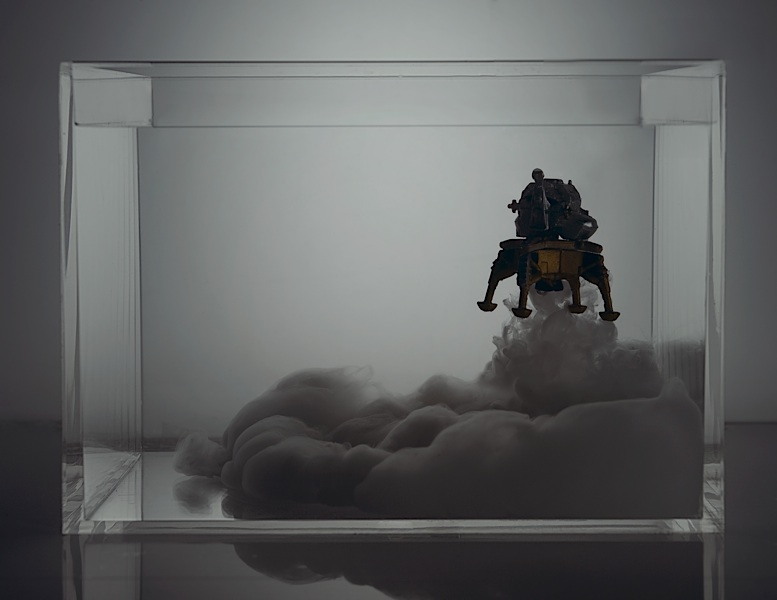
Inner Space: Photography of iconic space craft in liquid containers.

By Owen Silverwood. (More at the link).

When humanity disappears, a ring of dead spacecraft will remain as evidence of our existence.

Trevor Paglen – The Last Pictures from Creative Time on Vimeo.

“In September 2012, the television satellite EchoStar XVI will lift off from Kazakhstan with the disc attached to its anti-earth deck, enter a geostationary orbit, and proceed to broadcast over ten trillion images over its fifteen-year lifetime. When it nears the end of its useful life, EchoStar XVI will use the last of its fuel to enter a slightly higher “graveyard orbit,” where it will power down and die. While EchoStar XVI’s broadcast images are destined to be as fleeting as the light-speed radio waves they travel on, The Last Pictures will continue to slowly circle Earth until the Earth itself is no more.”

By Trevor Paglen.

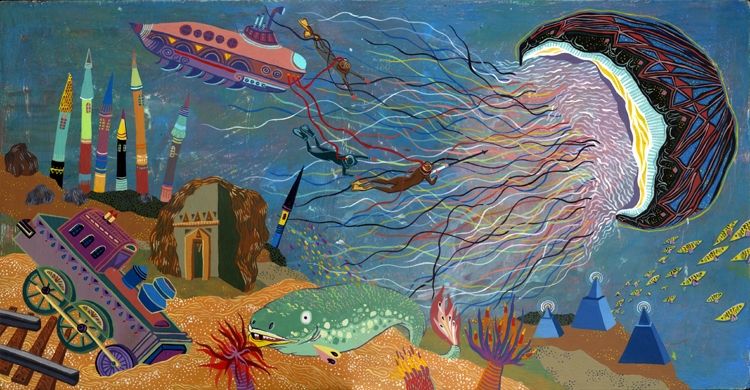
Space Rovers, Giant Jellyfish, and One Heck of a Storm: The Science-y Art of Valeriya Volkova

By Valeriya Volkova.

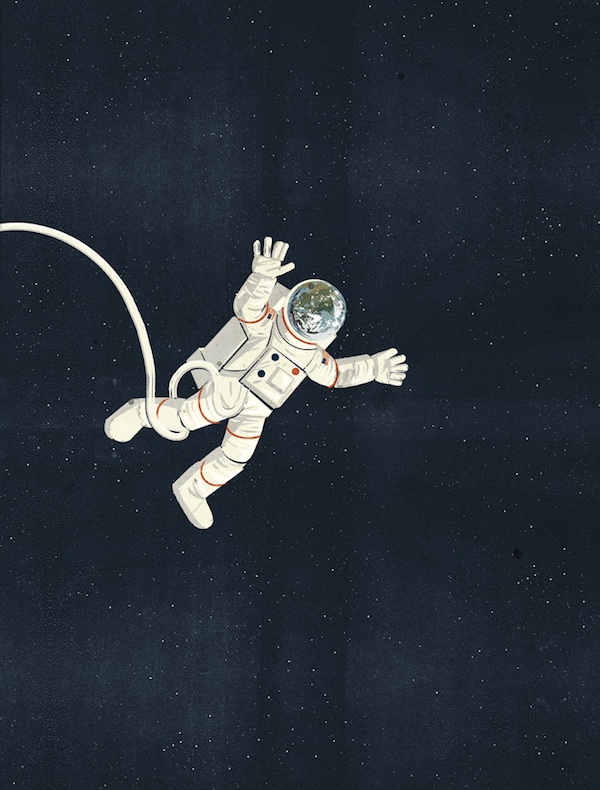
Alessandro Gottardo strangely compelling images: sweet, and in these cases, a little sciencey

Here’s a few great illustrations that could segue into discussions on green roofs and space programs.

By Alessandro Gottardo via My Modern Met.

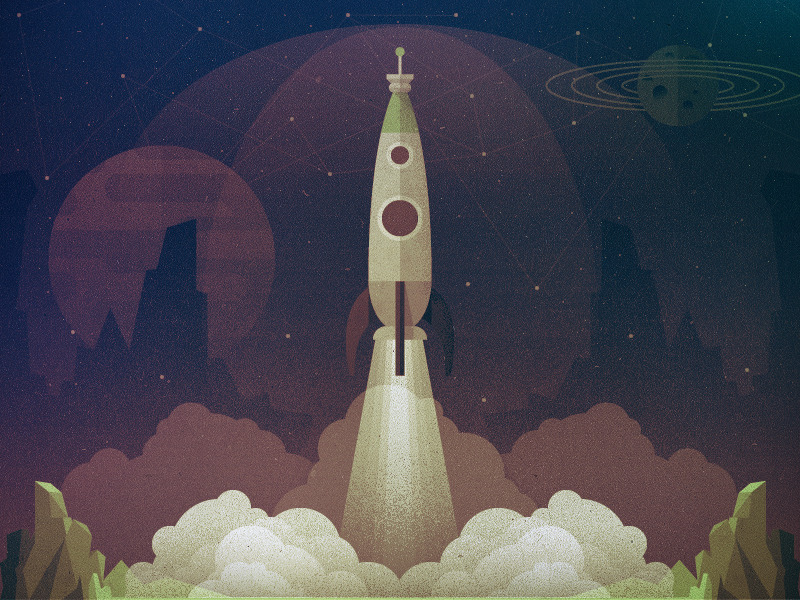
Great science flavoured artwork by Justin Mezzell

Go check out Justin Mezzell’s site.

From space, no-one cares about your tweets.


(Click image for larger version)

By Jonathan Haggard, via Hey Oscar Wilde!

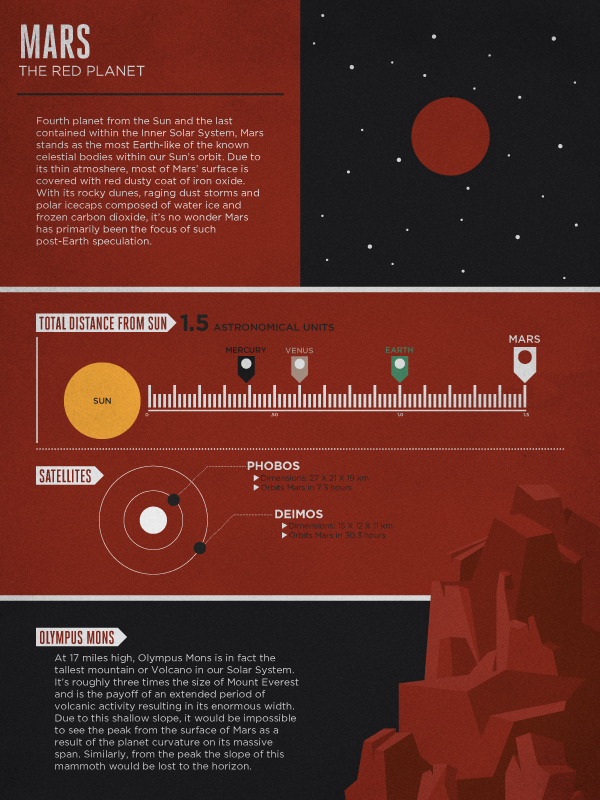
Witty science inspired graphic design by Christopher David Ryan

You could easily lose yourself in his wonderful website. Here’s a sampling.

By Christopher David Ryan.

Awe inspiring time lapse sequences from the International Space Station. #whoa

It’s footage like this that makes me wish I was an astronaut (best viewed in full screen).

“The International Space Station Expedition 30 crew shot some truly awe-inspiring time-lapse sequences flying over practically every square mile of the globe.

I downloaded the high-resolution image sets that have been made available by the NASA Johnson Space Center and constructed this short time-lapse film in hi-res 2K project format. I was amazed at how clean the Nikon D3S images turned out (even at ISO 3200 and above) which kept the post-processing requirements to a minimum.

By Adonis Pulatus.

This lovely image of the Wide-field Infrared Survey Explorer (WISE) sky is pretty breathtaking


(Click image for larger view)

“In the mosaic, the Milky Way Galaxy runs horizontally across this map. The Milky Way is shaped like a disk and our solar system is located in that disk about two-thirds of the way out from the center. So we see the Milky Way as a band running through the sky. As we look toward the center of the galaxy, we are looking through more of the disk than when we are looking at large angles away from the center, and you can see a noticeable increase in stars (colored blue-green) toward the center of the image.”

From NASA.

The Space We Live In: Breathtaking video rendering what it might be like to fly around beautiful things in the universe..

I don’t think is based on any real astronomical data, but boy does it look really really pretty. Check it out in HD and in full screen (and also in the dark). Plus, I’d imagine that technically – given the scales involved, you would never be able to get this kind of perspective in motion unless you were traveling faster than the speed of light, in which case, what you see would likely be altered.

By matthiasm.de.

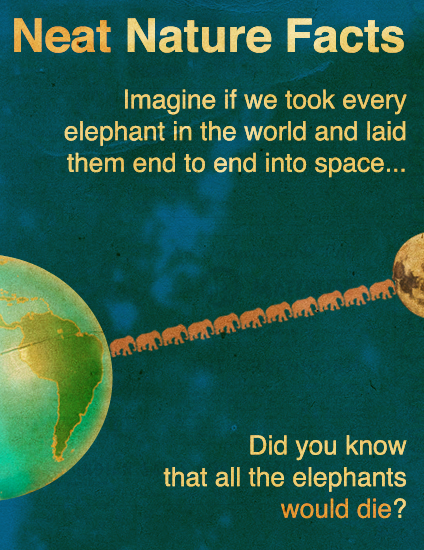
Imagine if we took every elephant in the world and laid them end to end in space…

From Fake Science.

Graffiti on spacecraft. #funny

By Philipp Igumnov.