.

Category: *

This is what a paper engineer can do with a bit of mathematics. #beautiful

“Matthew Shlian works within the increasingly nebulous space between art and engineering. As a paper engineer, Shlian’s work is rooted in print media, book arts, and commercial design, though he frequently finds himself collaborating with a cadre of scientists and researchers who are just now recognizing the practical connections between paper folding and folding at microscopic and nanoscopic scales.” (From Ghostly International)

By Matthew Shlian, via Colossal.

NASA versus AT&T: You be the judge.

From DogHouseDiaries.

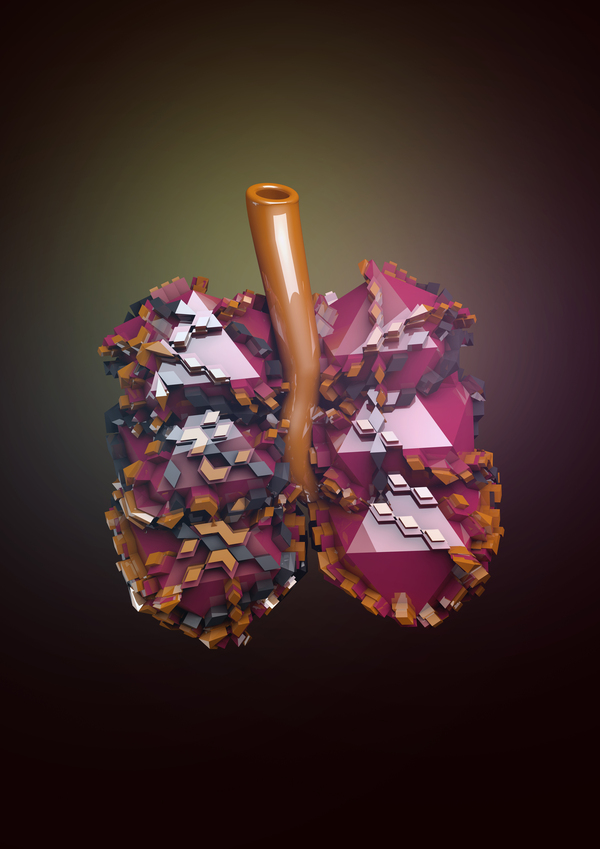
Wild 3D digital renditions of anatomical organs by Victoria Cartwright

By Victoria Cartwright.

“FAQ: The Snake Fight Portion of your Thesis Defense” via @mcsweeneys

The full piece by Luke Burns is at McSweeney’s, and it’s awesome. I especially liked this bit:

Q: Are the snakes big?
A: We have lots of different snakes. The quality of your work determines which snake you will fight. The better your thesis is, the smaller the snake will be.

Published at McSweeney’s. Via Brian Switek.

Some writing (with a nod to thermodynamics) that didn’t make the cut in my book proposal.

So, I’m just finishing up a non-fiction book proposal for my agent and initially I had the below text as an entry point. In the end, I ditched it because I decided to instead use a personal anecdote about a child and her unicorn questions. Anyway, I still kind of like the below, so it seemed a shame not to show it off somewhere.

– – –

By DAVID NG

THIS IS NO (AN) ORDINARY BOOK

1

The book you are holding in your hands follows the laws of thermodynamics. This is possibly something you take for granted, or more likely, it is something you are not familiar with – maybe because of the use of terminology foreign to you. Nevertheless, it is a reality that informs some of your expectations of this book. You assume, for instance, that the book will not spontaneously turn into an elephant – no matter how fond you might be of elephants. You also assume that the book will not leap away from your hands, unless, of course: (1) you hurl it away yourself; or (2) you are surprised by an errant gust of wind; or (3) you are accosted by an excitable neighbour (perhaps an elephant?) who physically snatches it from your hands and throws it across the room. Although all of these silly assumptions sound obvious, it is the laws of thermodynamics that encapsulate some fundamental science necessary to translate them into elegant conceptual and mathematical descriptions. Furthermore, these elegant laws work everywhere. More importantly, the moral of our fable (and we can call it a fable because of the involvement of our elephant) is that often we find that obvious assumptions can also be obviously explained by robust scientific concepts.

2

But what if the assumptions are not so obvious; what if they are confusing even? What if you are getting information from a variety of conflicting places? What if someone you trust told you that there is value in eating this book. They tell you that ingestion of this book will cure cancer, or that it will make you rich, or that it might even earn you a pet elephant. What if they tell you that they know this to be true, because they have “seen it with their own eyes?” At this point, a person might use a variety of different criteria to judge this assumption. How much do I trust this individual? Is the individual knowledgable? What is the evidence involved? How good is the evidence? How badly do people want the assumption to be true? Should this matter?

All of these criteria sound reasonable, and presumably if you use them, you would come to the conclusion that maybe eating this book isn’t such a good idea. Yet, interestingly, when people are poised with numerous day to day claims about the world, they don’t always think to use all of these criteria. In fact, sometimes decisions are often made by quickly skimming through these criteria, or focusing on only one of them. In particular, many people evaluate these assumptions without looking deeply at things like the expertise of the source, or the soundness of the evidence. Which is unfortunate, since this is really an ignorance of the scientific process, a way of obtaining knowledge that has fundamentally changed the course of human history, and has provided us with information to make sense of the physical world around us. This process isn’t always the best way to evaluate claims – religion and philosophy may have more pertinent roles in questions about how the book might move your soul, or what the purpose of this book is – but for many scenarios, where there are empirical things you can measure and see, it’s a pretty decent way to evaluate your options and make good important decisions.

3

Then, of course, there is the issue of forgetting the roles that science plays in almost everything you do and everything you have. This is something you already know, but don’t really think about: that the vast majority of your activities and objects past have been historically informed by both scientific concepts and the scientific process; and that the vast majority of your activities and objects future will be informed by new scientific concepts and society’s continued participation in the scientific process. This book, for instance, didn’t materialized magically. Intellectually, the words were recorded on a computer, and an author’s health is maintained by medical research. Physically, there were players from biodiversity (the pulp from the trees, the dyes to create the ink) and advances in publishing technology involved (the printing press, distribution mechanisms). But these science-centric things are, in the best case scenario, often forgotten, and in the worst case scenario, are deliberately hidden from us. It’s as if science literacy isn’t worth acknowledging. The scientific way of thinking is being ignored. The world is crying, “Sciencegeek down” without an afterthought.

This book’s assumption is that this isn’t a good thing. And that, dear reader, is the real elephant in this room.

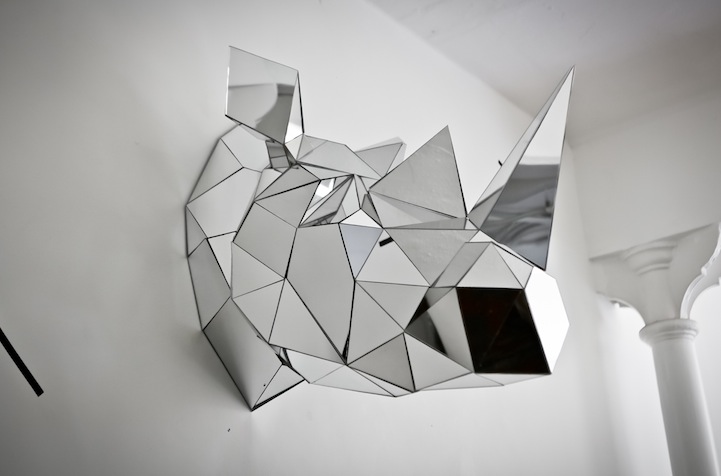
A wolf, bear, and rhino made with geometric mirrored pieces.

By Arran Gregory, via My Modern Met.

My kids thought this was the funniest thing ever. I think I see several physics equations.

Specifically ones concerning vectors, angular momentum, law of the lever, gravity, friction, and general force calculations.

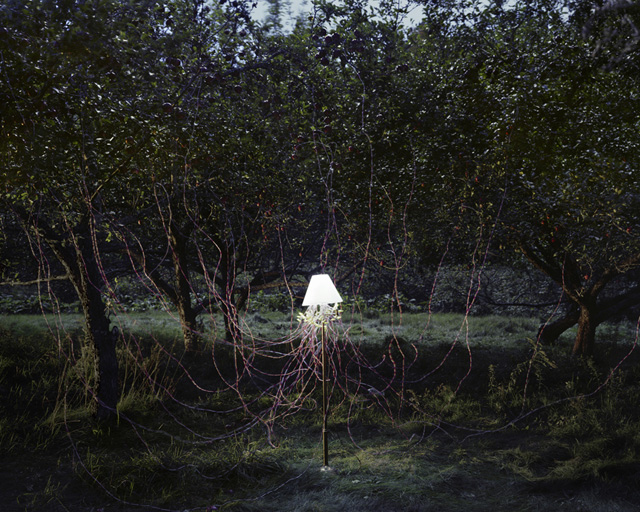
Lamp powered by 300 live apples and other great photographs of science in action

Check out these amazing photographs by Caleb Charland.

And the remainder here from a collection called “Demonstrations”

Skeleton Key with Copper Wires

Atomic Model

Bouncing Pen Light

Solid Liquid Gas

North Pole with Needles and Water

By Caleb Charland, via Colossal.

Superhydrophobic carbon nanotube water droplet bouncing GIF goodness.

“Superhydrophobic surfaces are those which repel water to such a degree that droplets roll right off. The forces of surface tension actually overtake the friction of the surface the droplet rests on, and this is what keep the droplets from wetting.”

From itsokaytobesmart, via Fresh Photons. Original paper by Adrianus I. Aria and Morteza Gharib here.

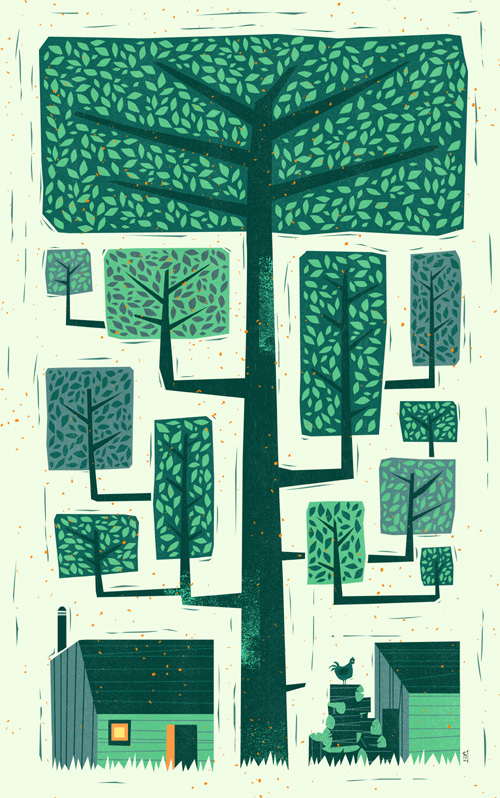
Peter Donnelly’s beautiful woodblock art of tree related scenery

By Peter Donnelly.

O.K. I got a little teary watching this touching video about the Mars Curiosity Rover. #scienceisawesomethatisall

Via Boing Boing.

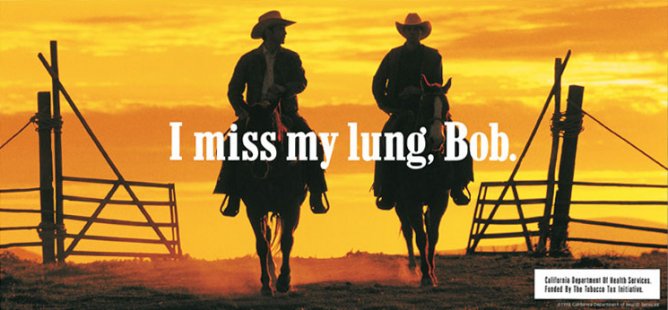
Clever Anti-Cigarette Ads


I miss my lung, 1998. California Deparment of Health Services.


Joe Chemo, 1996. Concept: Scott Plous. Illustration: Ron Turner.

Via Adbusters.

Dan Winters’ amazing photos of a space shuttle launch

“The work begins the day before launch, when he [Dan Winters] positions up to nine cameras as little as 700 ft. (213 m) away from the pad. Each camera is manually focused and set for the particular shot it is meant to capture, and the wheels of the lens are then taped into position so that they can’t be shaken out of focus when the engines are lit. Electronic triggers—of Winters’ own devising—that do react to the vibrations are attached to the cameras so that the shutter will start snapping the instant ignition occurs.

To prevent the cameras from tipping over on their tripods, Winters drills anchoring posts deep into the soil and attaches the tripods to them with the same tie-down straps truckers use to secure their loads. He also braces each leg of the tripod with 50-lb. (23 kg) sandbags to minimize vibration. Waterproof tarps protect the whole assembly until launch day, when they are removed and the cameras are armed. Throughout the launch, they fire at up to five frames per second. Only after the vehicle has vanished into the sky and the pad crew has inspected the area for brushfires, toxic residue and other dangers, are the photographers allowed to recover their equipment. (Text from Time)

Photos by Dan Winters, also soon available in book form. (Via My Modern Met)

Q: Why did the puffin cross the road?

A: So that this lovely photograph could be taken?

By Andreas Mulder.

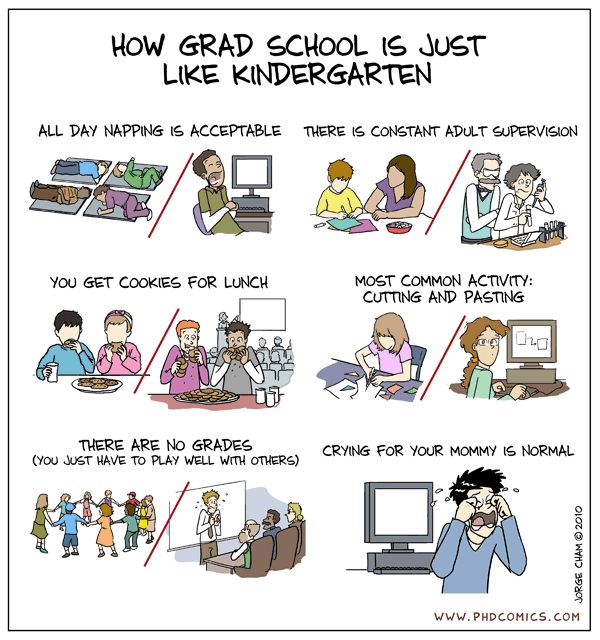
How Grad School is just like Kindergarten

By PhD Comics.

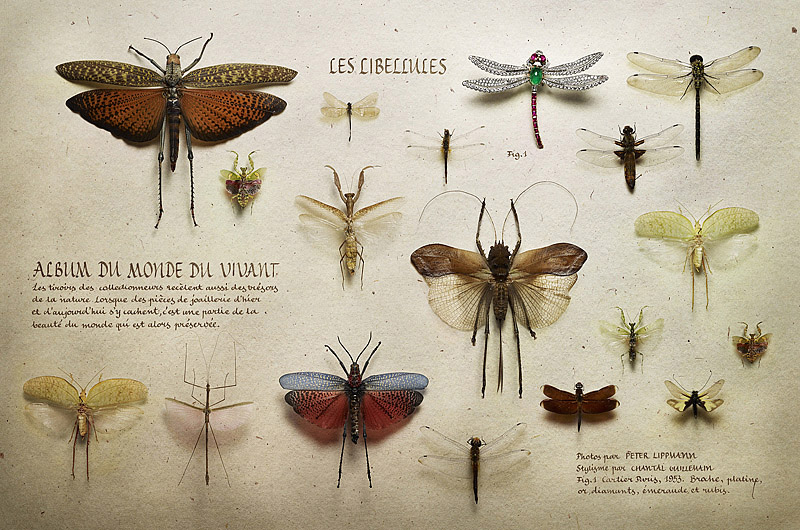
One of these things is not like the other in this biodiversity themed Cartier ad. Can you spot it? #biodiversity

By Peter Lippmann for Cartier. Via Stacey Thinx.

Tupper’s self-referential formula #whoa

Learning about this has made my brain quietly implode.

“Tupper’s self-referential formula is a self-referential formula defined by Jeff Tupper that, when graphed in two dimensions, can visually reproduce the formula itself. It is used in various math and computer science courses as an exercise in graphing formulae.

Specifically (From Wikipedia):

The formula is an inequality defined by:

{1\over 2} < \left\lfloor \mathrm{mod}\left(\left\lfloor {y \over 17} \right\rfloor 2^{-17 \lfloor x \rfloor - \mathrm{mod}(\lfloor y\rfloor, 17)},2\right)\right\rfloor

where \lfloor \cdot \rfloor denotes the floor function and mod is the modulo operation.

Let k equal the following:

48584506361897134235820959624942020445814005879832445494830930850619347047088099284506447698655243648499972470249151191
104116057391774078569197543265718554420572104457358836818298237541396343382251994521916512843483329051311931999535024137
58765239264874613394906870130562295813219481113685339535565290850023875092856892694555974281546386510730049106723058933586
052544096664351265349363643957125565695936815184334857605266940161251266951421550539554519153785457525756590740540157929
001765967965480064427829131488548259914721248506352686630476300

If one graphs the set of points (x,y-k) with 0 \le x \le 106 and k \le y \le k + 17 such that they satisfy the inequality given above, the resulting graph looks like this:

Teaching intro biology is harder than teaching intro history.

By Saturday Morning Breakfast Cereal. Thanks for the tip Dave!

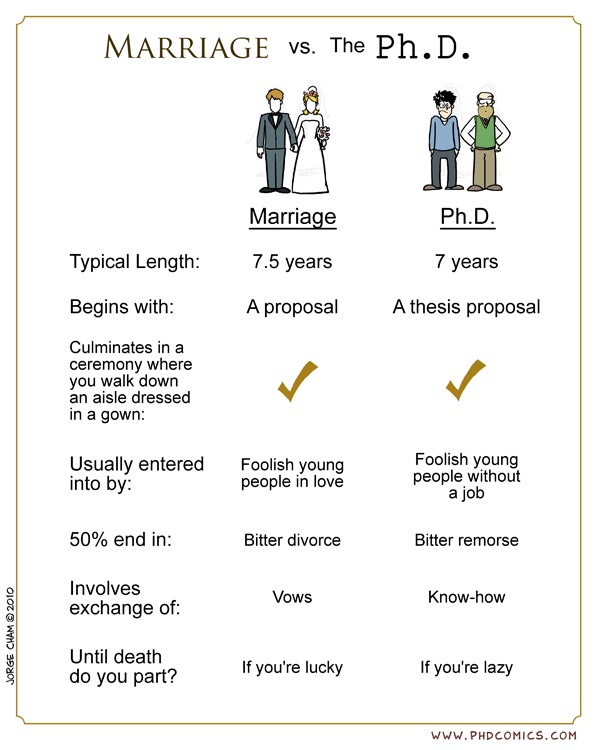
In which we compare getting married versus getting a Ph.D

By PHD Comics.

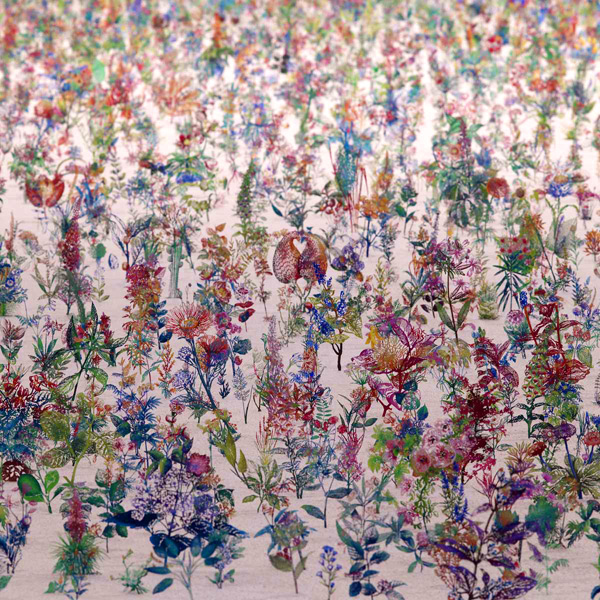
A field of botanical thin steel cuttings: black on one side, colorful on the other.

“London-based artist Zadok Ben David created this incredible installation using 12,000 cut steel botanical specimens modeled from old textbook illustrations, each embedded in a thin layer of sand. On first encountering the sprawling array of plants they appear completely black, thus the installation’s title: Blackfield. However when viewed from the opposite side, a field of black turns into a wall of color.”

By Zadok Ben David, text via Colossal