
.
Tag: physics

July 12, 2012
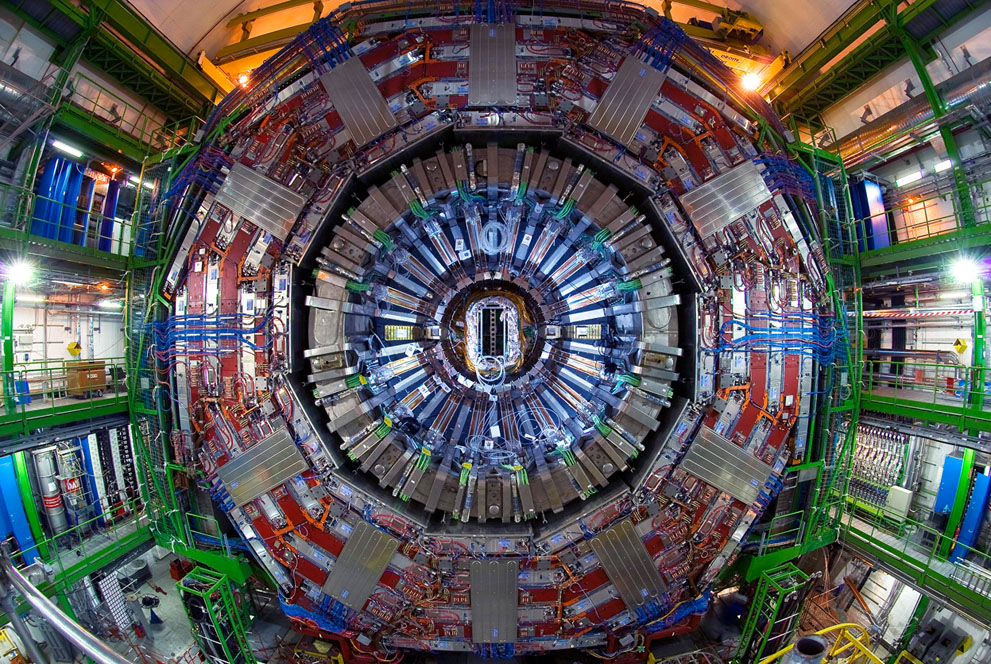
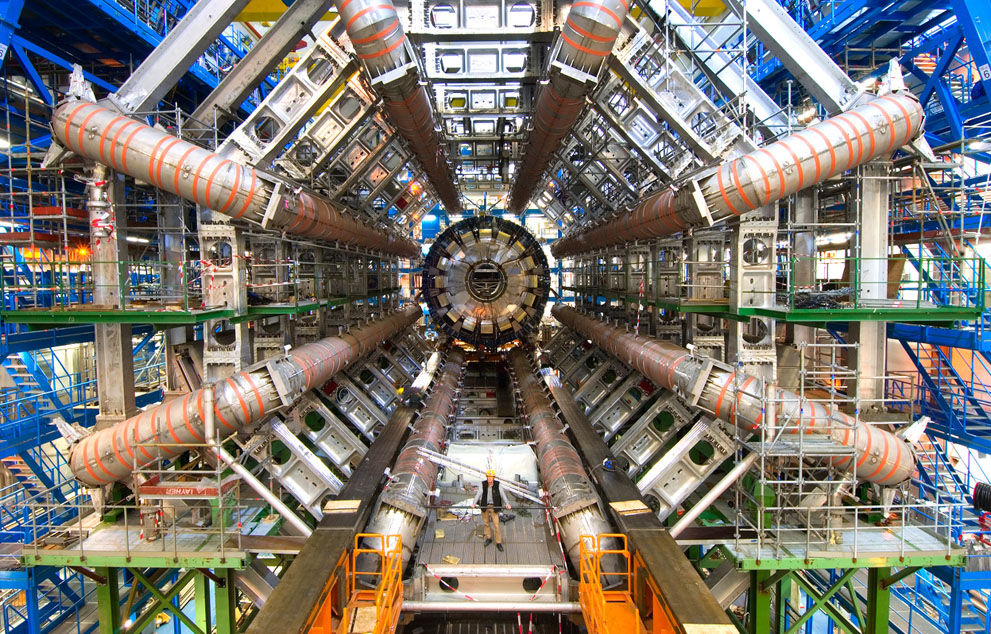
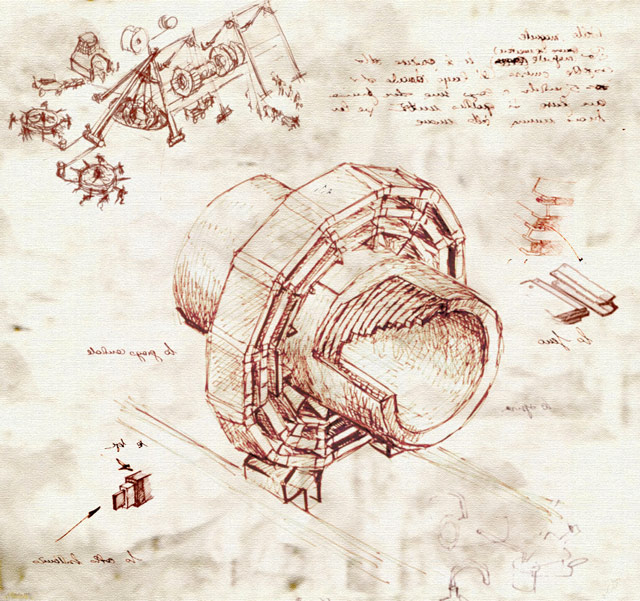
Large particle accelerators are the gothic cathedrals of our time. #lovelymetaphor
From the NYT piece by Lawrence M. Krauss.
“The physicist Victor F. Weisskopf — the colorful director in the early 1960s of CERN, the European Organization for Nuclear Research, which operates the collider — once described large particle accelerators as the gothic cathedrals of our time. Like those beautiful remnants of antiquity, accelerators require the cutting edge of technology, they take decades or more to build, and they require the concerted efforts of thousands of craftsmen and women. At CERN, each of the mammoth detectors used to study collisions requires the work of thousands of physicists, from scores of countries, speaking several dozen languages.”
Read the rest of the article here.
July 11, 2012
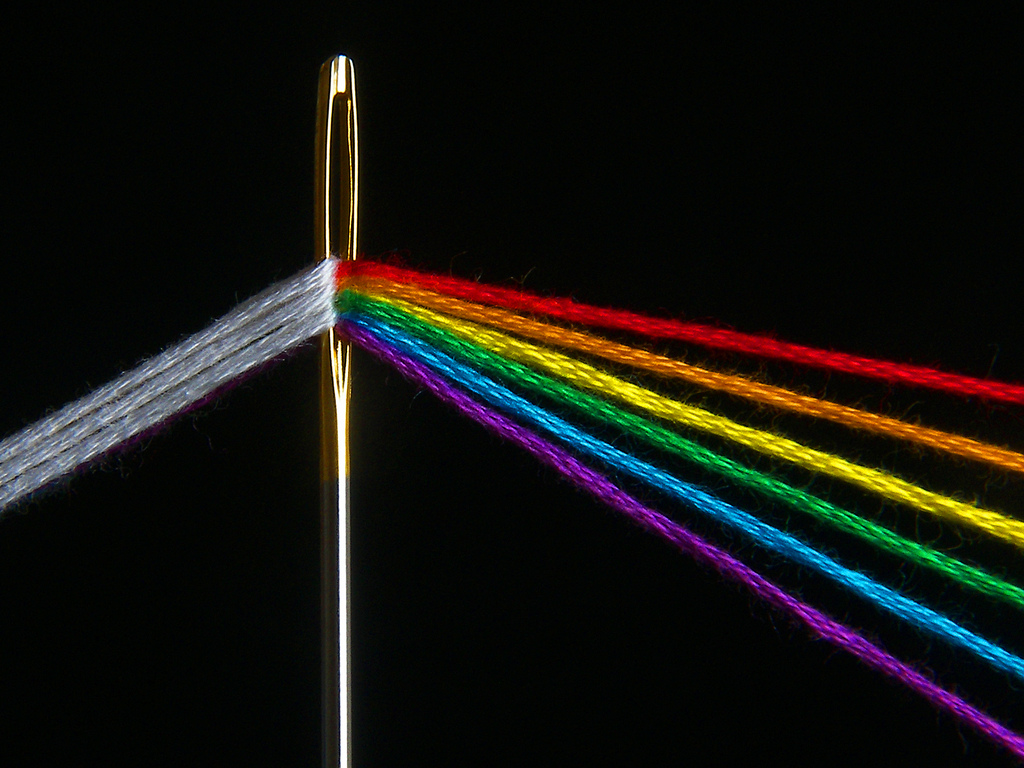
Dark Side of the Loom #greatvisual #optics
What a great visual! Handy for all sorts of discussions on optics and light in general.
July 10, 2012
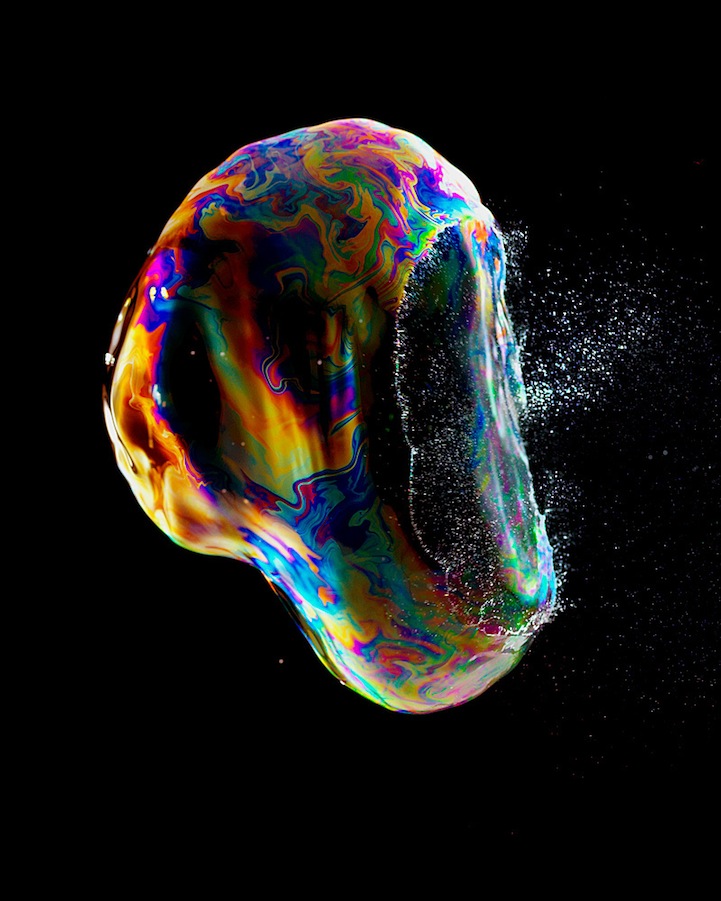
Artwork of beautiful (though impossible) radiation absorption patterns (a.k.a cool shadows).
At least, I’m pretty sure it would be impossible. Would make a lovely graphic (I think) when discussing electromagnetic radiation, particularly those relating to visible range and absorption concepts.


By Jason Ratliff, via The Visual News.

July 9, 2012
Grant writers: On discussing the applied benefits of funding lightsaber research…
…Please watch this video. Note the research benefits are twofold. First, the obvious fact that lightsaber would be real; and second, the fact that that birdie must be damn near indestructible!
Inspired by the fact that we just bought one of those cheap badminton set-ups and the kids think it is an AWESOME way to spend your summer days in your backyard (especially when you make lightsaber and/or Kung Fu sounds whilst playing).
Also, what other applications would go into this grant?





July 4, 2012
The Higgs Boson Walks into a Church…
First: this.
“Cern scientists reporting from the Large Hadron Collider (LHC) have claimed the discovery of a new particle consistent with the Higgs boson.” (Also note the great quote by Hawking at the above link)

Via reddit, joke by Brian Mallow

June 18, 2012
Ohm Sweet Ohm: Handy Cross-Stitch Resistor Reference Chart #awesome

By Becky Stern, and available here (via Fresh Photons)
June 13, 2012
Our Friend the Atom: Gorgeous Book Cover from 1950s

“Walt Disney Productions published a book in 1956 titled, Our Friend the Atom. A television episode of Disneyland aired in 1957 under the same name and can be found on the DVD set Tomorrowland: Disney in Space and Beyond.”
Via Paleo-Future.



May 29, 2012
Einstein’s office on the day of his death.

“The death of a public figure of Albert Einstein’s stature is the sort of event that, literally and figuratively, stops the presses. No scientist has been more famous, no antiwar activist’s voice has carried more conviction, no exemplar of genius has ever been as frequently invoked (albeit in language often dripping with sarcasm: “Nice going, Einstein!”) than the German-born father of modern physics. So when word came on a Monday morning in April 1955 that Einstein had died, at age 76, at New Jersey’s Princeton Hospital, the victim of an aortic aneurysm, the scramble was on to recount the story of his life and, as urgently, his death.
LIFE photographer Ralph Morse was among scores of journalists who descended on Princeton that day, hoping to find and report on something, anything, that might offer insight into what Einstein’s passing meant to his friends, family and peers as well as strangers around the world. No one but Morse, however, finagled his way into Einstein’s office. No one but Morse came away with a photograph that, six decades later, serves as a haunting reflection of both the man and his life’s work: a seemingly simple picture of Einstein’s desk, cluttered with notebooks, journals, a pipe, a tobacco tin; behind the desk a blackboard covered with equations and formulas that, to the untrained eye, possess an almost runic power.”
Photograph by Ralph Morse, via LIFE
(Do check out the link – the text above is pulled from that source, which tells the remarkable story of how Ralph managed to get this picture).
May 29, 2012
Schrödinger’s Cat vs. Pavlov’s Dog: Who would win?
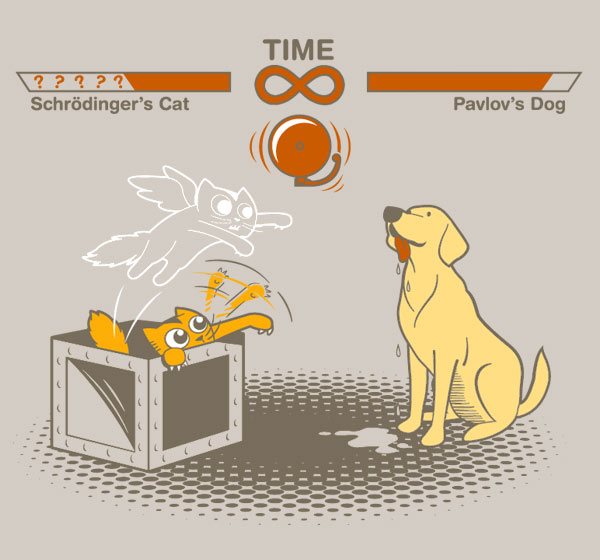
I suppose, technically, the fight is over (one way or another) once the dog takes a look at the cat…
Also available as a t-shirt – link.
May 25, 2012
Atomic model paintings by Brendan Monroe. #beautiful

After the New Model .18 x 18 in / 46 x 46 cm, acrylic on paper

After Bohr’s Model .18 x 18 in / 46 x 46 cm, acrylic on paper
This is a nice artistic treatment of the Bohr Model of atoms, which if you don’t quite remember, goes like this (from wiki):
“In atomic physics, the Bohr model, introduced by Niels Bohr in 1913, depicts the atom as a small, positively charged nucleus surrounded by electrons that travel in circular orbits around the nucleus—similar in structure to the solar system, but with electrostatic forces providing attraction, rather than gravity. This was an improvement on the earlier cubic model (1902), the plum-pudding model (1904), the Saturnian model (1904), and the Rutherford model (1911). Since the Bohr model is a quantum-physics–based modification of the Rutherford model, many sources combine the two, referring to the Rutherford–Bohr model.”
By Brendan Monroe.


 popperfont.net