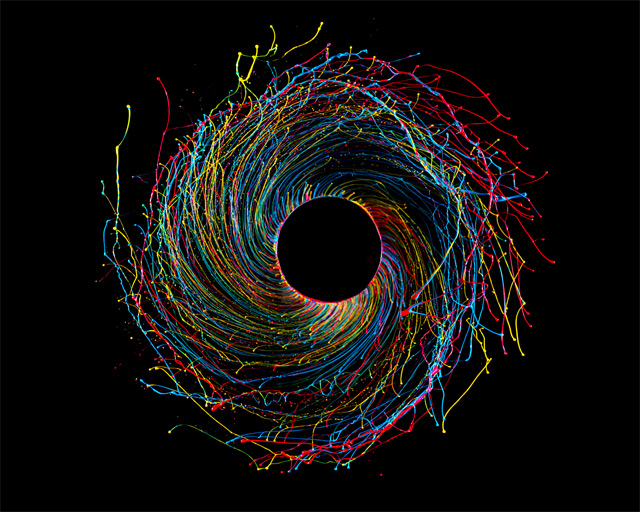
This is all over the web (and rightly so). A thing of beauty. Click on the image for a closer look, or click on this Flickr link for full 100Mb resolution.
And all over the internet, but now also archived here at Popperfont if you ever need a graphic on (amphibians, natural selection, biodiversity, thrust calculations, insert keyword here).
“If, by some simple and possible means, such as the lessening of the Earth’s magnetic field, which now deflects most of the cosmic rays, they came through in great strength, evolution would go mad.”
From Amazing Stories, February, 1940. Via Fresh Photons.
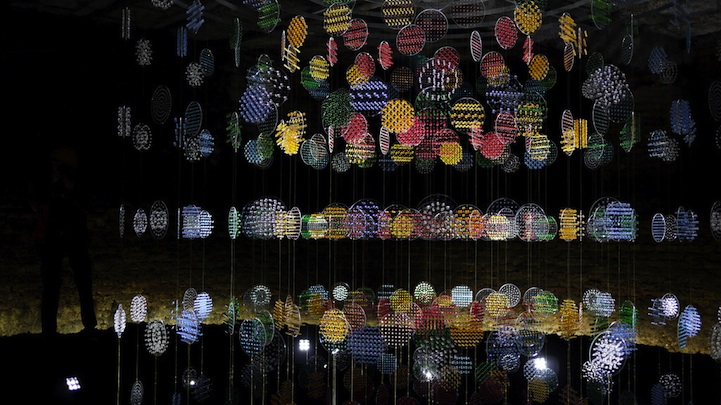
Superposition 2013 (entitled Covariance) is a really intriguing looking installation by Lyndall Phelps and Ben Stills and is also now open for visiting (if you’re in London).
“And that’s the hope for our new project Superposition, enabling people to access and engage with physics through art and getting people to think (perhaps just for a minute) about the role physics plays in their lives and the world at large.
This pilot project pairs a physicist (Ben Still) with an artist (Lyndall Phelps) and challenges them to explore physics through the visual arts. The conversations that they have, the ideas that are sparked, and the experiences that they have, will be documented on this blog while the artwork that is conceived between them will be exhibited during the summer of 2013.”
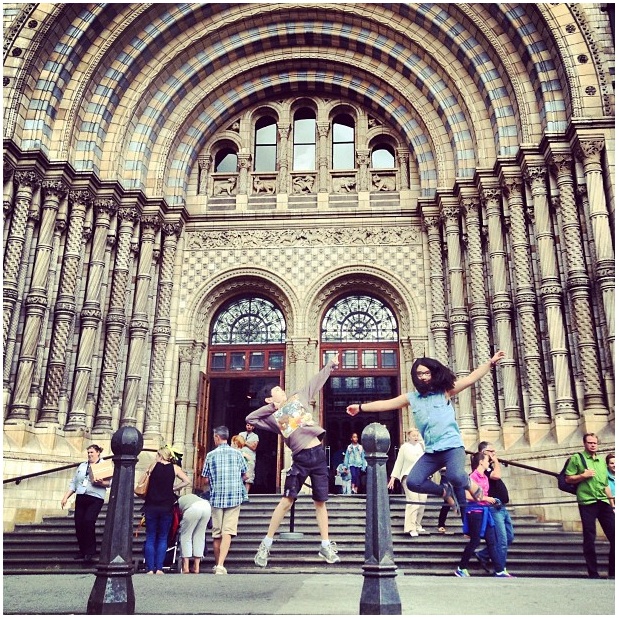
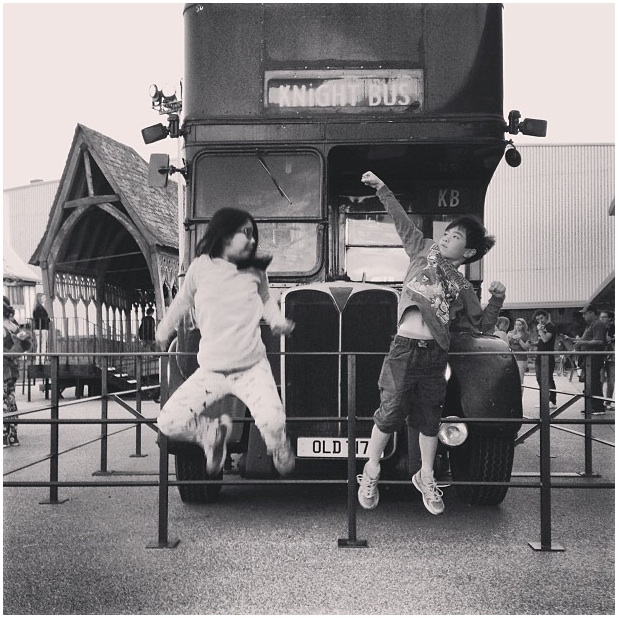
Just a couple pictures from our summer. Locales in order are: London’s Natural History Museum; Howth, Ireland; Harry Potter Studios, Leavesden; Chester Cathedral; Chester town center; Mam Tor summit, Peak District; Lyme Park, Derbyshire; Lille, France; and one of us parents in Lyme Park.
Great humour piece by Sarah Rosenshine. Below is the first paragraph, and I’ve posted it here for archival purposes, but definitely, definitely go read it over at McSweeney’s.
“All right, you found me. Like a subatomic Carmen Sandiego, here I am. Oh, that joke is dated? I’m sorry, everything past the Stone Age is current when you were here at the beginning of time. So please, spare me your inability to comprehend temporal relativity.
Look, I didn’t call you all to the Garden Inn, Geneva so I could trade barbs with CNN’s lone Science and Technology Correspondent. No, I called this press conference for one reason: to ask that you please stop calling me the God Particle.”
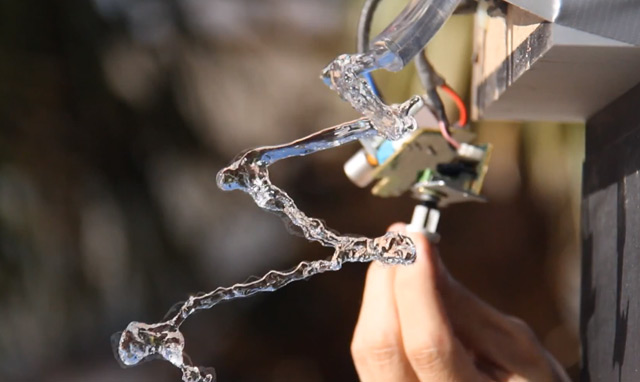
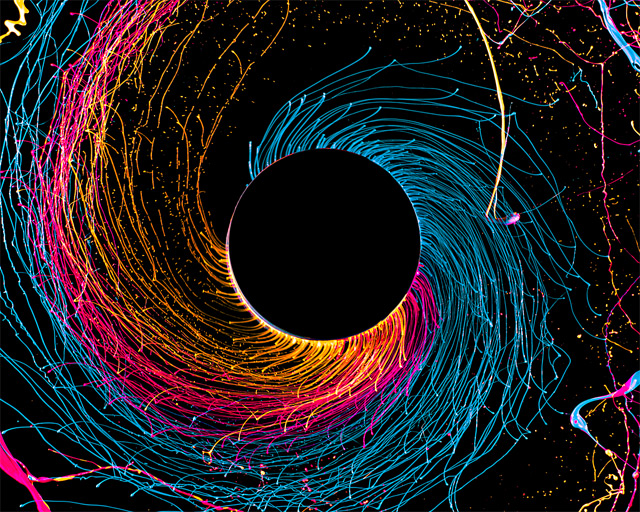
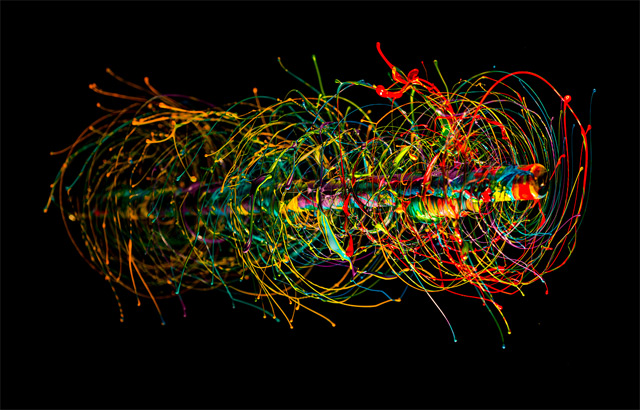
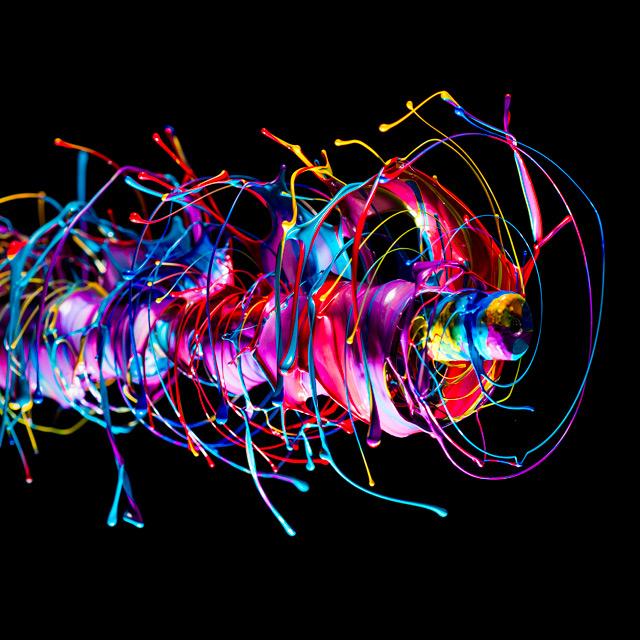
“Ever since I created the first version of this video a year ago I’ve been wanting to try it again with more water and better lighting / footage. This is a really fun project and when you first see the results, chances are your jaw will drop. The main thing to keep in mind for this project is that you need a camera that shoots 24 fps.
The effect that you are seeing can’t be seen with the naked eye. The effect only works through the camera. However, there is a version of the project you can do where the effect would be visible with the naked eye. For that project, you’d have to use a strobe light.
For this project you’ll need:
A powered speaker
Water source
Soft rubber hose
Tone generating software
24 fps camera
Tape.
Run the rubber hose down past the speaker so that the hose touches the speaker. Leave about 1 or 2 inches of the hose hanging past the bottom of the speaker. Secure the hose to the speaker with tape or whatever works best for you. The goal is to make sure the hose is touching the actual speaker so that when the speaker produces sound (vibrates) it will vibrate the hose.
Set up your camera and switch it to 24 fps. The higher the shutter speed the better the results. But also keep in the mind that the higher your shutter speed, the more light you need. Run an audio cable from your computer to the speaker. Set your tone generating software to 24hz and hit play.Turn on the water. Now look through the camera and watch the magic begin. If you want the water to look like it’s moving backward set the frequency to 23hz. If you want to look like it’s moving forward in slow motion set it to 25hz.
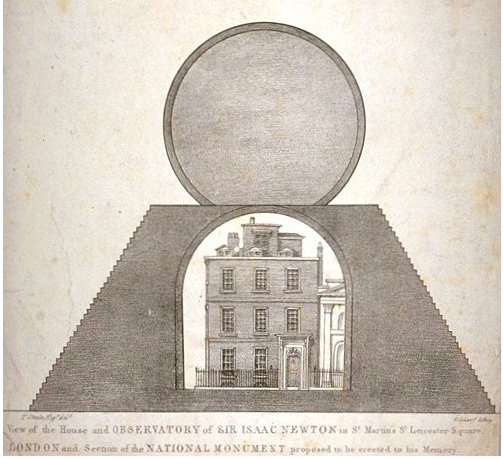
This would have been something else, if it came to pass.
“In an anonymous letter to the London Times in 1825, Thomas Steele of Magdalen College, Cambridge, proposed enshrining Isaac Newton’s residence in a stepped stone pyramid surmounted by a vast stone globe. The physicist himself had died more than a century earlier, in 1727, and lay in Westminster Abbey, but Steele felt that preserving his home would produce a monument ‘not unworthy of the nation and of his memory'”
ABSTRACT:
In Spiderman 2 there is a scene in which Spiderman stops a runaway train using his webbing to provide a counter-force. Using the information available this paper examines the material properties of the webbing under these conditions and finds the Young’s modulus to be 3.12GPa, a reasonable value for spider silk.
INTRODUCTION:
In the early sixties Marvel Comics first introduced Spiderman; a superhero with the abilities and scaled strength of a spider. In a recent movie incarnation, Spiderman has the ability to sling webs from spinnerets located in his wrists. These webs have been shown to be capable of taking great amounts of strain, and have displayed a high level of adhesiveness. Arguably the greatest test of these webs is found in the 2004 movie, Spiderman 2; wherein Spiderman manages to bring a runaway train to a stop by sticking multiple webs to adjacent buildings, and bracing himself on the front of the train until it comes to a rest just before dropping into a river [1]. In this paper we attempt to model the forces upon the webbing in such a situation, and compare it to measured values of the Youngs modulus and yield strengths of real spider’s web.


















 popperfont.net