.

Tag: medicine

Parliament Betrays People in Developing Countries Needing Medicines – Bill C-398 Voted Down

Statement from the Canadian HIV/AIDS Legal Network and the Grandmothers Advocacy Network. (link)

NOVEMBER 28, 2012 – We are profoundly disappointed that Parliament has decided to reject reason and overwhelming evidence by defeating Bill C-398, which would have ensured greater access to affordable medicines for people dying of treatable diseases such as AIDS, malaria and tuberculosis in developing countries. By choosing to believe the blatant lies and misinformation circulating about this bill, MPs who voted against the bill have reneged on Parliament’s earlier pledge and have betrayed people in developing countries — including hundreds of thousands of children — who need medicines to prevent suffering and death, including from AIDS, tuberculosis and malaria.

Bill C-398 would have streamlined Canada’s Access to Medicines Regime (CAMR) by cutting red tape that is wholly unnecessary and proven fatal to the future use of the system. The bill would have made it easier for both developing countries and generic drug manufacturers supplying medicines to use CAMR to help save lives and reduce suffering. A previous iteration of the bill (Bill C-393) was overwhelmingly passed in the House of Commons in the last Parliament — before it died in the Senate with the election call. That bill enjoyed support from members of all parties in the House of Commons, reaffirming that this should be a non-partisan issue. Bill C-398 had the support of medical and legal experts, humanitarian activists, faith leaders, AIDS and international development organizations across the country and health activists around the world. Dozens of prominent Canadians supported the call to action, and 80% of the public supports fixing CAMR according to a national opinion poll.

Bill C-398 reintroduced to the House of Commons the same amendments that very strong majority had already previously endorsed. It was a second chance to finish the job of fixing CAMR and supporting developing countries with needed, lower-cost medicines.

It is a travesty that the Harper Government, having made much of its initiative on maternal and child health, would now turn its back on an opportunity to help people dying of treatable diseases — through a smart policy that that would have cost no taxpayer money and, in fact, would make Canada’s frozen foreign aid dollars even more effective, by harnessing the power of generic competition to get less expensive medicines to developing countries. A government that preaches the virtues of markets and “value for money” chose to disregard both; instead, it prioritized its incorrect reading of World Trade Organization (WTO) rules on protecting patents over a workable mechanism for supplying more affordable, life-saving medicines to developing countries struggling with the ravages of the AIDS pandemic and other public health burdens. This is shamefully callous and a discriminatory double-standard for which those who can least afford it pay the ultimate price.

We wish to thank the many champions of this bill, from all political parties, who took Bill C-398 through the legislative process. The fight is not over. Too much is at stake.

But the bottom line is this: after more than eight years of waiting for Canada to deliver on its pledge to help get more affordable medicines to Africa and other developing countries, the world will still have to wait — and people will die preventable deaths because too many Parliamentarians did not have the courage to do the right thing.


For more information please contact:

Richard Elliott

Executive Director

Canadian HIV/AIDS Legal Network

relliott@aidslaw.ca           


For more information: www.medicinesforall.ca

About the Canadian HIV/AIDS Legal Network

The Canadian HIV/AIDS Legal Network (www.aidslaw.ca) promotes the human rights of people living with and vulnerable to HIV/AIDS, in Canada and internationally, through research and analysis, advocacy and litigation, public education and community mobilization. The Legal Network is Canada’s leading advocacy organization working on the legal and human rights issues raised by HIV/AIDS.

About the Grandmothers Advocacy Network

The Grandmothers Advocacy Network (GRAN) is composed of volunteer grandmothers and grand-others from across Canada (http://grandmothersadvocacy.org). We act as a Canadian voice for Africa’s sub-Saharan grandmothers who are caring for millions of children made vulnerable by AIDS. We work for changes in Canadian policies to improve their quality of life.

Adding to the “dumb ways to die” list: Because of a patent. #C398

Apologies if you haven’t seen this yet (it will stick to your brain like nothing you’ve ever experienced), but it provides a little light hearted context for a serious issue.

Serious issue explained in a piece entitled A moment of your time: about Bill C-398 and how Canadians can contribute to global health.

(Video campaign by McCann Melbourne, animation by Julian Frost).

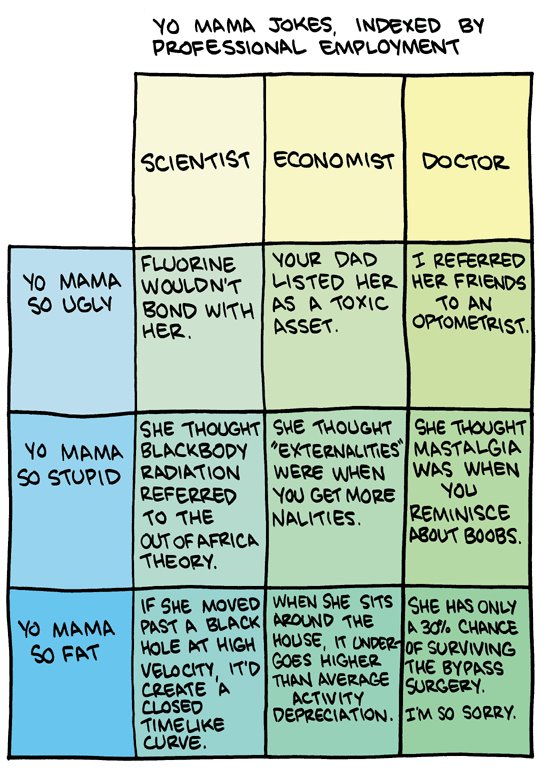
Yo Mama Jokes Indexed by Professional Employment

By Saturday Morning Breakfast Cereal.

You know you’re a science geek when you set your table with virus doilies

By Laura Splan.

A moment of your time: about Bill C-398 and how Canadians can contribute to global health

Dear Canadians:

On wednesday, a very important piece of policy will be discussed in parliament.   It’s called Bill C-398 and it deserves our attention.  It seems that it has been challenging for some to see its merits, and so, I’d like to take moment to clarify what it’s all about.  It turns out that it’s not just important – the narrative is compelling as well: it has a rich history of political intrigue; it is a story where viruses factor in prominently; it has a plot that involves armies of angry grandmothers; and above it all, learning about Bill C-398 can literally save lives.

Note, that the below piece is a re-edit of sorts, an update of a piece I wrote for Boing Boing that was an attempt to discuss that political intrigue.  And also note that there is some bias in my commentary – but I think this is natural.  There are obviously a variety of viewpoints involved and my own happens to disagree with those who choose to listen to corporate and political interests – more so when those interests rely on reasoning that is often spun a certain way to misrepresent useful facts. My bias happens to fall on the side of human dignity: something I think we should all spend a moment to contemplate, and something I think all Canadians would feel is a cause worth fighting for.

– – –

“Access to life-saving medicines is not a luxury, but a human right.”

~Canadian HIV/AIDS Legal Network

To me, the above statement is one of those things that sound like a no-brainer. Put another way, if I were to ask you whether you thought a person’s income should determine whether they live or die from something like HIV/AIDS, then I think you would see that the answer is nothing but obvious. But here I am, in Canada, writing this post, because there is a very real danger that members of my government think that this isn’t such an easy decision after all – that maybe wealth and business interests do matter when dealing with such ethical choices, and that there is a hierarchy where certain lives are worth more than others.

Let me backtrack a bit, and provide a little context. I’d rather not write a rant, emotional and heart wrenching as this discussion can be – I’d prefer to rely on reason, and not on rhetoric. Yes, rhetoric helps, but reason and validity are much more powerful.  I want everybody to understand why this is an important issue, one that deserves coverage, and one that deserves our involvement. More importantly, I want everybody to understand why the right thing to do is obvious.

To start, let me mention the letters and numbers that make up the label, “Bill C-398.” Keep them in your head – at least for a moment. If you’re the sort that prefers hearing at least a quick definition, then this one might work:

“Bill C-398 aims to reform CAMR and make it easier for Canada to export affordable, life-saving, generic medicines to developing countries.”

~Canadian HIV/AIDS Legal Network

If you’re thinking that this is a Canadian thing, then think again. Other rich countries are watching how Canada will behave. There’s always a few in Europe, and apparently even China is curious. In the U.S., the topic appears to be quenched, but the behaviour of the Canadian government could catalyze dialogue. And if you’re not from a rich country? Well, you might actually have lives that will be affected by it, millions of lives even.

Here’s the problem in a nutshell: the developing world is heavily burdened with a variety of diseases, many of which are causing massive numbers of suffering and deaths.

This is understandably big. It’s a huge global challenge, and there are many reasons for why it exists and why it is difficult to both comprehend and fix. However, the presence of effective medicines is not one of the reasons. There is medicine out there that can help, and there is also a flow (sometimes slow) of discoveries that make these medicines better and more effective. In the case of HIV/AIDS, there are drugs that essentially turn the disease from a death sentence to something that is chronic and manageable. I can’t overstate how significant that piece of information is: it tells us that people do not have to die from HIV/AIDS.

So what’s the issue?

The issue is control without regard for doing the right thing: This is essentially about patents. It’s not that patents are bad, but rather that patents can be bad. As you probably already know, patents are a service provided by government to protect an inventor, such that the inventor has an element of control over how their innovation/product gets used. This is generally a good thing, because ultimately it provides order to a process that would get very chaotic very quickly should the patent not exist. However, sometimes the inventor isn’t the best person to make decisions about control. Sometimes, the inventor doesn’t have the best information to take stock of a situation, or sometimes there might be a moral argument where monetary performance should not take precedent. In other words, sometimes, there are special circumstances where you could say it is reasonable that this control is tweaked.

To illustrate this, here are some hypothetical (and not so hypothetical examples):

1. Your country has experienced a massive storm, perhaps one named after a character in Grease, and it has hit the East coast very very hard.  Many folks are still without power and water, but there is technology that would be incredibly useful to mitigate this. However, your resources are already stretched and this technology is too expensive at the scale that is required in such an emergency.

2. Someone has declared war on your country. To defend yourself, you would like to utilize a particular product. Unfortunately, it is under a cost prohibitive patent and therefore out of reach.

3. There are markets where your life saving drug is not being sold because no-one can afford them anyway. However, the drug (which could be a matter of life and death for millions) could be made at a cost (i.e. a generic) that makes it accessible in these markets, but if and only if, the patent over them is adjusted.

Here is my point. In all of the above cases, you would like to live in a civil society where the government can step in and forcibly change the patent, because in every case, there is an element of morality involved. And guess what – governments can do this and they do! It’s called a “compulsory license,” and they exist for this very purpose.

In fact, even the WTO is on board with this idea. They recognize that in some circumstances, such as those pertaining to global health, there needs to be an understanding that using such compulsory licenses is both necessary and an obligation. In fact, if you have a hankering for the legalese that outlines this for patents over essential medicines, you need only look up info on the Doha Declaration.

Canada actually took this to heart with a bill that came into force in 2005. Often referred to as “Canada’s Access to Medicine Regime” (or CAMR), it was an effort to put into action, the principles and details provided by the Doha Declaration. It was a way to try and enact compulsory licenses for the home production of generic drugs so that more accessible drugs could be produced. It was a good gesture.

Unfortunately, this initial attempt was flawed. The process was simply way too complicated, contingent on an army of legal expertise to navigate, which was all the more problematic because many of the actors involved did not have the means or access to do this. Indeed, the bill seems to contain a paradox in it, in that it can be interpreted as logically impossible to use. If you look closely, there’s a “you can’t do B until you do A” and a “you can’t do A until you do B” error in the details (see question 9 in this document for more details).

It was also very inefficient in that when a compulsory license was negotiated, it was always a one time affair, a one order affair, with specific amounts that could not be changed despite possible reassessment of needs, only good for one country, etc, etc, etc. Indeed, in the years that the law has been available, it has pretty much sat idle (I believe there has still only been one successful case where drugs were actually made and delivered, which provided ample evidence to demonstrate that this process was difficult at best). In fact, if someone were to asked me how difficult things are, the best description I could come up with, is that is it “catastrophically high maintenance.”

Which (finally) brings us to “Bill C-398.” This bill is basically “the edit.” Its sole purpose is to address the things that made the previous bill so ineffective, and at its heart it allows a more streamline and efficient way to issue these compulsory licenses so that production of these generics is more feasible.

No brainer right?

“Oh, but it’s not that simple,” they say. “There are many counter arguments,” they say. Only these counter arguments tend to sound like this:

Q: Shouldn’t we focus on other aspects of the problem. Like health infrastructure, or public education for HIV?

A: Hmmm… Let me get this straight. A government can only do one thing at a time? Nevermind the fact that passing this bill doesn’t actually cost the taxpayers anything. If anything, research has suggested that the foreign aid that we do provide will likely have greater bang for its buck.

Or maybe something like this:

Q: Wouldn’t these changes effect the pharmaceutical company’s bottom line, which in turn will effect R&D funding, and drive the home costs of medicine up?

A: The language is pretty clear in that these are generics that can only be sold in certain markets. These markets happen to constitute a very small percentage of pharmaceutical revenues (we’re talking single digits here). Oh yeah, plus you get royalties from doing this anyway. Also, there’s nothing stopping you from making your own generic version, so that you can enter the market yourself. Indeed, all research and current evidence would suggest a possible gain in bottom line. Plus, the R&D argument is totally a red herring. If that were so crucial, it might help if you spent less on PR and the like. Sneaky.

But what kills me, is that even if there is a reasonable and say unforeseen cause for concern, the Bill has a freaking “sunset clause” which is basically something that gives all parties a “we’ll see how it goes, in case it’s not working” escape route.

All to say, that because of this kind of political and big pharma semantics, there is a very real likelihood that the Bill will die (perhaps in the next few days when it is up for a second reading).  This would be an interesting commentary on the values of our government, although there is already a rich backdrop to this political story.

You should know that this is a Bill that had a previous incarnation two years ago.  It once lived in the country calling itself Bill C393, and it was one of those few Bills passed by the House of Commons where party lines were clearly broken.  Unfortunately,  during that time, the Conservative Senate stalled their vote to make it law, and they did this because they knew that there was an opportunity to “save face” with their industry interests by avoiding the issue altogether.

This was the frustrating part, and I have to admit, my trust in Canadian politics really took a hit.  Here, certain members of Senate, a place that traditionally falls in line with the vote of the House of Commons (because that is, after all, the democratic element of decision making), stalled discussion on this Bill 4 times over 4 days, and in doing so, Bill C-393 got killed by association when a new election was called.

To put this in perspective (and to use internet vernacular), let me just say that this horrific series of events represented a political facepalm of the highest possible order.  In fact, we invented a term for it: we called it a #megafacepalm.

And so here we are with another attempt. This is the essence of why you should care about BILL C-398. But what can you do?

Well, for starters, you can lend a hand by speaking out. Retweet this blog post, write about it yourself. You should definitely send an email to Prime Minister Harper and a few of his key Members of Parliament by using this ridiculously easy petition. If you’ve got something meatier to say, how about copy pasting this entire list of emails, and let the Canadian government know how you feel. If you’re not Canadian, do these things anyway, and then make this issue pertinent in your own country. This is an urgent matter, and for Canadians, there is only so much time to advocate. It’s really an amazing chance for Canada to lead the way.

You can also immerse yourself in this cause and get as much information as possible. You can check out organizations such as the Canadian HIV/AIDS Legal Network, which has all sorts of great documents including this informative myth versus fact sheet.

If you’re a university student, you can check out your local UAEM chapter. If you’re a Grandmother, you can hear what Grandmothers Advocacy Network have to say. Better yet, check them all out, or join these groups and volunteer your time.

There is also a twitter campaign in progress.  Flood the feed with hashtags like #C398, #fixCAMR, #medicinesforall, #cdnpoli and tweet out your support with phrases like:

“Please vote YES to Bill #C398 on Wed! We need to #fixCAMR and improve #accesstomedicines! #cdnpoli”

“Have you signed the petition in support of #accesstomedicines yet? Go to www.medicinesforall.ca! Let’s #fixCAMR & pass #C398!”

If you think the idea of Bil C-398 above seems reasonable and just, please do whatever you can. Because through it all, you should never ever forget: “Access to life-saving medicines is not a luxury, it is a human right.”

Beautiful ink drawing of anatomy

By Alex Konahin, via Illusion.

Beautiful illustrations by Victo Ngai #environment #cancer #wow

Man, the rest of Victo’s work is amazing. Definitely worth checking out.

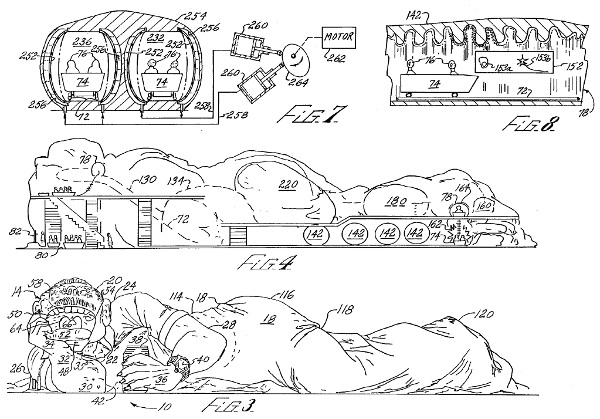
This would be SO awesome: An amusement park ride masquerading as an anatomy lesson

An educational amusement apparatus forms a large building structure having an external appearance simulating a man and a woman resting partially under a blanket, wherein riders are taken through a succession of cavities that simulate internal organs of the man and woman. Entrance to a head chamber simulating an oral cavity is achieved by a stairway supported by a simulated arm of the man, the oral cavity having displays of teeth in normal and abnormal conditions, and serving as a staging area for a train to carry the riders. The train passes into a simulated cranial cavity of the woman, past a sectional display of simulated ear organs, and into a body portion of the building that is representative of the abdomen of both the man and the woman, first through a simulated esophagus, stomach, and intestine of an alimentary canal, through simulated urinary and reproductive tracts, then through a simulated liver and a simulated cardiovascular canal, and finally through a simulated lung and windpipe to an exit staging area of the building.

Proposed by Shao-Chun Chu in 1988. See here for patent documents (via Futility Closet)

The A-Z of Epidemiology: germs from Anthrax to Zoonoses. A disturbing bedtime book for kids.

Written and performed by Jennifer Gardy: http://jennifergardy.com – Animated by Tom Scott: http://tomscott.com – Credits by Jessica Latshaw:http://jessicalatshawofficial.com

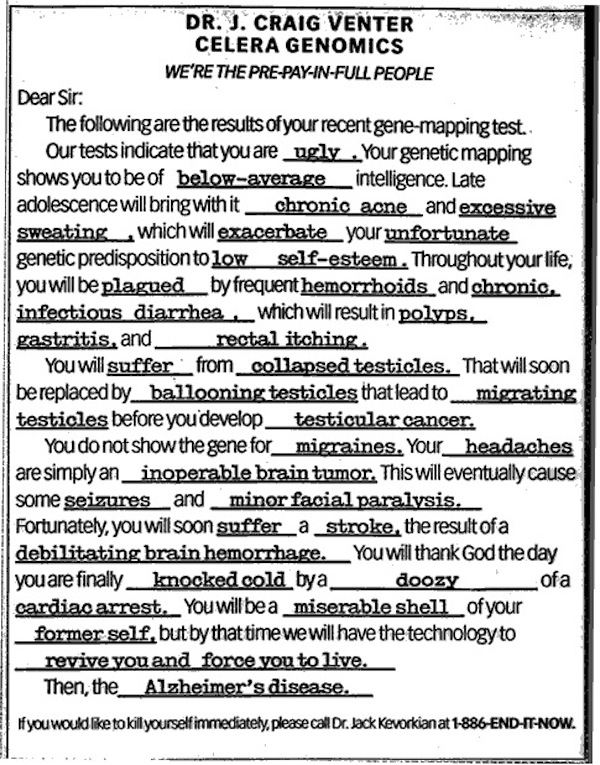
One doozy of a genetic test. Kind of nasty too.

From Esquire, July 2000.

Underskin: Human anatomy as a London Tube Map.

By Sam Loman.

Wound Man: An illustration which first appeared in European surgical texts in the Middle Ages.

It laid out schematically the various wounds a person might suffer in battle or in accidents, often with surrounding or accompanying text stating treatments for the various injuries. It first appeared in print in Johannes de Ketham’s Fasciculus Medicinae (Venice, 1492) and was used often in surgical texts throughout the sixteenth century and even into the seventeenth century. (Wikipedia)

Via Stacey Thinx

Angry Words From a Gnome Who to This Day Continues to Think The Human Genome Project was Actually The Human Gnome Project

By DAVID NG

It’s hard to believe that the Human Gnome Project formally began in 1990s. It was quite frankly a great time for all of us gnomes as we thought we had finally gained the attention and respect we deserved as a community. But decades later, we as a community are disappointed, angry, full of resentment, and still addicted to nicotine.

To our knowledge, of the billions of research funds given to human gnome initiatives, none of it ever actually went to fund “gnome” research. Instead, a sizable portion went to human human research, and in an apparent slap in the face to my kindred, significant amounts also went towards research looking at bacterial, yeast, worm, fugu, fly, and mouse genetics. Suffice to say, that with the exception of humans, these are all organisms that do not smoke pipes. To say that this has been hard on my community is an understatement of vast proportions. Apart from the soaring lung-cancer rates, I find I am continually aware of other lost opportunities the money could have been used towards.

For instance, for whatever reason, we as a race are forever doomed by our incessant need to wear pointy hats. I hate my stupid hat—loath it with a passion. And yet I have to wear it. We all do. Why this is so has been mystery for many an age. Maybe that’s why I go through 70 grams of tobacco each day. And whilst pointy hats are fine for garden work (one of our main sources of economic recovery), they are hardly advantageous in the current global market—especially when first impressions play a key role. Surely, there is an underlying neurological basis for this behavior—a basis that science could have elucidated.

And what about our facial hair? Believe me, it is not because we are particularly fond of our beards. It’s not even because tobacco pipes look cooler in this context. Our beards just happen to grow at amazingly fast rates! This is not such a huge issue with me and the other male gnomes, but my poor wife actually has to shave every 45 minutes or else deal with social harassment. This is also compounded by the fact that services, like laser hair removal or electrolysis, are just too expensive, especially on a gardener’s income. Ironically, the only gnomes who could possibly afford these high tech solutions are the few who have made it into Hollywood where maintaining the typecast “bearded” look is required anyway. Furthermore, even when a hairless gnome is needed on a movie set (e.g., Mini Me in the Austin Powers franchise), we still get passed over because of our goddamn pointy hats! I bet billions could have sorted this problem out a long time ago.

But if there was ever a strong case for gnome research, you only need to look at my poor Uncle Bill. This unlucky bastard of a gnome must have some bladder problem or something, since he is (no exaggeration) urinating constantly. Seriously, I don’t think he’s even had a chance to put his penis away since he started 14 years ago! And the truth of the matter is that this particular problem is relatively rampant in my circles. Most start off fishing, and then they feel the urge and then whammo! It’s like a disease. I don’t think it’s too difficult to appreciate the magnitude of this medical condition. Aside from the psychological pain endured, imagine how uncomfortable it must be to leave it “out” constantly in all manner of weather conditions. I don’t care if you are the gardener type— when it’s cold, it’s cold! Plus, it makes smoking a pipe tricky.

Anyway, I’m not here to preach endlessly about our problems. I just here to say I want a fair piece of the action. If the project is called the Human Gnome Project, then it only makes sense that at least some of the money should go towards gnome research—right?

O.K., I’ve said my piece. I really have to go outside now to smoke my pipe—stupid human nicotine patch, piece-of-crap waste of money …

(This is very old and originally published at Yankee Pot Roast, inspired by this)

Anatomical Model: Barbie Edition.

O.K. when are we going to get an anatomical Chewbacca (seriously)?

Model by Jason Freeny, via Colossal.

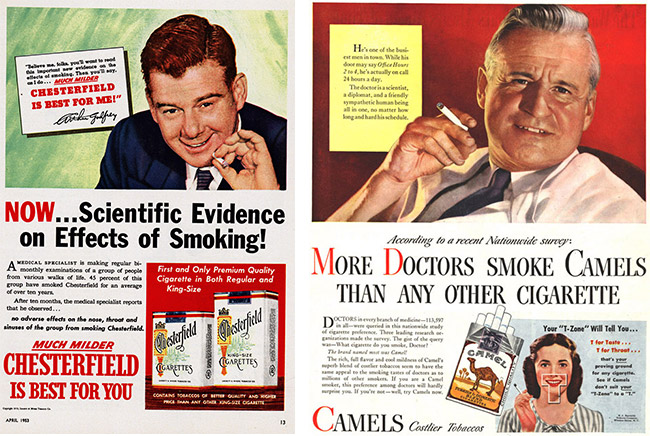
Vintage ads where the science is very wrong (or just looks wrong)

From Collector’s Weekly, via Boing Boing.

Wild 3D digital renditions of anatomical organs by Victoria Cartwright

By Victoria Cartwright.

Clever Anti-Cigarette Ads


I miss my lung, 1998. California Deparment of Health Services.


Joe Chemo, 1996. Concept: Scott Plous. Illustration: Ron Turner.

Via Adbusters.

This felt collage of X-ray and CT Scan equipment is pretty cool.

By Jacopo Rosati, via Flickr.

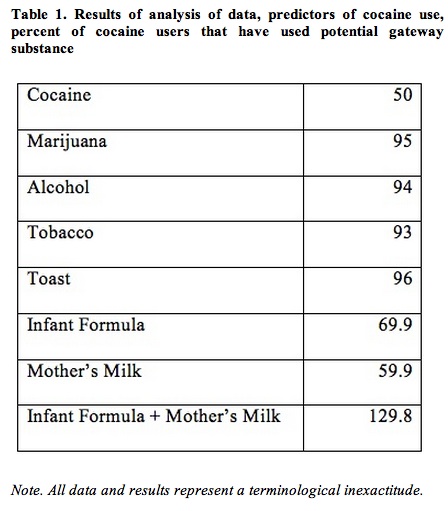
A paper that examines breast feeding in so far as its role as a gateway drug (with bonus data on the effect of toast)

Just published today at The Science Creative Quarterly. A tongue and cheek research piece looking at how breastfeeding (and the simple act of infants drinking milk) is a more potent gateway drug to cocaine than, say, marijuana.

“Continuing with the results from Table 1, it is important to note that toast has been used by 96 percent of current cocaine users in our sample. This shows a strong positive relationship between cocaine use and the eating of toast. Future research is necessary in this regard to identify which form of toast has the greatest predictive power—we did not ask the participants for details regarding their toast. For example, is plain toast, butter, margarine, marmalade, or jam the best predictor? Perhaps most importantly, does it matter which side of the piece of toast has any topping?

The most remarkable result is in regard to infant formula and mother’s milk. Though individually each of these substances have been used by a relatively low percentage of cocaine users, compared to the other substances, one must remember that all infants have likely had one or both of these substances. Combined together, 129.8 percent of cocaine users in our sample have had either infant formula and/or mother’s milk—this number of greater than 100 percent because a subset of our sample received both mother’s milk and infant formula because they were ravenous beasts as infants.”

From Nipping it at the Boob: The Gateway Properties of Mother’s Milk by Martin A. Andresen.

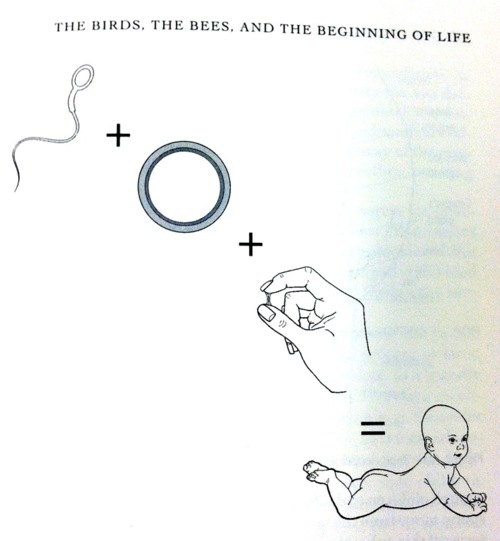
Sperm plus egg plus disembodied hand equals baby?

From Thanks, Textbooks.