.

Tag: genetics

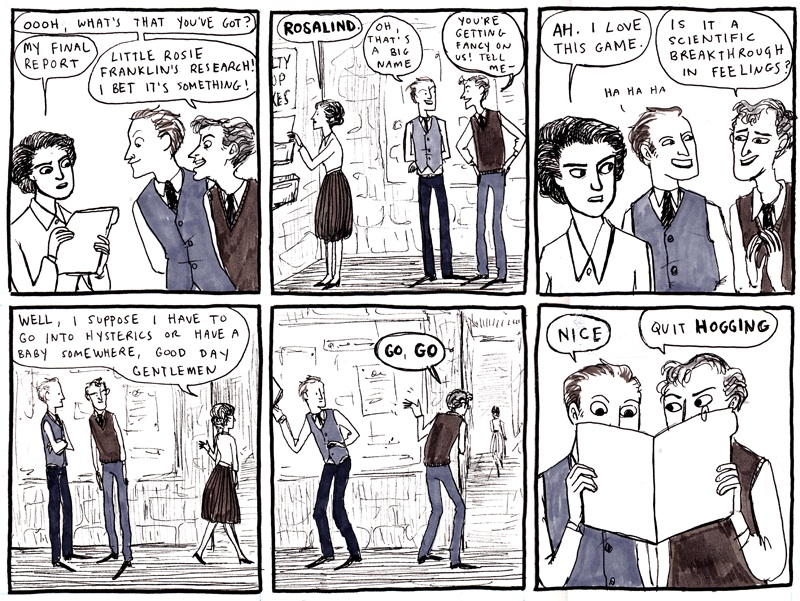
Rosalind Franklin in comic form: pretty much perfectly describes the scientific facepalm

“The trouble with reading about a given woman’s history who was born before your mom is that sometimes, they were hilarious, powerful, tough, loud, et cetera et cetera all good comic making material! But then sometimes, man, the main thing about them is that they just got screwed, big time. I think when I read about Rosalind Franklin, or Mary Anning, or whoever, of just how shitty stealing someone else’s ideas really is. If I opened a newspaper and saw my comic in it signed by some random dude who was getting paid for it, I’d lose my cool! Dear readers, I would have an undignified tantrum. Wouldn’t you?” Kate Beaton

By the awesome Kate Beaton.

Why I majored in Biology: The Pie Chart.

Via sugarglue.tumblr.com

Muggle to Wizard/Witch ratio Mendelian genetics question

Photo by Mai Blahg via tumblr.com under “biology” tag.

Superpower chart. Things to strive for genetically?

Considering that it always seems like most superheroes got their powers via some sort of genetic mechanism, then maybe this graphic could be useful.

(Click on image for larger version)

By Pop Chart Lab.

Naked Mole Rat Genome Sequenced.

Paper link: (E. B. Kim et alNature doi:10.1038/nature10533;2011)

“The naked mole rat is one of Mother Nature’s great survivors. The busy underground lairs in which the animals live almost always run low on oxygen and high on carbon dioxide. Steady subterranean temperatures have sapped the creatures’ ability to regulate their body temperature. Yet what they sacrifice in quality of life they more than make up for in extraordinary quantity. Comfortably the longest-living rodent, naked mole rats can live for more than 30 years. They seem impervious to cancer and do not feel some types of pain.

All of which means that the frankly ugly naked mole rat could prove a sight for sore eyes in the biomedical community. The information published on its genome and transcriptome has already revealed patterns of gene expression different from those in humans, mice and rats, and this may underlie its longevity. With further study, mechanisms of ageing, genetic regulation of lifespan, adaption to extreme environments, low-oxygen tolerance, cancer resistance, sexual development and hormonal regulation are up for grabs.”

Via Nature. Image from Livescience.com.

Support Cloning – It could be awesome! (The T-Shirt) #funny

Via Neatoshop.com. Art by Mike Jacobson.

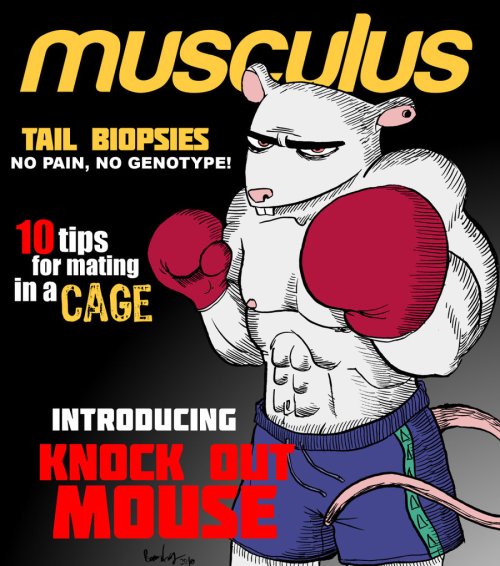
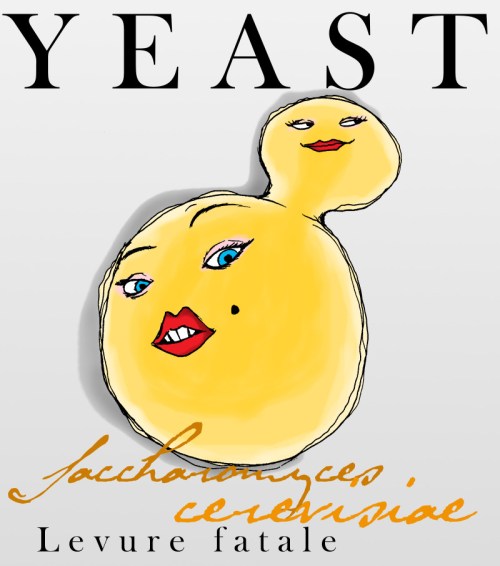
Model Organisms: The magazine covers.

These are awesome. From the talented Velica – link.

Crapbook: social networking via the microbial profile found in your feces

Julian Davies, a colleague of mine at UBC, coined the term “crapbook” in a lecture today. He was talking about a site called “My.Microbe” and, well, I had to check it out.

“The non-profit programme MyMicrobes, launched today, is inviting people to have their gut bacteria sequenced for about €1,500 (US$2,100). Acting as both social network and DNA database, the website offers a place for people to share diet tips, stories and gastrointestinal woes with one another. In exchange, researchers hope to gather a wealth of data about the bacteria living in people’s guts.” (From Nature – link)

Kind of wierd, actually. And expensive too!

(Link to My.Microbe)

One for your slideshow about genetics. This cat is inbred.

Via MY DRUNK KITCHEN

Combining DNA to create the most powerful supervillain ever known!

 This is very very funny, and is seriously a contender for the “official” comic piece for the Arts/Science Integrated Course on Global Issues that I teach (I like the bit at the end about macroeconomics).

From Saturday Morning Breakfast Cereal

Breakfast of Champions does Replication

By DAVID NG

To begin with, we’ll start with a chicken scratch drawing of a DNA molecule, which you know is double stranded. My poor pathetic attempt at illustration is therefore going to look like this:

You also know that each strand of DNA is composed of building blocks called nucleotides, and that these nucleotides are always interacting in a complementary manner. For example, A’s are always with T’s, C’s are always with G’s, Beavis is always with Butthead, etc etc etc. Let’s draw them in like so:


Read the rest of this entry »

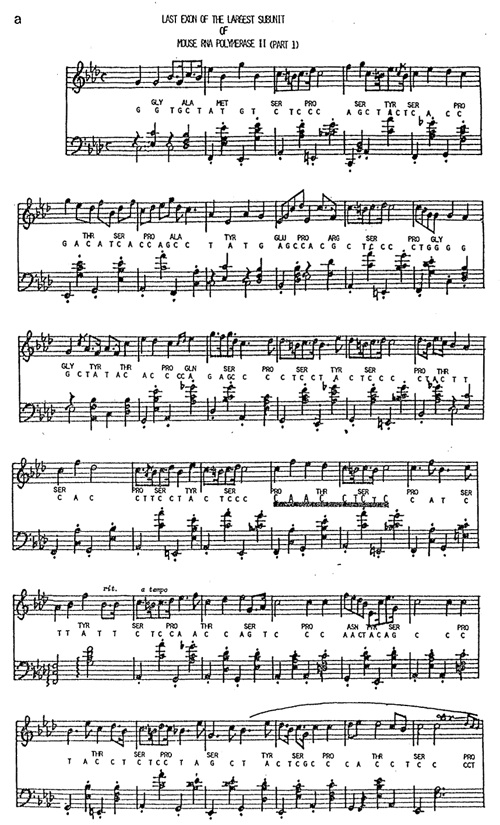
The scientist as mad artist – an example using DNA for musical composition

By DAVID NG

This lovely piece of music is actually reprinted from a wonderful paper entitled “The all pervasive principle of repetitious recurrence governs not only coding sequence construction but also human endeavor in musical composition” (link to pubmed abstract page) and the above image is a figure depicting musical notation as translated from the last exon of the largest subunit of mouse RNA polymerase II. As if this isn’t delicious enough, the article goes on to show that the musical piece shows strong similarities to Chopin’s Noturne OP55. No. 1.

The principle author* Sosumu Ohno begins the paper with an awesome beginning. He writes:

“Whereas ordinary mortals are content to mimic others, creative geniuses are condemned to plagiarize themselves” is my shorter, albeit inarticulate, version of what Van Veen said in Ada by Vladimir Nobokov. Indeed, it seems that vaunted geniuses seldom invented more than one modus operandi during their lifetimes, and even civilization has largely been dependant upon plagiarizing a small number of creative works; e.g. the multitudes of Gothic churches can be viewed as pan European plagiarism of the abbey church of St. Denis and/or the cathedral at Sens. This is not surprising for new genes sensu stricto hae seldom been invented. Evolution rather relies on plagiarizing an old and tested theme…”

And then continues to make a case for great works (musical composition) to be inherently derived from DNA coding sequence.

I often use this paper in a little game I play in class called “Is this real?” and this paper in particular has been the cause of much controversy over the years. Ohno, himself, was a celebrated geneticist with many accomplishments, perhaps the most famous of which was being one of the first to notice that one of the two X chromosomes, in females, existed in a heterochromatin (silenced) form. He was also one of the first geneticists to look into the potential importance of repetitive genetic elements in a genome.

It was from this (and influenced heavily by his wife, Midori) that he developed an interest in expressing DNA code as musical pieces – the obvious advantage being that repetitive elements are likely easier to “hear” than to “see.”

Anyway, a few years back a number of high profile clients cried foul when I had to correct them and tell them that the paper was real, and so I made the additional effort to contact him. Unfortunately, he had just passed away, but the office that looked after his trust wrote back saying “it’s real.” Nice.

For more on Sosumu Ohno, click here for his wiki entry.

*The second author is his wife, the more musically proficient one.

Building up Societies and Global Dominance: The Difference Between Us and the Neanderthal.

Svante Pääbo on the Neanderthal Genome Project.

“I want to know what changed in fully modern humans, compared with Neanderthals, that made a difference. What made it possible for us to build up these enormous societies, and spread around the globe.”

This article in the New Yorker by (usually) environmental writer, Elizabeth Kolbert, does a wonderful job of discussing the implications of the Neanderthal Genome project (although it’s unfortunately behind a paywall).

In other words, the basic idea is that two key differences that put Homo sapiens apart from the other primates (and really the rest of biodiversity) is the fact that we excel at acts of teamwork (simple example: how often do other creatures team-up to lift something heavy); and we’re also much more inclined to explore the unknown (evident in geographical migration, but I guess also from a philosophical epistemology view as well).

Bring into this narrative is the fact that Neanderthals are our closest biological relative where: (1) DNA samples are obtainable, and (2) the two aforemention traits don’t seem to apply. Therefore, sequencing the Neanderthal genome and comparing it to ours, may provide some insight into the genetic basis of such things.