
.
Tag: biology

October 7, 2011
Powers of Ten. Like Star Wars, the original version is still the best.
I remember seeing this in elementary school and thinking, “Whoa…” The remarkable thing is that it is still awesome.
October 7, 2011
Crapbook: social networking via the microbial profile found in your feces
Julian Davies, a colleague of mine at UBC, coined the term “crapbook” in a lecture today. He was talking about a site called “My.Microbe” and, well, I had to check it out.
“The non-profit programme MyMicrobes, launched today, is inviting people to have their gut bacteria sequenced for about €1,500 (US$2,100). Acting as both social network and DNA database, the website offers a place for people to share diet tips, stories and gastrointestinal woes with one another. In exchange, researchers hope to gather a wealth of data about the bacteria living in people’s guts.” (From Nature – link)
Kind of wierd, actually. And expensive too!
October 6, 2011
This is incredible: digital visual translation of brain activity. Raises some interesting questions about science and aesthetics.
Saw this earlier, but only just getting to it now. Tagged because this might come in useful for discussions on whether science can empirically analyse something like aesthetics. i.e. if we can code brain activity for what you see, can we code brain activity for how we “feel” about what we see…
Abstract goes:
“Quantitative modeling of human brain activity can provide crucial insights about cortical representations and can form the basis for brain decoding devices. Recent functional magnetic resonance imaging (fMRI) studies have modeled brain activity elicited by static visual patterns and have reconstructed these patterns from brain activity. However, blood oxygen level-dependent (BOLD) signals measured via fMRI are very slow, so it has been difficult to model brain activity elicited by dynamic stimuli such as natural movies. Here we present a new motion-energy encoding model that largely overcomes this limitation. The model describes fast visual information and slow hemodynamics by separate components. We recorded BOLD signals in occipitotemporal visual cortex of human subjects who watched natural movies and fit the model separately to individual voxels. Visualization of the fit models reveals how early visual areas represent the information in movies. To demonstrate the power of our approach, we also constructed a Bayesian decoder by combining estimated encoding models with a sampled natural movie prior. The decoder provides remarkable reconstructions of the viewed movies. These results demonstrate that dynamic brain activity measured under naturalistic conditions can be decoded using current fMRI technology.”
Gallant’s lab page has a great summary, and link to abstract and article can be found here.
October 1, 2011
What if Smurfs were real? Presumably the systematic biology folks would have some words.

What if Smurfs were real? The Smurf is actually the result of a symbiotic relationship between two organisms. We believe that Smurfs put their ’embryos’ in the button of a developing mushroom. From a distance, Smurfs seem like they are wearing a hat and pants but as you can see this is a fallacy. The fungus provides camouflage and protective epidermal layers for the creature, while the creature provides nutrients and mobility for the spreading of spores.
Via Nate Ethallinan.

September 26, 2011
The N.I.H. rejects Dr. Phil
By DAVID NG
Dear Dr. Phil,
Thank you for submitting your application for the director’s position at the National Institutes of Health. As the N.I.H. is the principal force guiding America’s efforts in medical research, we have strived to consider every candidate’s application seriously.
Our first impression was not a good one. You have a loud and exuberant manner that is an oddity in our network of colleagues, and for the duration of the interview process, you were physically sitting on top of Dr. James Watson (a man considerably smaller than you), oblivious to his muffled and strained murmurs beneath you. We found this quite distracting and wonder what this reflects of your character. Furthermore, although he has only a minor role in the selection process, the Nobel laureate was quite put out. As the conversation continued, we found other characteristics that troubled us. Your commitment to, as you call it, “big ideas,” whilst commendable, seemed a tad impetuous. Your mention of using your television program or perhaps “your good friend” Oprah’s television program to (in your own words) “GIVE FREE GENE THERAPY TO EACH AND EVERY MEMBER OF THE AUDIENCE!” is frankly very unsettling to us.
In truth, we fear that your celebrity status may ultimately impede our principal mandate of excellence in health research. Although some of our members thought it wonderful that you have a Muppet in your likeness on “Sesame Street,” your list of other references (e.g., “I drink scotch with Kelsey Grammer on a regular basis”) hardly elicits confidence. To be blunt, your scientific C.V. is poor and your repeated attempts to demonstrate your scientific prowess were laughable at best. (Adjusting the pH in your hot tub does not count, nor does your vasectomy.)
Finally, we found your tendency to talk in meaningless, corny phrases very irritating. Responses like “Sometimes you just got to give yourself what you wish someone else would give you” or “You’re only lonely if you’re not there for you” are very confusing, to say the least. In fact, our members felt that overall you were even more irritating than the applicant who used the word “testicular” 67 times in his interview. One member of our hiring committee actually wrote the comment “Who the [expletive] is this guy—Foghorn Leghorn doing Yoda?”
Consequently, the hiring committee regrets to inform you that your application has not been shortlisted for further consideration at this time. Please tell Ms. Winfrey to stop bothering us.
Yours sincerely,
Dr. Paul Batley Johnson
Hiring Committee
National Institutes of Health
(One of my older humour pieces – original link here)
September 23, 2011
Microbiological laboratory hazard of bearded men.
Barbeito, MS; Mathews, CT; Taylor, LA (1967). “Microbiological laboratory hazard of bearded men”. Applied microbiology 15 (4): 899–906. PMID 4963447
“An investigation was conducted to evaluate the hypothesis that a bearded man subjects his family and friends to risk of infection if his beard is contaminated by infectious microorganisms while he is working in a microbiological laboratory. Bearded and unbearded men were tested with Serratia marcescens and Bacillus subtilis var. niger.Contact aerosol transmission from a contaminated beard on a mannequin to a suitable host was evaluated with both Newcastle disease virus and Clostridium botulinum toxin, type A. The experiments showed that beards retained microorganisms and toxin despite washing with soap and water. Although washing reduced the amount of virus or toxin,a sufficient amount remained to produce disease upon contact with a suitable host.”
Pdf of first page of article
Link to journal article
Assorted awesome figures below:


September 22, 2011
Tree made with blood vessels.

By boojumsan via Flickr
September 20, 2011
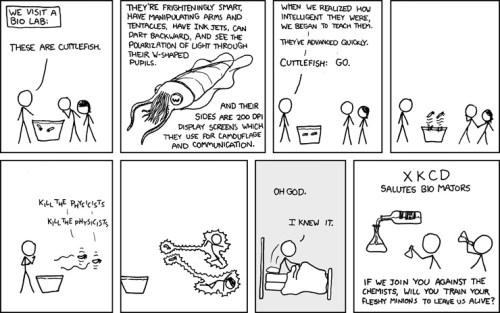
Godzilla anatomy
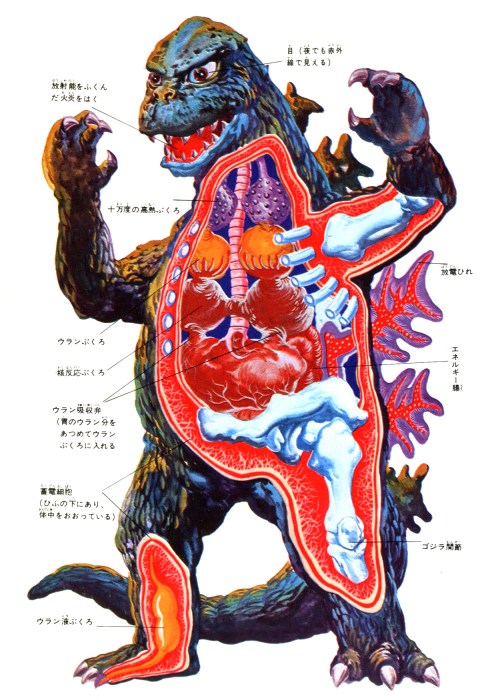
Interesting fire breathing apparatus layout (dual tubes for ignition?). I’m also curious what that big gland is in his leg. Anyone read Japanese?
Via Black Sun
September 20, 2011
I…am…Scientist…Asian…Rockstar… (O.K. maybe not a rockstar). What science subject should I write my next song about?
Yes, it’s true! In my younger days, I had many a futile dream of being a rockstar in a rock band. Nowadays, I live this dream vicariously with the odd song (poorly) written and recorded for science’s sake. Generally, this is done as a challenge, whereupon I make the comments section a place for suggestions.
For example, below is a song I had to put together because someone threw in the word “mitochondria.”

Here is the mp3 for your listening pleasure (best with headphones) – just click below to listen.
MITOCHONDRIA!
(verses)
Floating round in a cell,
making A T P
In your own kind of hell
in the cytoplasmic sea
You got own DNA
Came maternally
Never sure how you stayed
Endosymbiotically
(Chorus)
Mitochondria, Mitochondria, Mitochondria, Mitochondria
Mitochondria, Mitochondria, Mitochondria, Mitochondria
(Bridge)
Inner membrane, oxidation, many cristae, metabolism
Electron transportation chain!
REPEAT VERSES
Anyway, enough with the organelle talk – leave some suggestions below and I’ll do my best to have something written within 2 to 3 weeks.
September 18, 2011
3D structure of AIDS retroviral protein solved by gamers
ABSTRACT:
Following the failure of a wide range of attempts to solve the crystal structure of M-PMV retroviral protease by molecular replacement, we challenged players of the protein folding game Foldit to produce accurate models of the protein. Remarkably, Foldit players were able to generate models of sufficient quality for successful molecular replacement and subsequent structure determination. The refined structure provides new insights for the design of antiretroviral drugs.
September 1, 2011
Not exactly what to think of this: Growing sphincters in petri dishes.
“Eyes, sperm, you name it: these days, chances are someone’s cooking it up on a little slab of agar and gearing up to graft/sew/implant it in anything that comes near. Today’s body part is the anal sphincter, that handy little ring of muscle that maintains the separation between your insides and your outsides. Researchers grew them from cells, implanted them in mice, and compared the new sphincters’ function with the animals’, ah, native orifices. And apparently, they were quite satisfactory.”
(via Discover)
 popperfont.net