(via IFLS – I kind of wish that Fb page would sometimes try a little harder attributing folks who come up with this great stuff. I mean if I can find it in 2 seconds with a google search…)
O.K. so if there is one conference, that I want to kind of spend a disproportionate amount of time to get ready for, it would have to be this one.
Yes, this would be the vaulted Science Online 2013 conference. Last year, I kind of winged it, and still ended up: (1) doing a little performance, (2) catching up with a lot of old friends, (3) being introduced to a ton of amazing folks, and (4) starting the odd discussion that laid groundwork for a collaboration or two.
So here it is: a blog post that serves as my “this is what I want to do, and who else is coming” info station. This would also double as an introductory post for those who might be interested in some of the things I do, and maybe even want to chat with me.
Firstly, this is a picture of me (yes, I will be bringing the t-shirt along). I was also recently interviewed by Bora, so you can take a peek at that to get a sense of the sort of stuff I do. I run this lab, but in general, I’m interested in intersections between creativity and science; excellent ways to broach challenging science education logistics and/or topics (especially to audiences not that receptive to science); and (if you must know) I’m also always thinking of ways to weasel myself into one of those new Star Wars movies planned for the future (because I think I would be perfect as one of those Stormtroopers who fires his/her laser gun, a piece of technology that is presumably very advanced, and still miss the target that is only a room length away and not even moving terribly fast). And if you’d like to learn more about some of the web hijinks I’ve been involved in, or some of the “writing” I’ve done, then do feel free to peruse my pseudo (and oft neglected) portfolio site.
– – –
But on to the matter at hand: the conference runs from January 30th to February 2nd and will likely involve the most intense 70 to 80 hours of epic science discussion you can imagine. With those parameters in mind, here’s the gist of what I hope to accomplish.
This, I think, will be one of those discussions that will be both wonderful, challenging, surprising, and prone to tangential exploration (i.e. a back and forth about the variety of unconventional methods that can be used to talk science). The key question (and the prevailing tension of this topic), I suppose, is whether that tangential nature is a good thing or a bad thing – does it distract or dilute from the real translation of science, and/or if it does, is that sometimes alright.
I’m actually hoping to take in the collective wisdom of the session (as well as the conference in general) to think more seriously about this idea, primarily because it concerns the challenge of preaching outside the choir. In other words, how does one embed the notion of science culture into everyone’s self identity, whether it’s in large parts like in the case of Tom and I, or (perhaps more importantly) in smaller, nuanced but still critical ways for those who aren’t as passionate about such things, or those who blatantly resist it. As well, I want to know if this collected wisdom is something that should be described, archived, even assessed somewhere – say as a journal, book, ebook, ap, workshop, or website or whatever. I know I think so – and I hope there are others who also think so (we can, for instance, brainstorm about what this might look like, if there is interest).
Cara and Melanie – might be worth having a chat beforehand since I think your session will be tackling some similar themes, albeit dealing with a much feistier (and impertinent) element?
In terms of general science-y goodness and general networking, I want to chat with people who are really in awe of the quiet grandness and messy elegance of the scientific method, and who also want to think of interesting ways to explore it within an elementary school setting. And I’m not just talking about doing experiments (which will be done and will be awesome), but even in seeing if we can figure out the most effective, creative and engaging ways to talk to kids about weighty concepts like validity and evidence.
My end goal is to design a 1 day elementary school teacher workshop (which would possibly be later adapted to an elementary school fieldtrip program), and any insight into what ideas/exercises might be good to pursue or avoid would be very handy. In fact, hearing about examples of great programs that already exist would also be much appreciated.
Next up, I’d like to explore possible research opportunities where it would be great to gain some metrics on some of the programs my lab currently runs. This is one of the cases where funding already exists to perform the activities: but it just needs an interested party to design a research question around said activity. In particular, we have this really interesting field trip (called the Science Creative Literary Symposia) which essentially teams up a Science Graduate Student with a Creative Writing (and sometimes Visual Arts) MFA student. Here, the two of them are guided to design a days worth of activities where a classroom of 9 to 11 year olds can do some relatively fancy science experimentation (in my lab in tune with the specialty of the scientist), as well as ask them to do some expository creative writing or creative art around the experience (also in tune with the preferred genre of the writer/artist).
The intent of this fieldtrip is primarily to show that mixing these two things isn’t so strange afterall. In fact, another point to be made is that there are many similarities in these seemingly two divergent tasks, and that therefore one shouldn’t necessarily assume you can’t enjoy both. We’ve done this fieldtrip for a few years now, and I think we now have it as a well oiled machine, consistently generating great reviews from both the kids and teachers who attend. It just seems like a remarkable opportunity to design a study with the aim to query the children’s impressions around concepts of science and creativity.
Anyway, if this sounds intriguing to you (especially if you’re the type that considers the creative arts when sharing science, or if you have a background in education research), then do let me know – I know Marie-Claire and I will have a good chat about this, and I know I’m itching to release my grant writing chops for this…
Finally, I’m looking for someone who would appreciate a $5000 art grant to help host a Phylo deck. Usually folks from a Natural History Museum makes the most sense here, but I’m open to all sorts of suggestions (environmental and science education NGOs, publications could also work). Essentially, I think it would be kind of cool to initiate discussions with the formal intent of having the deck ready for the next conference in 2014 (i.e. a recurring tradition). I’m also at the beginning stages of initiating some education research around this project as well (essentially to assess its utility in terms of actually making children/players think more about biodiversity), but would love to have more involved. The idea of a hosted deck is pretty cool – they can certainly look nice, as sample cards from this deck in progress can attest to. I’ve started an exploratory tweet here, but curious if there might be others that are intrigued.
Oh, and actually, there is one more thing. I’ve sort of started on the process of writing a book, on science literacy no less: but given that my writing background tends to be a little unconventional to say the least (for example, my pieces tend to look like this, this, and this), I have to admit that the whole prospect is scaring the bejeezus out of me. Basically, it would be lovely to just chat with other science book writers, both those who are Yodas in the industry, as well as others who might also be new to the endeavour.
– – –
Now onto my homework – which isn’t really as arduous as it sounds, because Bora, Karyn and Anton have made things easy for us. Here is a list of all the interesting folks who are coming out, and then here is this large archive of great interviews of past Science Online attendees (also just found this other archive of SA Incubator’s Q&A’s). For this post, I’ve gone and edited this list of links to focus on the folks who also happen to be attending this year. So my homework (and maybe yours too), is to slowly make your way through the below list (marked with year that the interview was conducted). If you’re not here because you haven’t sent in a Q&A to Bora, then you’re also welcome to leave a comment introducing yourself at the bottom (perhaps with mention of your favorite beverage and, if you’re up to the challenge, done as a six word memoir?)
Being a scientific investigation of a cultural conundrum
Soon it will be Christmas Eve, and once more children will be divided into distinct factions. Here, Cyr [1] described younger children (12 years) who have ditched this ‘childish’ belief. But he fails, by excluding from his questionnaire, to describe a third group who aren’t really sure – the undecided voters if you like. And as the eldest child, I have spent a large part of my life in this group. Moreover, being scientifically minded even at the age 7, I of course approached this problem according to well-established techniques of investigation.
My first stop was to consult the authorities. My parents (beneficiaries of a liberal arts education and a liberal dosing of 1960’s psychotropic compounds) reassured their young child by explaining that Santa, like all beliefs, was a social construction and as such was true to all who believed in him. When I asked how I would prove that, Mum told me that all truth was relative and that the concept of proof was no more than a projection of hegemony by the dominant culture. Which I thought was a load of old bollocks.
Disappointed but not discouraged I proceeded to a literature search (It wasn’t until much later in my career that I realised this was only ever done after at least 9 months of laborious investigation, although I was naive then, so give me a break). My little red bookshelf contained several volumes referring to Santa Claus. Most were personal accounts [2], and as such counted as no more than Level V evidence (expert opinion). Other styled themselves as authorities [3,4], but lacked references to definitive investigations.
Modern children of course have Pubmed, and conducting a search today for “Santa Claus Existence” gave 5 results, of which one was relevant. In 2002 Cyr surveyed whether paediatric inpatients still believed in Santa Claus. While a good and noteworthy study, this would still have not fit my purposes. I didn’t care if other children believed in Santa, and besides this was still only Level IV evidence (case-series). The author also declared his bias as a continuing believer, throwing all his conclusions under a cloud.
I realised I would have to abandon epidemiological techniques in favour of direct experimentation. I proceeded with the null hypothesis “Santa Claus does not exist”. I designed a trap to snare him in my bedroom, but after two failed years I realised the fault in my experimental design. The only way to reject the null hypothesis was to catch him, but not catching him left me unable to either accept or reject the null hypothesis. Unfortunately we hadn’t studied Karl Popper in reading room at that stage.
I decided to approach things in a more indirect manner. His ability to tell if children have been naughty or nice has been well-described [5]. More specifically, I decided to adjust my behaviour, the independent variable A, and observe the number of presents, the dependent variable B. If he did exist, then B would vary with A, but if my parents were bringing the loot then A should not cause B to vary, as I was an overindulged and spoilt child. Furthermore, being nice and still getting presents regardless would prove little, and besides naughty was much more fun.
So I was as naughty as possible on Christmas Eve. I threw tantrums, messed my room, pulled my sister’s hair and hid my brother’s toys. I interrupted my father and refused to eat my dinner. The next morning I awoke with eager anticipation of my results. I got pretty much the same presents as usual. I then realised with horror that I had no reference standard! What if I was going to get more and had been reduced? How would I know? My brother and sister served as case-controls, but this was wholly unsatisfactory. Was a Barbie doll worth one or two toy cars? Had they been naughty or nice, thus confounding the results?
In any event, I am sorry to report that despite having now reached adulthood, I have still been unable to establish a satisfactory experimental design for this problem. The levels of evidence in this field continue to be amongst the poorest in the literature, and anecdotal evidence abounds. However, there will be a bear-trap at the bottom of my chimney again this year. While Popper may maintain that it is impossible to prove that something does not exist, the truth is that I’ve only got to catch the bastard once to get my answer.
References
1. Cyr C. Do reindeer and children know something that we don’t? Paediatric inpatients’ beliefs in Santa Claus. CMAJ 2002 Dec 10; 167(12): 1325-1327
2. Moore CC. ‘Twas the Night Before Christmas. The Sentinel 1823. Heirloom edition available from Running Press Book Publishers.
3. Apple M, Baum LF, Riley, MO. The Life and Adventures of Santa Claus. Signet Classics
4. Perkes A. The Santa Claus Book. Lyle Stuart Publishing.
5. Coots JF, Kellogg S. Santa Claus is Comin’ to Town. HarperCollins
(see more of Popperfont’s Sciencegeek Advent Calendar Extravanganza here)
Sharing this among your science minded set would be GREATLY appreciated.
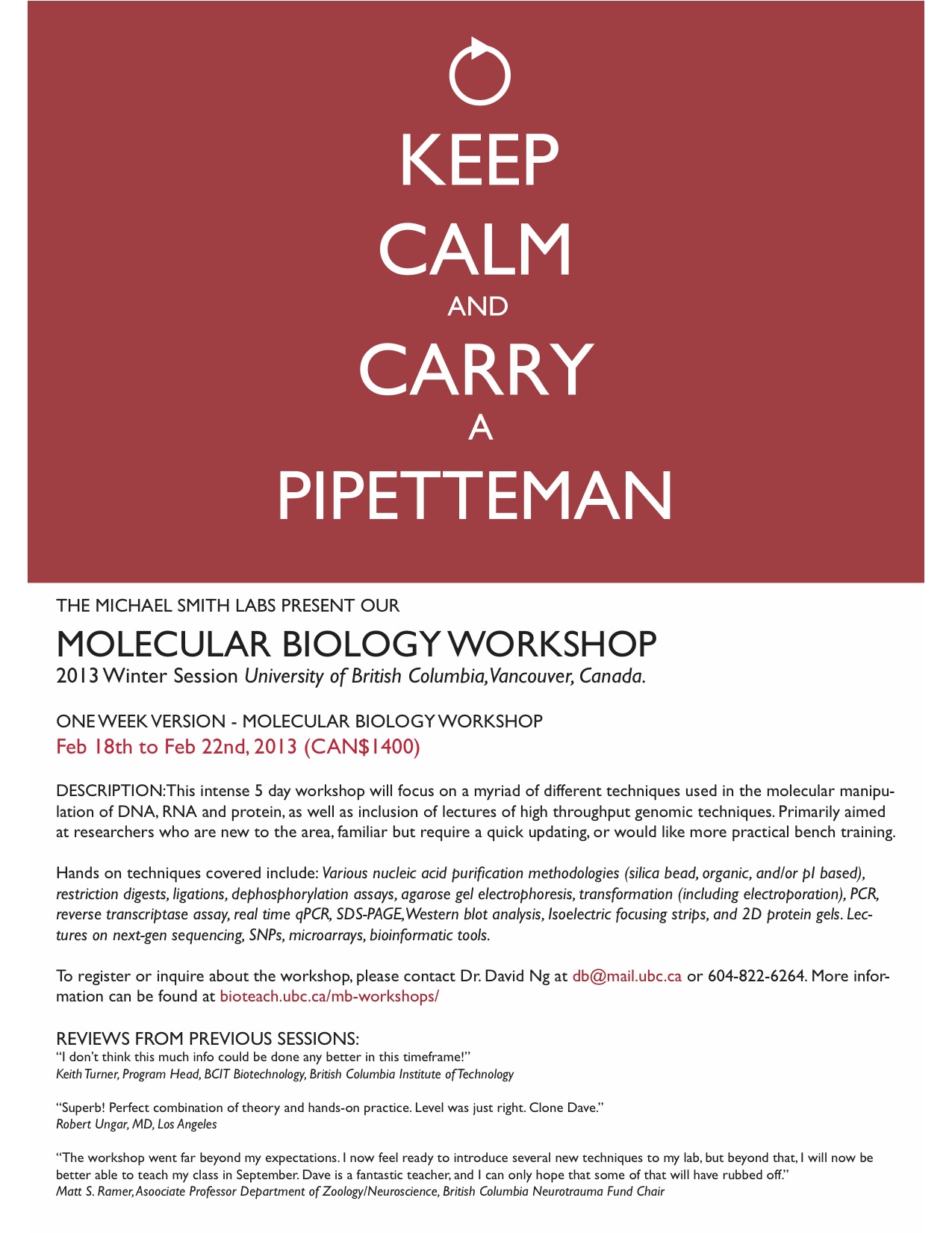
Once again, my lab is pleased to offer our popular Molecular Biology Workshops for those who wish to get quick, professional, theoretical, practical (and enjoyable) training in the fine science of molecular techniques. Our next one is scheduled for February 18th to 22nd at the University of British Columbia, in beautiful Vancouver. Although, this workshop is primarily designed for the professional life science researcher (graduate students, post-docs, faculty, industry, etc), we’ve also had great reviews from folks in fields as diverse as education, journalism, economics, politics, law, engineering, and computer science.
Cost is $1400 (discounts for group rates) for the 5 day workshop, where all funds go toward our various outreach activities. These include a menu of different field trip programs, our online projects (such as Phylomon), as well as our university undergraduate initiatives – more details about our outreach programs can be found at bioteach.ubc.ca. Note that we keep all of these initiatives free for the schools and general public!
Full details about the workshop can be found here.
DIY: HOW TO MAKE A TERRARIUM CHRISTMAS ORNAMENT! Full details at Inhabitat.com
“Materials required: Moss, plants and/or twigs small enough to fit into your terrarium ornament – Some soil – Tweezers – Reusable glass ornament orb – A ribbon (we used one from an old gift box) – A chain or string (we used an old bracelet) – (optional) Figurines or other fun tsotchkes to place inside your ornament”
Really enjoying this Nimona webcomic by Noelle Stevenson. Plus, she is also responsible for this hilarious tumblr called The Pokeymans Project, which is simply described as:
“Pokemon drawn from description alone by someone who doesn’t know anything about Pokemon.”
Will have to write about that one later, because it is an AWESOME segue into the art of scientific observation and descriptive writing (especially when it comes to biodiversity stuff).
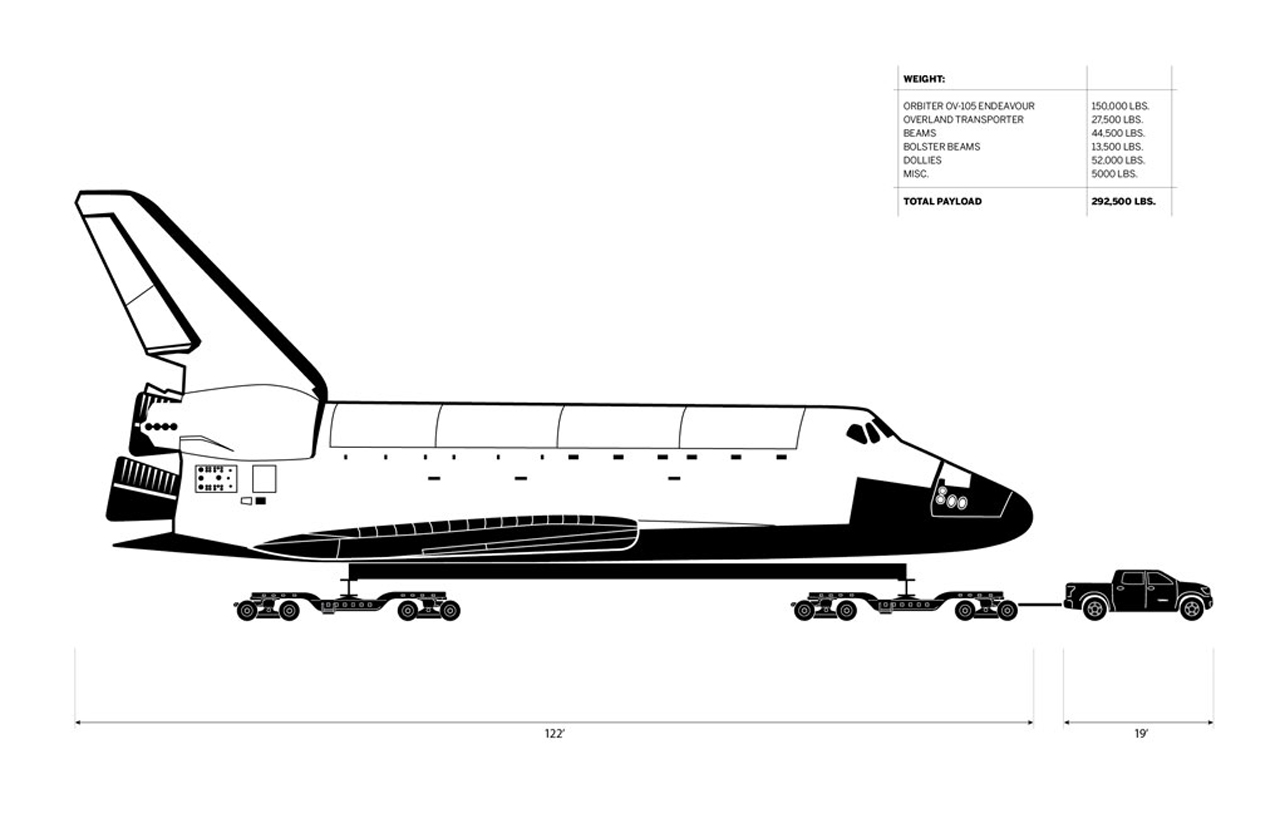
“Endeavour will be towed 12 miles from Los Angeles International Airport to the museum on October 13, and the Tundra will hitch up to the shuttle for the last quarter mile of the trip. The towing rig was made specifically for this event, allowing the full-size Toyota Tundra to pull almost 30 times its regular towing capacity. Toyota says that the truck used to tow Endeavour will be a stock V8 Tundra with no enhancements or modifications.”
Statement from the Canadian HIV/AIDS Legal Network and the Grandmothers Advocacy Network. (link)
NOVEMBER 28, 2012 – We are profoundly disappointed that Parliament has decided to reject reason and overwhelming evidence by defeating Bill C-398, which would have ensured greater access to affordable medicines for people dying of treatable diseases such as AIDS, malaria and tuberculosis in developing countries. By choosing to believe the blatant lies and misinformation circulating about this bill, MPs who voted against the bill have reneged on Parliament’s earlier pledge and have betrayed people in developing countries — including hundreds of thousands of children — who need medicines to prevent suffering and death, including from AIDS, tuberculosis and malaria.
Bill C-398 would have streamlined Canada’s Access to Medicines Regime (CAMR) by cutting red tape that is wholly unnecessary and proven fatal to the future use of the system. The bill would have made it easier for both developing countries and generic drug manufacturers supplying medicines to use CAMR to help save lives and reduce suffering. A previous iteration of the bill (Bill C-393) was overwhelmingly passed in the House of Commons in the last Parliament — before it died in the Senate with the election call. That bill enjoyed support from members of all parties in the House of Commons, reaffirming that this should be a non-partisan issue. Bill C-398 had the support of medical and legal experts, humanitarian activists, faith leaders, AIDS and international development organizations across the country and health activists around the world. Dozens of prominent Canadians supported the call to action, and 80% of the public supports fixing CAMR according to a national opinion poll.
Bill C-398 reintroduced to the House of Commons the same amendments that very strong majority had already previously endorsed. It was a second chance to finish the job of fixing CAMR and supporting developing countries with needed, lower-cost medicines.
It is a travesty that the Harper Government, having made much of its initiative on maternal and child health, would now turn its back on an opportunity to help people dying of treatable diseases — through a smart policy that that would have cost no taxpayer money and, in fact, would make Canada’s frozen foreign aid dollars even more effective, by harnessing the power of generic competition to get less expensive medicines to developing countries. A government that preaches the virtues of markets and “value for money” chose to disregard both; instead, it prioritized its incorrect reading of World Trade Organization (WTO) rules on protecting patents over a workable mechanism for supplying more affordable, life-saving medicines to developing countries struggling with the ravages of the AIDS pandemic and other public health burdens. This is shamefully callous and a discriminatory double-standard for which those who can least afford it pay the ultimate price.
We wish to thank the many champions of this bill, from all political parties, who took Bill C-398 through the legislative process. The fight is not over. Too much is at stake.
But the bottom line is this: after more than eight years of waiting for Canada to deliver on its pledge to help get more affordable medicines to Africa and other developing countries, the world will still have to wait — and people will die preventable deaths because too many Parliamentarians did not have the courage to do the right thing.
The Canadian HIV/AIDS Legal Network (www.aidslaw.ca) promotes the human rights of people living with and vulnerable to HIV/AIDS, in Canada and internationally, through research and analysis, advocacy and litigation, public education and community mobilization. The Legal Network is Canada’s leading advocacy organization working on the legal and human rights issues raised by HIV/AIDS.
About the Grandmothers Advocacy Network
The Grandmothers Advocacy Network (GRAN) is composed of volunteer grandmothers and grand-others from across Canada (http://grandmothersadvocacy.org). We act as a Canadian voice for Africa’s sub-Saharan grandmothers who are caring for millions of children made vulnerable by AIDS. We work for changes in Canadian policies to improve their quality of life.
“Latvian conceptual artist and creative director Voldemars Dudums created this insanely clever bird feeder using an old computer keyboard and some cubes of bacon fat. When the birds would fly down to snack their inadvertent key presses were fed to an api that parsed each little tap into a bonafide tweet on the @hungry_birds Twitter account”
Apologies if you haven’t seen this yet (it will stick to your brain like nothing you’ve ever experienced), but it provides a little light hearted context for a serious issue.

 Funny line from @itsrealTED
 Firstly, I’ll be co-moderating a session with
  In terms of general science-y goodness and general networking, I want to chat with people who are really in awe of the quiet grandness and messy elegance of the scientific method, and who also want to think of interesting ways to explore it within an elementary school setting. And I’m not just talking about doing experiments (which will be done and will be awesome), but even in seeing if we can figure out the most effective, creative and engaging ways to talk to kids about weighty concepts like validity and evidence.
 Next up, I’d like to explore possible research opportunities where it would be great to gain some metrics on some of the programs my lab currently runs. This is one of the cases where funding already exists to perform the activities: but it just needs an interested party to design a research question around said activity. In particular, we have this really interesting field trip (called the
  Finally, I’m looking for someone who would appreciate a $5000 art grant to help host a
  Oh, and actually, there is one more thing. I’ve sort of started on the process of writing a book, on science literacy no less: but given that my writing background tends to be a little unconventional to say the least (for example, my pieces tend to look like















 popperfont.net