
.
Tag: scientist


December 19, 2012
Sciencegeek Advent Calendar Extravaganza! – Day 19

DARWIN AS SANTA (A.K.A. ONE WAY DARWIN COULD JUMP THE SHARK)
See other Ways Darwin Could Jump the Shark

“Sporting his full white beard, Darwin is hired to impersonate Santa Claus at the local mall. He initially does well in this job, looking the part, being punctual, amicable, and knowledgeable about reindeer. However, he soon begins to insist on teaching children words like “invertebrate.” He also starts giving out stylish feces beads instead of candy canes. Later, he gets in an argument with another Santa Claus in another mall over biologically sound explanations for Rudolph’s glowing nose. The “Darwin vs. Santa Claus” fistfight goes viral on YouTube.”
By David Ng via McSweeney’s. Image: Source Unknown.
(see more of Popperfont’s Sciencegeek Advent Calendar Extravanganza here)
December 17, 2012
The “Name the Scientist: Cartoon Picture Edition” Quiz
How many can you get? (I got 6)

(Click on the image for a larger version).
By Chay Hawes. Answers found here.


October 12, 2012
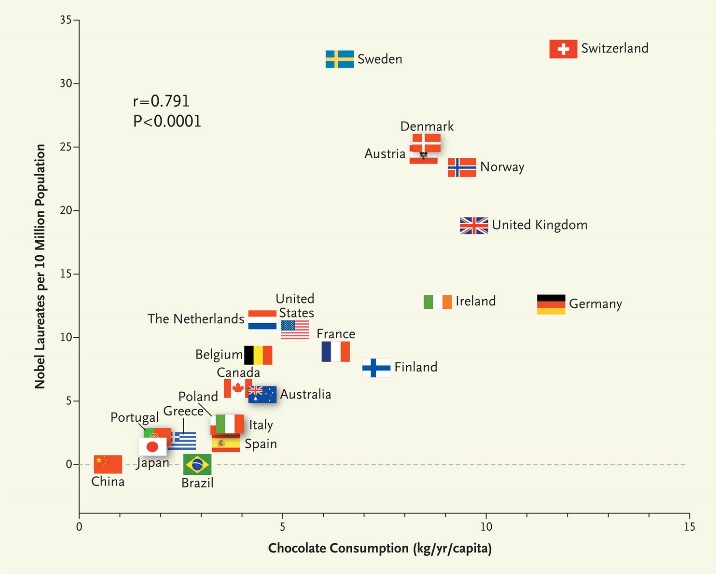
Graph: In which chocolate consumption strongly correlates with likelihood of getting a Nobel Prize.
Well… by way of the country the Nobel Laureate belongs to… (p.s. this is tongue in cheek, but good as a slide to talk about the old correlation versus causation issue)
Abstract:
“Dietary flavonoids, abundant in plant-based foods, have been shown to improve cognitive function. Specifically, a reduction in the risk of dementia, enhanced performance on some cognitive tests, and improved cognitive function in elderly patients with mild impairment have been associated with a regular intake of flavonoids. A subclass of flavonoids called flavanols, which are widely present in cocoa, green tea, red wine, and some fruits, seems to be effective in slowing down or even reversing the reductions in cognitive performance that occur with aging. Dietary flavanols have also been shown to improve endothelial function and to lower blood pressure by causing vasodilation in the peripheral vasculature and in the brain. Improved cognitive performance with the administration of a cocoa polyphenolic extract has even been reported in aged Wistar–Unilever rats.
Since chocolate consumption could hypothetically improve cognitive function not only in individuals but also in whole populations, I wondered whether there would be a correlation between a country’s level of chocolate consumption and its population’s cognitive function. To my knowledge, no data on overall national cognitive function are publicly available. Conceivably, however, the total number of Nobel laureates per capita could serve as a surrogate end point reflecting the proportion with superior cognitive function and thereby give us some measure of the overall cognitive function of a given country.”
By Franz H. Messerli, M.D. from Chocolate Consumption, Cognitive Function, and Nobel Laureates (October 10, 2012DOI: 10.1056/NEJMon1211064), via New England Journal of Medicine.
September 26, 2012
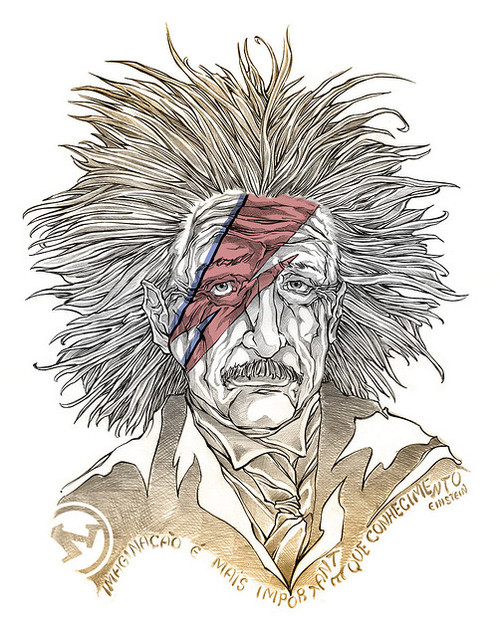
Newton, shoulders, giants and other things he may or may not have stood on during his lifetime.
By DAVID NG
Likely:
Grass.
A stage of some sort.
Guard.
Tippy toes.
Unlikely
Laminate Flooring
Astroturf.
Olympic podium.
Someone’s throat.
September 25, 2012
In case you’re wondering: Lemmings are not made of cloud. (via @mwand)
Good Ole Worm (a.k.a. Olaus Wormius)
From Rocketboom, via @mwand


September 6, 2012
Kate Beaton looks at Tesla and the ladies.
Kate is awesome as always.

Tesla was celibate and never married, claiming that his chastity was very helpful to his scientific abilities. However, towards the end of his life, he told a reporter, “Sometimes I feel that by not marrying, I made too great a sacrifice to my work….” There have been numerous accounts of women vying for Tesla’s affection, even some madly in love with him. Tesla, though polite and soft-spoken, behaved ambivalently towards these women in the romantic sense. (Wikipedia)
July 18, 2012
What kind of scientist is Batman? (And what do you think?)

Since the the new movie is fast upon us, I’d thought I’d revisit the above question. This was something that Ben Cohen posed at our old blog, The World’s Fair.
Basically, he referenced a great Simpson’s episode (Marge v. the Monorail), which has the corresponding dialogue:
Marge: Homer?
Homer: Yelloh?
Marge: There’s a man here who thinks he can help you.
Homer: Batman?
Marge: No, he’s a scientist.
Homer: Batman’s a scientist.
In any event, back then (this was in 2008), we got some great responses. It would be lovely to hear some more, especially with the Batman iconography maturing so much during the last 4 years, but for now, I’ve reprinted all the responses we were able to get the first time around.
– – –
(From 2008) Scienceblogger responses below:
Afarensis
Obviously, he is a forensic scientist…
The World’s Fair (Dave Ng Ed Note: a.k.a my response)
I’m gonna go out on a limb here, and suggest that Batman is (amongst other things) a “bat scientist.” This, I think, would make him a chiropterist, since Bats belong to the family Chiroptera (greek for “hand-wing”). I can imagine Mr. Wayne going to his fancy cocktail parties and providing all manner of banter and trivia on bats, all the while chuckling to himself and thinking, “the fools.” Anyway, whatever discipline he falls under, at the very least he could do with some counseling – that dude has issues.
Note: There’s actually a North American Symposium on Bat Research in North Carolina coming up in October. Maybe, Mr. Wayne is a keynote?
Discovering Biology in a Digital World
Holy Moly! What kind of scientist are you, Batman? This important question, posed by Benjamin Cohen of The World’s Fair, is one that cannot be ignored. And, most importantly, can be quickly answered…. (more)
Adventures in Ethics and Science
“That’s Dr. Batman to you, evil doer!” Ben at The World’s Fair asks what kind of scientist Batman is. (Of course, he does this after producing something like reliable testimony that Batman is a scientist to begin with.) Sandra Porter makes the case that he’s a geneticist,… (more)
Pharyngula
The “What kind of scientist is Batman” problem. This new strange question is sweeping the scienceblogs: “what kind of scientist is Batman?” The answer is obvious…. (more)
Respectful Insolence
Batman’s no scientist.
Now Reed Richards, there’s a scientist. 
Uncertain Principles
Ask a ScienceBlogger: Cartoon Edition What sort of scientist is Batman? (more)
Scienceblogs.com (Tim)
OT: I don’t know what kind of scientist Batman is, but his religious affiliation is Episcopalian/Catholic (lapsed). http://www.adherents.com/lit/comics/comic_book_religion.html
– – –
Over 100 comments to be found at Pharyngula, The World’s Fair, Uncertain Principles, and thisComic Book Forum.
July 11, 2012
Wonderful artwork in this brilliant history of organic chemistry slideshow.
Download the full presentation here (pdf).

“Vladimir Markovnikov,a chemist and political progressive, was outmaneuvered by the crafty and conservative Aleksandr Zaitsev. Both men would go on to fame as discoverers of significant trends in chemical reactivity and organic chemistry students today still learn “Zaitsev’s Rule” and “Markovnikov’s Rule.”

“So, organic chemistry has come a long way from its early days. It might have reached its peak,in a certain sense, around 1972, when Robert Woodward of Harvard and Albert Eschenmoser of the Swiss Institute of Technology synthesized the very complex molecule we know as vitamin B-12. Ever since, it has been widely accepted that organic chemists can make pretty much any molecule that occurs in nature. That is really something!”
By David B. Cordes, via Fresh Photons.
July 10, 2012
Happy Birthday! Nikola Tesla turns 156.
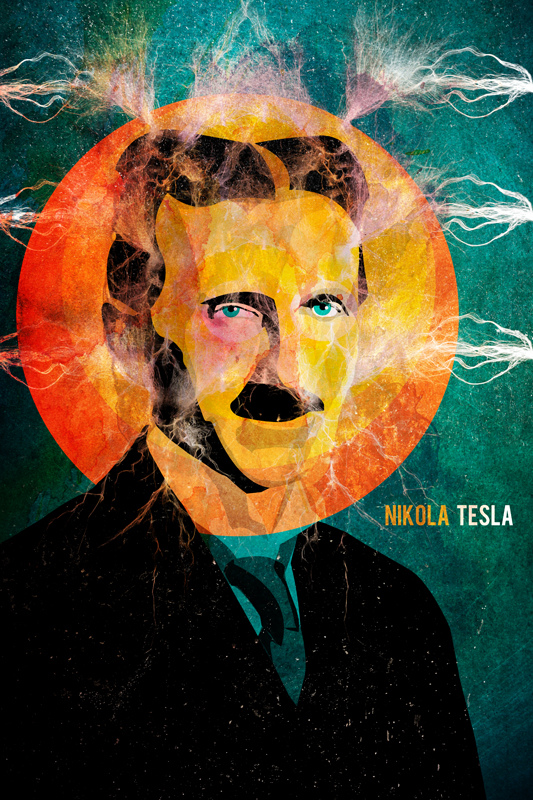
Lovely art by Alvaro Tapia, via Hey Oscar Wilde!
More from Tesla’s wikipedia page here.
Awesome, and of note, on this site:


June 30, 2012
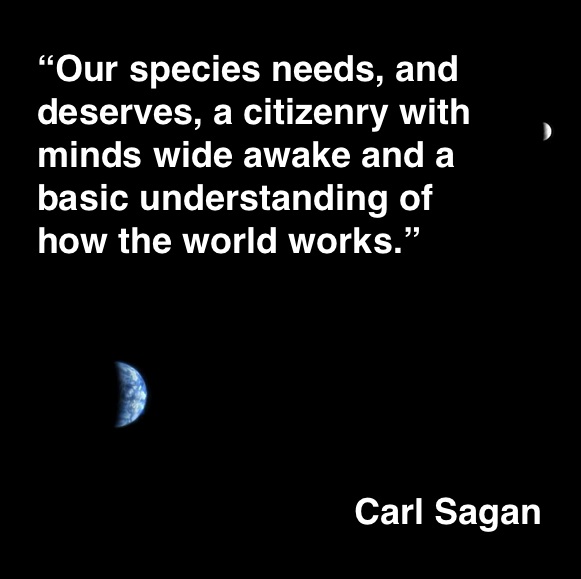
“Our species needs, and deserves, a citizenry with minds wide awake and a basic understanding of how the world works.”
Love this quote, and so I had to quickly make a little graphic for it. Image from NASA/JPL-Caltech/University of Arizona (source link). Font: Helvetica bold.
June 28, 2012
Wonderful vintage evolution illustrations from the American Philosophical Society Flickr account

“This image from Ernst Haeckel’s 1874 The Evolution of Man shows comparisons between cross-sections of different animals and their embryos at different stages of development. For Haeckel the development of an embryo retraced the evolutionary history of the animal. The different colors represent the four types of tissues out of which all the organs formed. Ernst Haeckel. Anthropogenie, oder, Entwickelungsgeschichte des Menschen. Leipzig: W. Engelmann. 1874.” – link

“Title: Outlines of Comparative Physiology
Maker: Louis Agassiz, 1851
Significance: In opposition to Darwin” – link
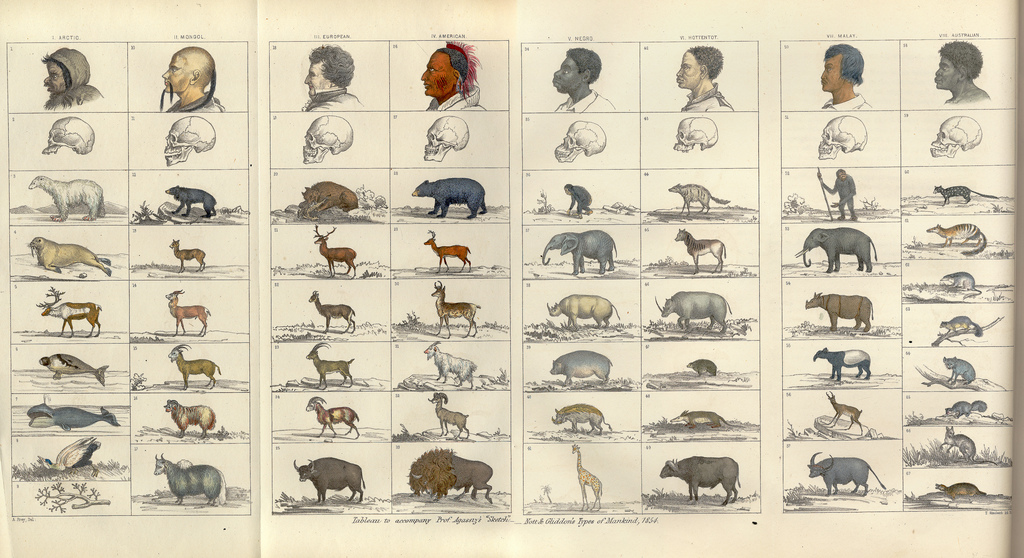
“Nott, Types of Mankind
Here American physician J. C. Nott attempted to illustrate geologist Louis Agassiz’s theory, which was that each region of the world was populated by separately created sets of species, both animal and human. Such ideas about human species at the time were often influenced by western racial prejudices, as the idea of multiple, separately created races could be used to justify slavery and other forms of subjugation. Darwin disagreed, firmly maintaining that all humans were descended from the same human ancestor. Josiah Clark Nott (1804–1873). Types of Mankind…. Philadelphia: Lippincott and Grambo, 1854.” – link
See and learn more from the APS Flickr account, via Fresh Photons.
 popperfont.net