Nice graphic of a great Einstein quote.
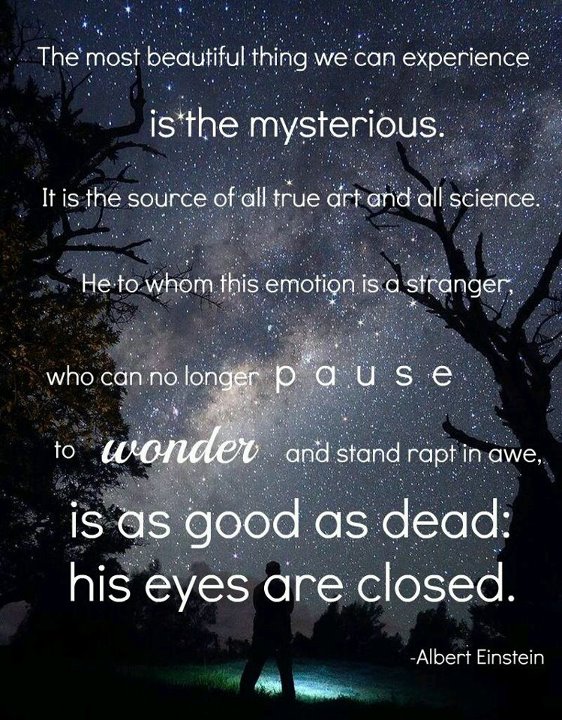
Quote by Einstein. Image source unknown.

Quote by Einstein. Image source unknown.
Classic…
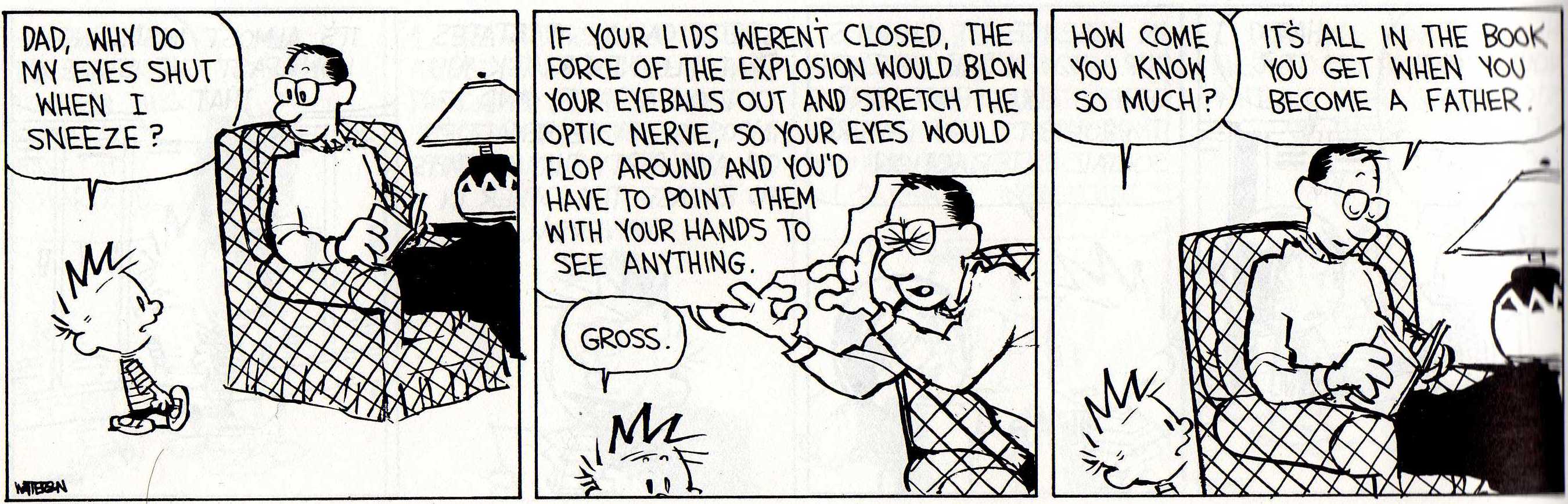
By Bill Watterson

By Gavin Aung Than at Zenpencils.com. Words by Phil Plait.
By DAVID NG
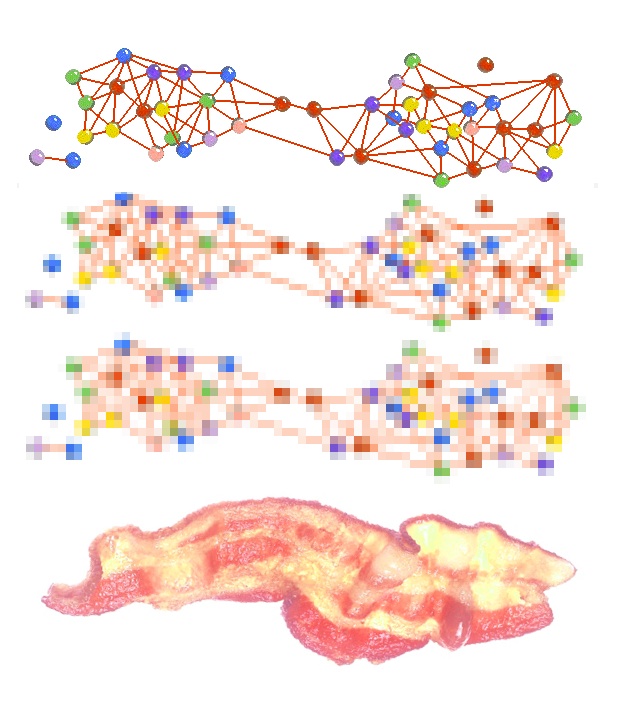
Lately, I’ve been doing a little writing on the philosophy of science, and a consequence of this, is my mind pondering the plight of Bacon. Not the food, but rather Sir Francis Bacon, who as you may or may not know, is the renown writer and gentlemen of the 16th and 17th centuries – famous for being a member of Parliament, friend to the British Monarchy, and (most important to me) often referred to as the “Father of the Scientific Method.”
Such thinking then naturally led to Kevin Bacon, who in turn, reminded me of the “Six Degrees of Kevin Bacon.” Which is also to say that inevitably, I landed at entertaining the specifics of the “Six Degrees of Sir Francis Bacon.”
This refers to the phrase, “The Six Degrees of Separation,” which submits that you are less than six “friend of a friend” steps away from everyone else on the planet. In other words, it suggests that mankind is more connected than you would think. Interestingly, this calculation has never been formally proven, and there might even be some evidence to suggest that social media has brought it down to four degrees, but despite all this technical wrangling, it is nevertheless obvious that it probably only works well if the people involved happen to be alive.
Which is to say that the “Six Degrees of Sir Francis Bacon,” a man who died in 1626, are probably all dead.
With this in mind, we need to return to the “Six Degrees of Kevin Bacon.” Whilst, this originally concerned itself with connections in the entertainment industry, the phrase nowadays is kind of symbolic of humanity’s interconnectedness. Put another way, Kevin Bacon is a little like an unofficial figurehead of this game.
But figureheads are usually transient. Indeed, the fact of the matter is that Mr. Bacon is no longer the sprightly young man that danced into our hearts in Footloose. Nor is he, despite the fact that he played an “invisible” character in Hollow Man, capable of hiding from the debilitating onward march of time. In essence, he should be fully aware that as he ages, the concept and the mathematics of the “Six Degrees of Kevin Bacon,” will no longer be practical – indeed, it will no longer even be relevant. Consequently, you might suppose that one day, there will need to be a proper discussion about a “six degrees” successor.
And why not start that discussion now? Namely, how would one decide on such a successor? Of course, this would come with a few rules. For instance, whoever is chosen should, at the very least, be younger than Kevin Bacon. Perhaps Mr. Kevin Bacon should even have a role in this process. Anyway, as I continue to procrastinate from doing whatever it is I am supposed to be doing, I’d like to put forth the following scenarios and then maybe see if the procrastinating community at large has any thoughts on the matter:
—
1. The British Monarchy model.
This is where the weight of responsibility is passed on to the first born. Furthermore, since we’re being thematic and all, this option should totally include a throne and also a crown that can be worn on special occasions. Maybe a fancy sword as well. Yes, a sword would be totally awesome – “The six degrees of so and so and his/her sword” has a nice ring to it.
—
2. The Democratic Model
Why not do this with an open election? This would certainly be entertaining to watch, and would no doubt fuel some interesting discussion. Although the mind boggles at how the nominees will be decided upon, and how exactly they would present themselves (more so, since the principle of the Six Degrees, hypothetically is meant to be immune from the nuisance of ideology).
—
3. The “So You Think You Can Dance” model.
This would be the obligatory “how can we turn this into reality TV” option. Furthermore, as Mr. Bacon, himself, is no stranger to the entertainment industry, it is perhaps the most logical model to find a successor. A dance off, moreover, would be nothing less than magical. Think of the how fun this might be, think of the spectacle, think of the press, and think of the Kevin Bacon themed So You Think You Can Dance stationary. As well, each time a successor is chosen, the theme of the next reality show could be tweaked according to the accomplishments of the new figurehead. Imagine different contests each time around, ranging from cooking to planning a wedding, to a full on Hunger Games styled competition.
—
4. The Kevin Bacon as an Eternal Deity Model (and the similar themed “Kevin Bacon Reincarnate Model”)
Let’s face it – maybe Kevin Bacon would rather keep all the glory to himself, and also keep it forever. If so, there is another option out there. Both Jesus of Nazareth and Kim Jong-il of North Korea used it. Basically, it’s where Kevin Bacon declares himself the reference point, and instead of looking for a successor, the actual number of degrees changes with time. In other words, in a few years, we can call it “The seven degrees of Kevin Bacon,” and then “The eight degrees…” and so on and so on. Alternatively, it could be like the Dalai Lama, and every time you pass on, there is a reincarnated version of you being born elsewhere. I am not sure how this would work exactly (how would we identify this reincarnated Kevin Bacon?), but it seems to me a reasonable idea. Plus, the thought of an organized religion with the word “bacon” in it has great appeal.
—
Anyway, it would be interesting to hear of any other ideas, or even better, to hear a successor suggestion or two. As well, let me just end by saying that if this all sounds a little too complicated, then let’s simplify things and just pick me. I would totally be down with being next in line – especially if I can somehow score a throne, crown and a sword out of the deal.
(Originally published at boingboing.net With apologies to Kevin Bacon and Sir Francis Bacon)
Robert Krulwich over at NPR highlights this lovely video where Feynman succinctly describes science.
Even better, is the commentary that Robert adds. It’s so lovely that I have to show you a little:
“Science is our way of describing — as best we can — how the world works. The world, it is presumed, works perfectly well without us. Our thinking about it makes no important difference. It is out there, being the world. We are locked in, busy in our minds. And when our minds make a guess about what’s happening out there, if we put our guess to the test, and we don’t get the results we expect, as Feynman says, there can be only one conclusion: we’re wrong.”
But do read the whole thing over at his blog. It’s awesome.
(@mwand, thanks for the link!)

Available here (by Spelling Mistakes Cost Lives), via boingboing.net.

(Click on image for larger version)
From sheldoncomics.com.
This mystery might be cool to use in a class about hypotheses generation.

(Click on image for full size).
Specifically: “Mima mounds ( /ˈmaɪmə/) is a term used for low, flattened, circular to oval, domelike, natural mounds found in the northwestern United States, Idaho, Oregon, and Washington, that are composed of loose, unstratified, often gravelly sediment that is an overthickened A Horizon. These mounds range in diameter from 3 to more than 50 m; in height 30 cm to greater than 2 m; and in density from several to greater than 50 mounds per hectare. Within the northwestern United States, they are typically part of what is commonly known as hog-wallow landscape.” (wiki)
See all the hypotheses here. (Admittedly, I’m partial to the thought of busy gophers moving tons and tons of soil!)
Saw this earlier, but only just getting to it now. Tagged because this might come in useful for discussions on whether science can empirically analyse something like aesthetics. i.e. if we can code brain activity for what you see, can we code brain activity for how we “feel” about what we see…
Abstract goes:
“Quantitative modeling of human brain activity can provide crucial insights about cortical representations and can form the basis for brain decoding devices. Recent functional magnetic resonance imaging (fMRI) studies have modeled brain activity elicited by static visual patterns and have reconstructed these patterns from brain activity. However, blood oxygen level-dependent (BOLD) signals measured via fMRI are very slow, so it has been difficult to model brain activity elicited by dynamic stimuli such as natural movies. Here we present a new motion-energy encoding model that largely overcomes this limitation. The model describes fast visual information and slow hemodynamics by separate components. We recorded BOLD signals in occipitotemporal visual cortex of human subjects who watched natural movies and fit the model separately to individual voxels. Visualization of the fit models reveals how early visual areas represent the information in movies. To demonstrate the power of our approach, we also constructed a Bayesian decoder by combining estimated encoding models with a sampled natural movie prior. The decoder provides remarkable reconstructions of the viewed movies. These results demonstrate that dynamic brain activity measured under naturalistic conditions can be decoded using current fMRI technology.”
Gallant’s lab page has a great summary, and link to abstract and article can be found here.
An interesting link sent to me from @joannealisonfox. Read the preamble below, and then click to go to the link where the actual conversation between Collins and Dawkins is transcribed.
Question to ponder as you do this… Who wins the discussion?
There are two great debates under the broad heading of Science vs. God. The more familiar over the past few years is the narrower of the two: Can Darwinian evolution withstand the criticisms of Christians who believe that it contradicts the creation account in the Book of Genesis? In recent years, creationism took on new currency as the spiritual progenitor of “intelligent design” (I.D.), a scientifically worded attempt to show that blanks in the evolutionary narrative are more meaningful than its very convincing totality. I.D. lost some of its journalistic heat last December when a federal judge dismissed it as pseudoscience unsuitable for teaching in Pennsylvania schools.
But in fact creationism and I.D. are intimately related to a larger unresolved question, in which the aggressor’s role is reversed: Can religion stand up to the progress of science? This debate long predates Darwin, but the antireligion position is being promoted with increasing insistence by scientists angered by intelligent design and excited, perhaps intoxicated, by their disciplines’ increasing ability to map, quantify and change the nature of human experience. Brain imaging illustrates–in color!–the physical seat of the will and the passions, challenging the religious concept of a soul independent of glands and gristle. Brain chemists track imbalances that could account for the ecstatic states of visionary saints or, some suggest, of Jesus. Like Freudianism before it, the field of evolutionary psychology generates theories of altruism and even of religion that do not include God. Something called the multiverse hypothesis in cosmology speculates that ours may be but one in a cascade of universes, suddenly bettering the odds that life could have cropped up here accidentally, without divine intervention. (If the probabilities were 1 in a billion, and you’ve got 300 billion universes, why not?)
Roman Catholicism’s Christoph Cardinal Schönborn has dubbed the most fervent of faith-challenging scientists followers of “scientism” or “evolutionism,” since they hope science, beyond being a measure, can replace religion as a worldview and a touchstone. It is not an epithet that fits everyone wielding a test tube. But a growing proportion of the profession is experiencing what one major researcher calls “unprecedented outrage” at perceived insults to research and rationality, ranging from the alleged influence of the Christian right on Bush Administration science policy to the fanatic faith of the 9/11 terrorists to intelligent design’s ongoing claims. Some are radicalized enough to publicly pick an ancient scab: the idea that science and religion, far from being complementary responses to the unknown, are at utter odds–or, as Yale psychologist Paul Bloom has written bluntly, “Religion and science will always clash.” The market seems flooded with books by scientists describing a caged death match between science and God–with science winning, or at least chipping away at faith’s underlying verities.
Finding a spokesman for this side of the question was not hard, since Richard Dawkins, perhaps its foremost polemicist, has just come out with The God Delusion (Houghton Mifflin), the rare volume whose position is so clear it forgoes a subtitle. The five-week New York Times best seller (now at Number 8 ) attacks faith philosophically and historically as well as scientifically, but leans heavily on Darwinian theory, which was Dawkins’ expertise as a young scientist and more recently as an explicator of evolutionary psychology so lucid that he occupies the Charles Simonyi professorship for the public understanding of science at Oxford University.
Dawkins is riding the crest of an atheist literary wave. In 2004, The End of Faith, a multipronged indictment by neuroscience grad student Sam Harris, was published (over 400,000 copies in print). Harris has written a 96-page follow-up, Letter to a Christian Nation, which is now No. 14 on the Times list. Last February, Tufts University philosopher Daniel Dennett produced Breaking the Spell: Religion as a Natural Phenomenon, which has sold fewer copies but has helped usher the discussion into the public arena.
If Dennett and Harris are almost-scientists (Dennett runs a multidisciplinary scientific-philosophic program), the authors of half a dozen aggressively secular volumes are card carriers: In Moral Minds, Harvard biologist Marc Hauser explores the–nondivine–origins of our sense of right and wrong (September); in Six Impossible Things Before Breakfast (due in January) by self-described “atheist-reductionist-materialist” biologist Lewis Wolpert, religion is one of those impossible things; Victor Stenger, a physicist-astronomer, has a book coming out titled God: The Failed Hypothesis. Meanwhile, Ann Druyan, widow of archskeptical astrophysicist Carl Sagan, has edited Sagan’s unpublished lectures on God and his absence into a book, The Varieties of Scientific Experience, out this month.
Dawkins and his army have a swarm of articulate theological opponents, of course. But the most ardent of these don’t really care very much about science, and an argument in which one party stands immovable on Scripture and the other immobile on the periodic table doesn’t get anyone very far. Most Americans occupy the middle ground: we want it all. We want to cheer on science’s strides and still humble ourselves on the Sabbath. We want access to both MRIs and miracles. We want debates about issues like stem cells without conceding that the positions are so intrinsically inimical as to make discussion fruitless. And to balance formidable standard bearers like Dawkins, we seek those who possess religious conviction but also scientific achievements to credibly argue the widespread hope that science and God are in harmony–that, indeed, science is of God.
Informed conciliators have recently become more vocal. Stanford University biologist Joan Roughgarden has just come out with Evolution and Christian Faith, which provides what she calls a “strong Christian defense” of evolutionary biology, illustrating the discipline’s major concepts with biblical passages. Entomologist Edward O. Wilson, a famous skeptic of standard faith, has written The Creation: An Appeal to Save Life on Earth, urging believers and non-believers to unite over conservation. But foremost of those arguing for common ground is Francis Collins.
Collins’ devotion to genetics is, if possible, greater than Dawkins’. Director of the National Human Genome Research Institute since 1993, he headed a multinational 2,400-scientist team that co-mapped the 3 billion biochemical letters of our genetic blueprint, a milestone that then President Bill Clinton honored in a 2000 White House ceremony, comparing the genome chart to Meriwether Lewis’ map of his fateful continental exploration. Collins continues to lead his institute in studying the genome and mining it for medical breakthroughs.
He is also a forthright Christian who converted from atheism at age 27 and now finds time to advise young evangelical scientists on how to declare their faith in science’s largely agnostic upper reaches. His summer best seller, The Language of God: A Scientist Presents Evidence for Belief (Free Press), laid out some of the arguments he brought to bear in the 90-minute debate TIME arranged between Dawkins and Collins in our offices at the Time & Life Building in New York City on Sept. 30. Some excerpts from their spirited exchange:
Some poetry to consider. Quite striking, although I personally tend to disagree.
The Horrid Voice of Science
by Vachel Lindsay
“There’s machinery in the
butterfly;
There’s a mainspring to the
bee;
There’s hydraulics to a daisy,
And contraptions to a tree.
“If we could see the birdie
That makes the chirping sound
With x-ray, scientific eyes,
We could see the wheels go
round.”
And I hope all men
Who think like this
Will soon lie
Underground.
“In the dihydrogen monoxide hoax, water is called by an unfamiliar name, “dihydrogen monoxide”, followed by a listing of real negative effects of this chemical, in a mock attempt to convince people that it should be carefully regulated, labeled as hazardous, or banned. The hoax is designed to illustrate how the lack of scientific literacy and an exaggerated analysis can lead to misplaced fears.[1] “Dihydrogen monoxide”, shortened to “DHMO”, is a name for water that is consistent with basic rules of chemical nomenclature,[2] but is not among the names published by IUPAC[3] and is almost never used.”
Via Wikipedia
And related to the same hoax:
“A student at Eagle Rock Junior High won first prize at the Greater Idaho Falls Science Fair, April 26. He was attempting to show how conditioned we have become to alarmists practicing junk science and spreading fear of everything in our environment. In his project he urged people to sign a petition demanding strict control or total elimination of the chemical “dihydrogen monoxide.”
And for plenty of good reasons, since:
it can cause excessive sweating and vomiting
it is a major component in acid rain
it can cause severe burns in its gaseous state
accidental inhalation can kill you
it contributes to erosion
it decreases effectiveness of automobile brakes
it has been found in tumors of terminal cancer patients
He asked 50 people if they supported a ban of the chemical.
Forty-three (43) said yes,
six (6) were undecided,
and only one (1) knew that the chemical was water.
The title of his prize winning project was, “How Gullible Are We?”
He feels the conclusion is obvious.”
Via the newsgroup: rec.humor.funny
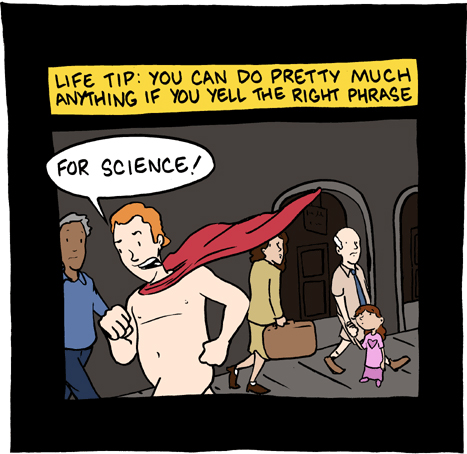
This one made me spit out coffee.
What I particularly like about this cartoon is the fact that I’ve been substituting other words for “science” and seeing if I can get the same desired effect.
In other words, try: “For Social Science!” or “For Canada!”
Doesn’t really work does it? In fact, the only other word I could come up with, where I think you might be able to get away with it, is “For Charity!”
Interesting?

Great quote from astrophysicist Neil deGrasse Tyson. Via chrispiascik.com. Also available as a t-shirt.
I said it before – the scientific method is awesome: but where are the cool visuals for it? You do a Google image search for the term “scientific method” and you’re awash with pretty basic and frankly uncool flowcharts. There’s even a weird acrostic involving slow rabbits, which is kind of funny, but hardly something that exudes awesomeness.
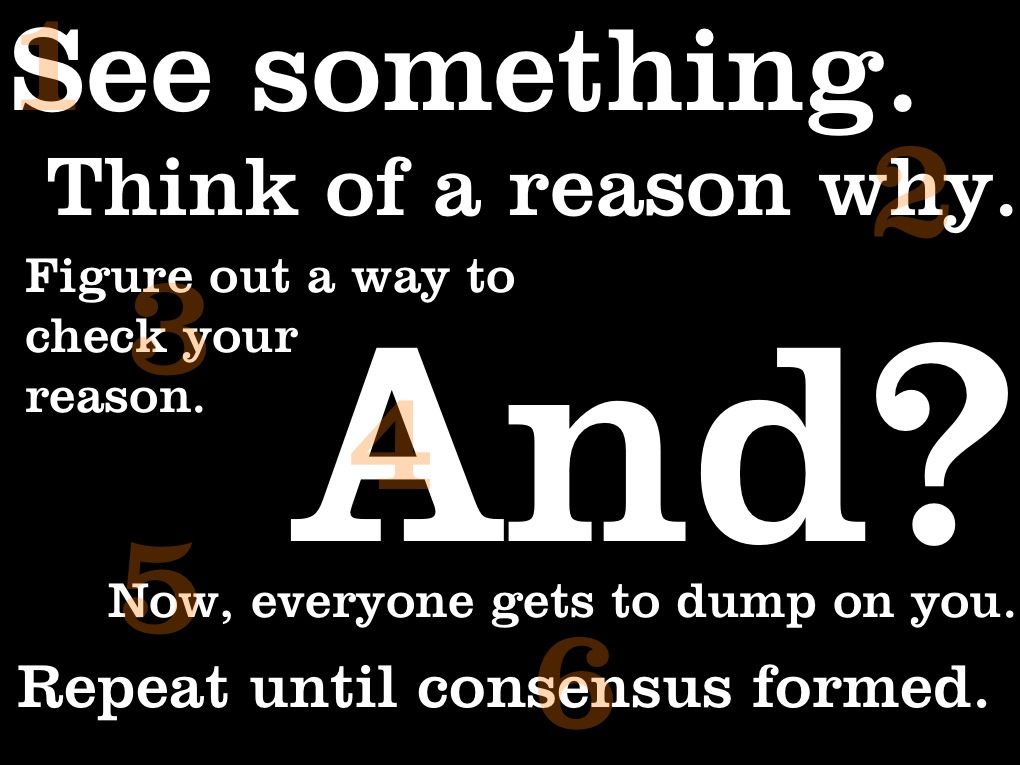
The one below is the one that I’ve made for my lectures, but unfortunately, my artistic talent is pretty much limited to “using a pretty font.”
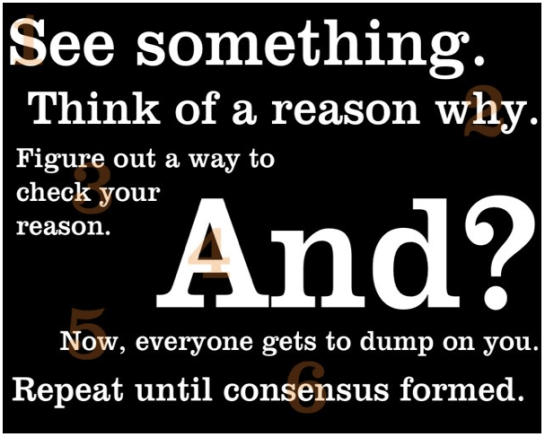
(Large slide img link here)
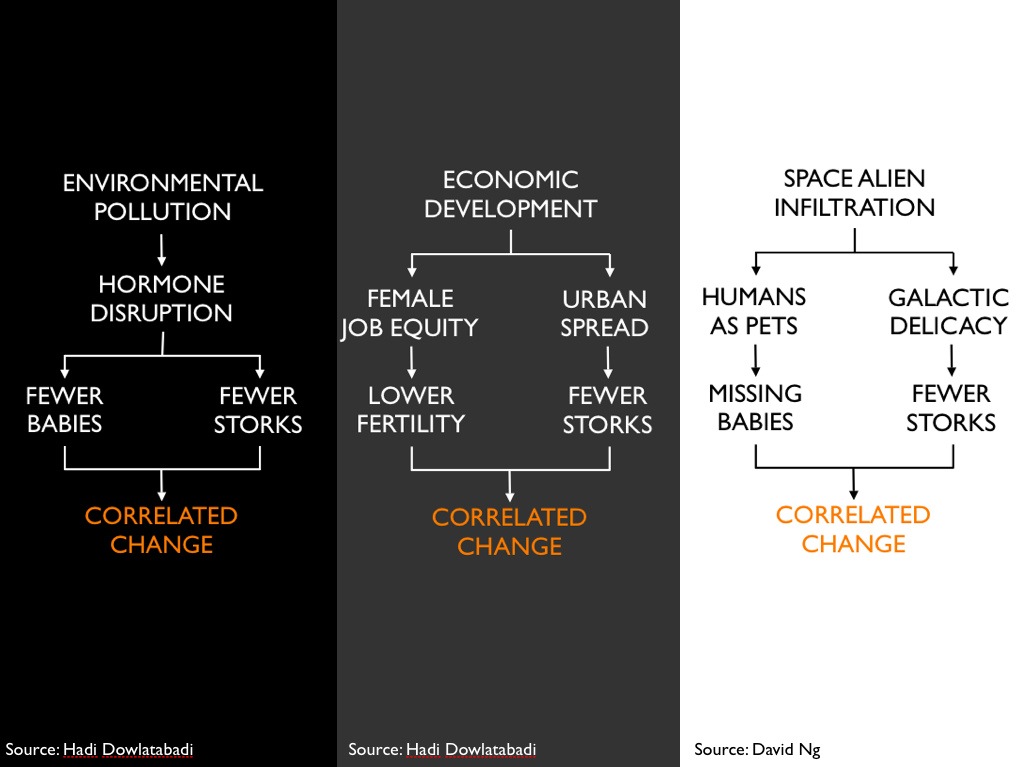
Here’s another I use for making hypotheses, with the scenario being a decline in birth rate and a decline in stork population occurring at the same time. Still, this is just using my other artistic talent which equates to “use the other pretty font you like.”

(Large slide img link here)
Would be wonderful though, if there are some out there that use cool illustrations or just nail it in the visual information department. If you know of any do pass them on in the comments.
(Originally posted at Boingboing.net)



 popperfont.net