This counts as one of the most riveting videos I’ve ever seen #curiosity #watchitnow via @BenLillie
I bet those 7 minutes must have been terrifying. Oh, and science FTW!!!
Via @BenLillie

I bet those 7 minutes must have been terrifying. Oh, and science FTW!!!
Via @BenLillie
“I sat there a long time,” he said, “but no one came.”
These were words that Stephen Hawking uttered upon observing an apparent no show of time travellers to his “time traveler party.” This was held on June 28, 2009, although the event was only advertised after this date (of course). As well, this sort of counts as indirect evidence against time traveling in general…
Via Futility Closet


“Euthanasia Coaster is a hypothetic euthanasia machine in the form of a roller coaster, engineered to humanely – with elegance and euphoria – take the life of a human being. Riding the coaster’s track, the rider is subjected to a series of intensive motion elements that induce various unique experiences: from euphoria to thrill, and from tunnel vision to loss of consciousness, and, eventually, death.”
Proposed details include:
Application:
Euthanasia, execution
Dimensions:
Height: 510 m
Drop lenght: 500 m
Track length: 7544 m
Duration:
Lift: 120 s
Drop: 10 s
Exposure to 10 g: 60 s
Total: 3:20
Features:
Max speed: 100m/s
Inversions: 7
Max g-force: 10 g
Cause of death:
Cerebral hypoxia, lack of oxygen supply to the brain.
Additional effects:
Greyout – loss of color vision;
Tunnel vision – loss of peripheral vision;
Blackout – complete loss of vision;
G-LOC – g-force induced Loss Of Consciousness.
By Julijonas Urbonas, via Thinx
In about a week from now, my lab’s Science Creative Literacy Symposia fieldtrip will begin a new season in earnest. Here, I’ve got a great mix of science grad students, and creative writing MFA’s coming together to design fieldtrips, all in an attempt to highlight the fact that mixing science with creative writing isn’t such a strange thing after all.
The first session will host a Grade 5/6 class, where kids will explore the basic theme of “invisible things.” To do this, the science experiment that has been lined up involves making a DIY cloud chamber – fully capable of picking up contrails from the activity of sub-atomic particles (I know… so awesome!).
I think this is just about the perfect sort of thing to broach the subject of things that are “invisible,” and as a nice touch, I believe the grad students may go about this fieldtrip without giving the kids a heads up on what they might see (i.e. they’re aiming for that wonderful feeling of surprise and elation with discovering something unexpected – “Whoa! What was that!”).
The methodology, itself, can be found in various places on the net, but this here below is a really nicely done YouTube video on the matter, which we’ve used as the basic template.
Still, like a lot of things on YouTube, there are often details that are missing which may actually be quite important. More so, if the intent is to get a class of 11 year olds to make 12 of these things that have to work in a somewhat reliable and safe fashion.
Anyway, apart from a dark room, here are the basic supplies needed:
– – –

– – –
There’s a couple key things that I can point out here. Firstly, the tin foil pie plate is essentially the base that will be made cold (with the dry ice), so as to create a temperature gradient, which in turn is responsible for producing an isopropanol cloud. As such, there’s a few important things it needs:
1. You need isopropanol, which is actually quite easy to get (look for the 99% rubbing alcohol in your local pharmacy). Dry ice on the other hand is sometimes tricky to get (in Canada for instance, there are official rules for its transportation).
2. It needs to be of a colour that allows you to see an isopropanol droplet cloud easily. Most videos seem to suggest something with a black surface, but this isn’t always easy to find, and possibly expensive if you need 12 of them. We’ve tried pie plates that were silver/grey (usually the most common) and red in colour (red was really difficult to observe), but the tin foil variety actually worked really well. This seems partly because it’s able to reflect the incoming flashlight, so that you can control the angle of light (just so) and in a way to best see this cloud.
3. It needs to be deep enough to encase a sufficient enough amount of dry ice, so as to more effectively maintain that cold temperature gradient. Here, we tested plates that were about 1/2 inch deep versus 1 inch deep, and the 1 inch variety worked much better. Presumably, it would also work if you just sat a thin sheet of metal right on top of a dry ice block (we were using pellets).
4. It needs to be of a material that best transfers the coldness of the dry ice to the rest of the chamber. This is why metal is often suggested, but the tin foil was just about perfect here. It’s metal, but it’s also very thin. I noted that the chamber got cold very quickly and reliably.
A second piece of equipment that needs mentioning, is the plastic cup. You can use glass, but the plastic cup works just as beautifully. Don’t forget that it has to be small enough to create a supersaturation situation, and it’s true (as the video suggested), that the smaller it is, the quicker you can see results. If possible, try to get cups without ridges so that there’s no obstructions to the observations.
Anyway, when you put it together, it’ll look a little like this:
– – –
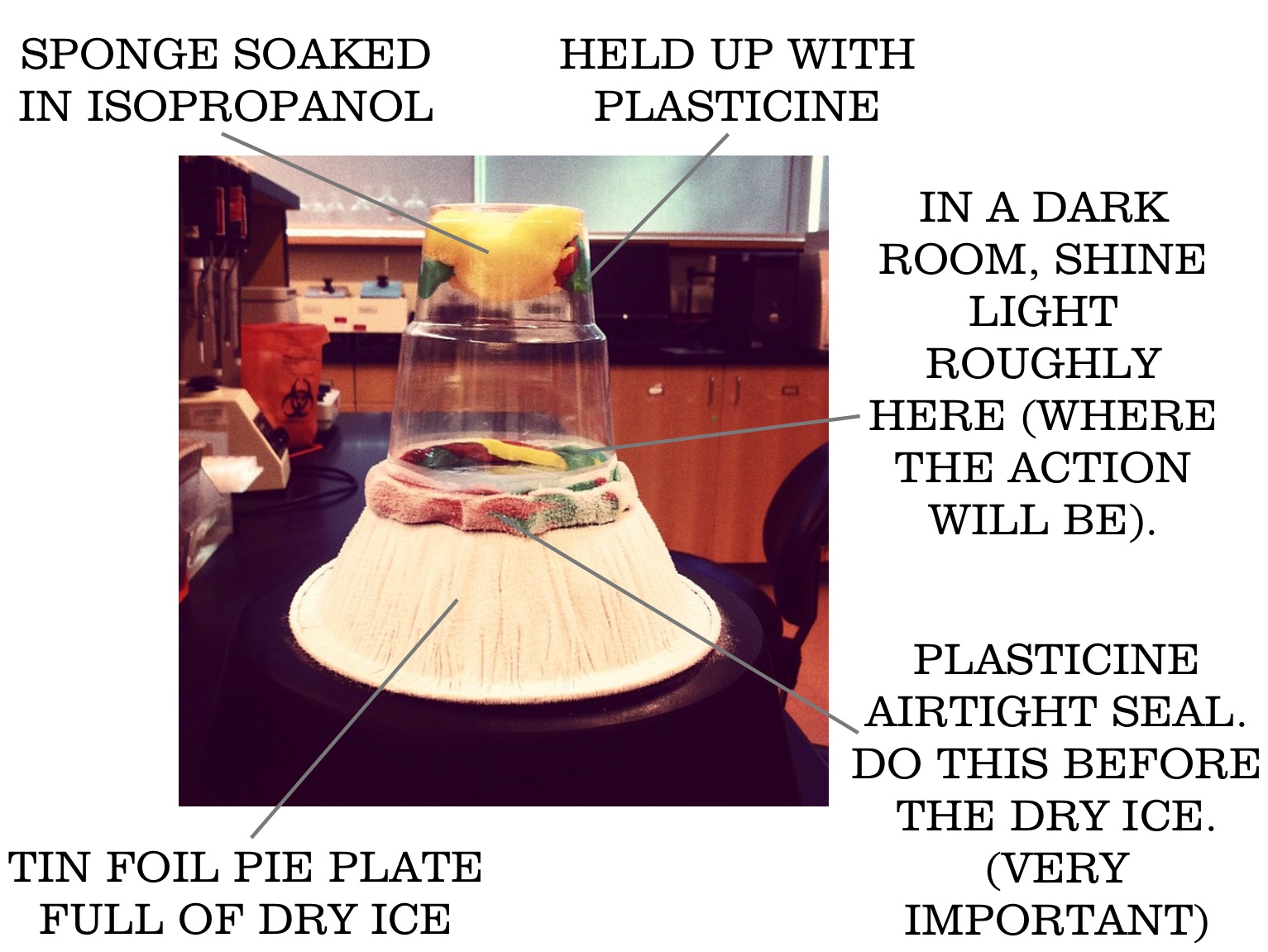
– – –
There’s a few key points here as well:
1. Having enough isopropanol in the system seems to be important. In this set up (with a 250ml cup) there seemed to be a big different in what we saw when there was 10ml versus 15ml of isopropanol in the system: in a nutshell, the 15ml generated a lot more visible activity (might be worth trying 20ml on the day of).
2. Concurrently, this also means you need something capable of absorbing a decent about of the alcohol, so that it’s not drippy. The video mentioned using a piece of felt, but a clipping from a “super absorbent auto sponge” worked much better (it was also a lot easier to anchor to the roof of the cup).
3. This part is IMPORTANT. The seal between the cup (after the sponge and isopropanol steps are done) and the tin foil pie plate must be completely airtight. This is why plasticine is such a great idea! As well, you should do this before any of the cooling steps, since the cooling will simply condensate water onto anything and everything, making surfaces wet and difficult to work with. I suggest putting together the cloud chamber in the following order:
(i) Construct cup + sponge + plasticine + isopropanol + tin foil pie plate” contraption. NOTE: add the isopropanol into the cup (directly on the sponge) immediately before sealing the system with plasticine. This minimizes the amount of isopropanol fumes hitting the air. In the same vein, direct handling of isopropanol is best done by an adult, and in our case, we’ll get the kids to do the sealing but will supply them with gloves (partly as a precaution, and partly because kids just like wearing gloves in a science lab) – full safety details can be found here and here (MSDS) (Thanks Dave).
(ii) Move these contraptions to your dark room (if you’re not already in it – we’ll be using a windowless lecture hall for instance).
(iii) Flip the contraptions upside down, so that the empty pie plate is now on top, AND THEN load the dry ice. (Here, of course, you’ll need to flip the whole thing upright again, so that the sponge is back on top with the dry ice at the bottom encased in the upside down pie plate – we’re going to do this with the base of an ice bucket but some sort of cold resistant matt should also work well). NOTE that dry ice should also be handled by an adult as prolonged contact can cause frostbite – see here for MSDS.
(iv) Then turn the lights off, and use your flashlight to shine a beam of light in such a way as to see that droplet cloud (looks a little like a miniature snow storm), and then, well…, then you wait. You should see something within a few minutes, but it definitely helps to be patient here.
Anyway, I’ll report back after we’ve done this, and let you know how it went with the kids. As a heads up, the creative writing portion will involve writing and acting out mini screenplays – I can’t wait!


Sources: unknown (although presumably a Bat Cave somewhere…)

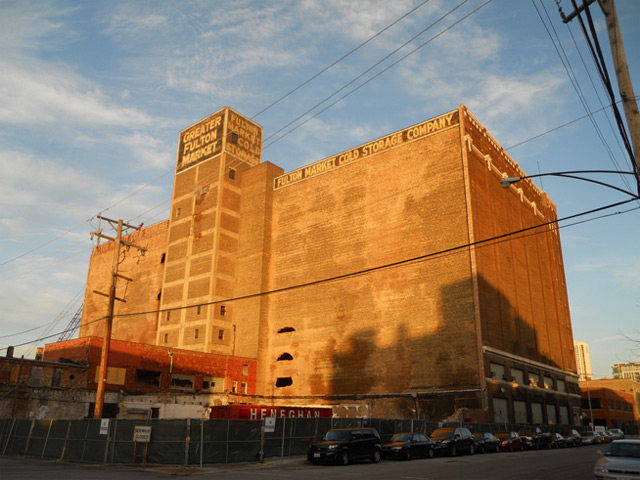


“For nine decades Fulton Market Cold Storage Company operated in Chicago’s meatpacking district with a full ten stories of freezing storage situated close to major railways. […] Architects Hartshorne and Plunkard were hired to help convert the ice-encrusted space into a new, modernized office building and specific with the task of the most epic refrigerator defrost in history.”
By Gary Robert, via Colossal.
– – –
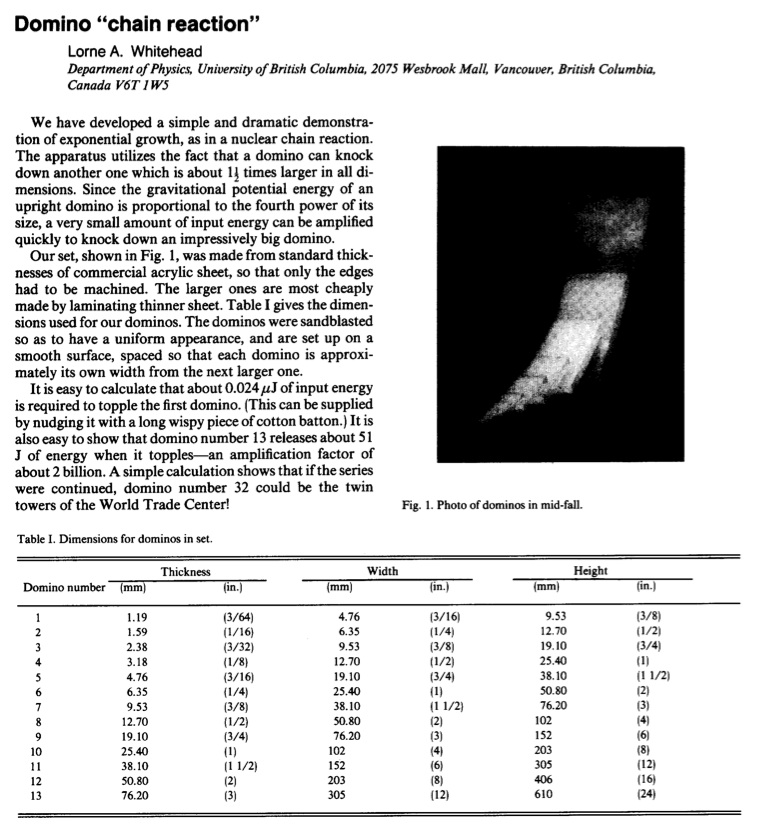
“A domino can knock over another domino about 1.5x larger than itself. A chain of dominos of increasing size makes a kind of mechanical chain reaction that starts with a tiny push and knocks down an impressively large domino.
See http://arxiv.org/abs/physics/0401018 for a sophisticated discussion of the physics.”
First presented by Lorne Whitehead, American Journal of Physics, Vol. 51, page 182 (1983). – pdf

where
N0 = the critical number of guests above which each speaker will try overcome the background noise by raising his voice
K = the average number of guests in each conversational group
a = the average sound absorption coefficient of the room
V = the room’s volume
h = a properly weighted mean free path of a ray of sound
d0 = the conventional minimum distance between speakers
Sm = the minimum signal-to-noise ratio for the listeners
– – –

As derived by William R. MacLean, “On the Acoustics of Cocktail Parties,” Journal of the Acoustical Society of America, January 1959, 79-80 (link | pdf). Text via Futility Closet.
(a.k.a. It’s a New Year, so time to start things up again!)

Illustration from “Our Friend the Atom” (1956 Walt Disney Book by Heinz Haber). Via Fresh Photons
Click image to see full size.
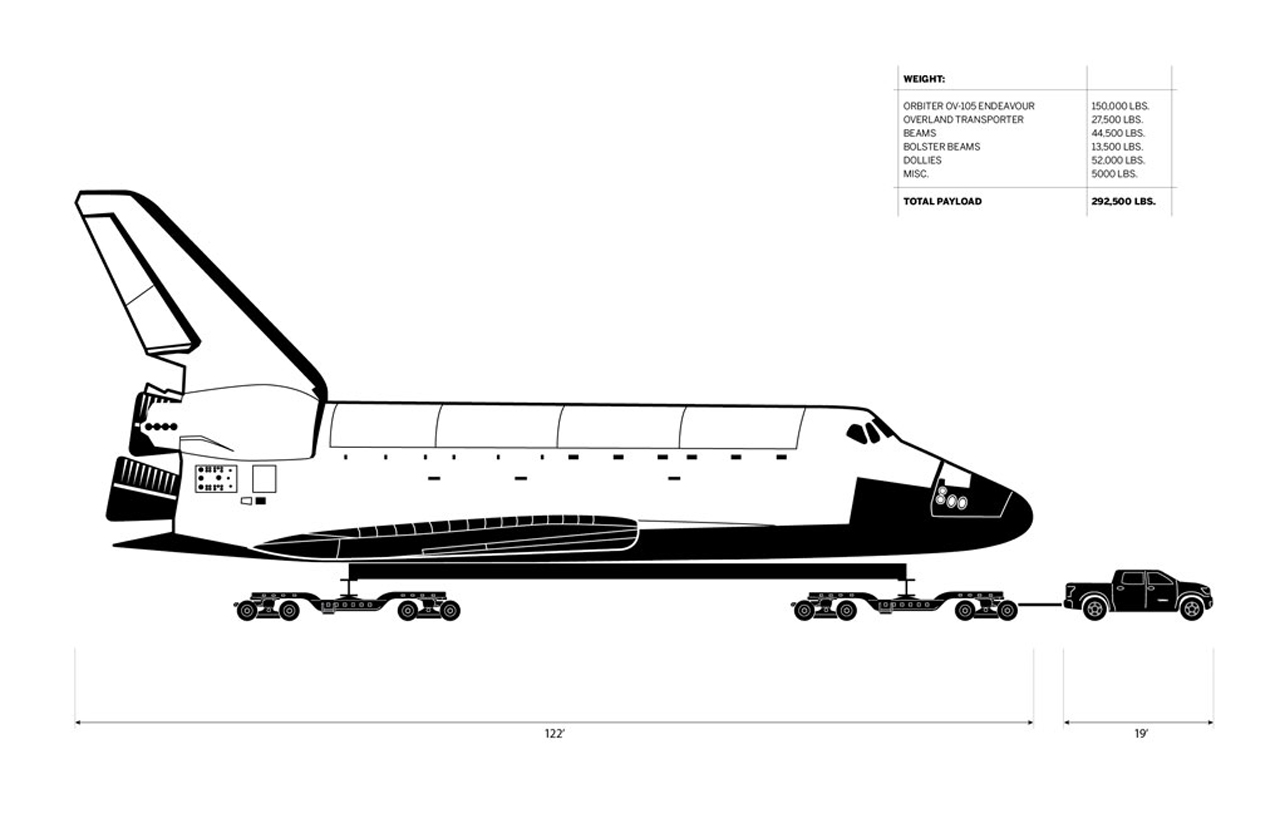
“Endeavour will be towed 12 miles from Los Angeles International Airport to the museum on October 13, and the Tundra will hitch up to the shuttle for the last quarter mile of the trip. The towing rig was made specifically for this event, allowing the full-size Toyota Tundra to pull almost 30 times its regular towing capacity. Toyota says that the truck used to tow Endeavour will be a stock V8 Tundra with no enhancements or modifications.”
From AutoBlog.

CERN
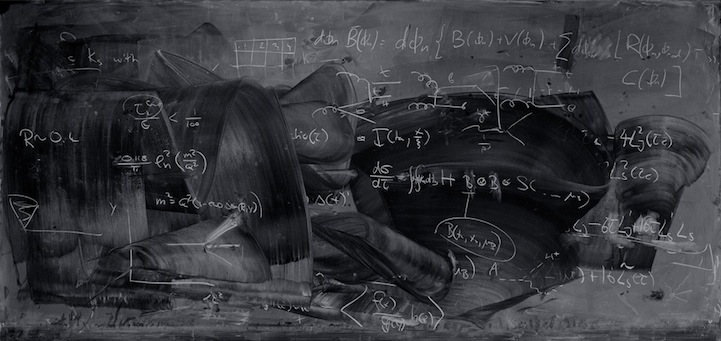
Berkeley
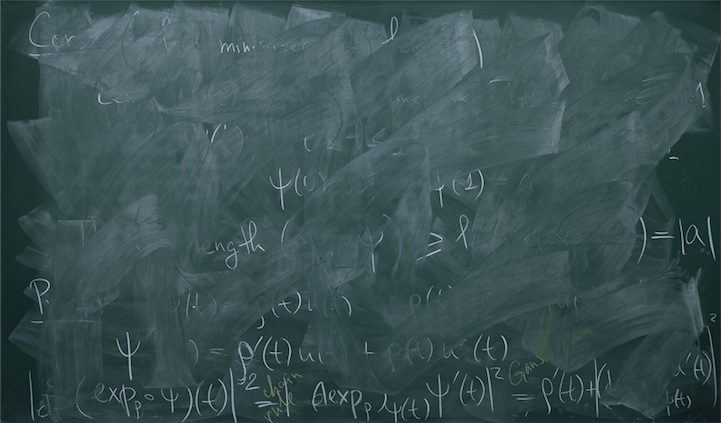
Cambridge

Oxford
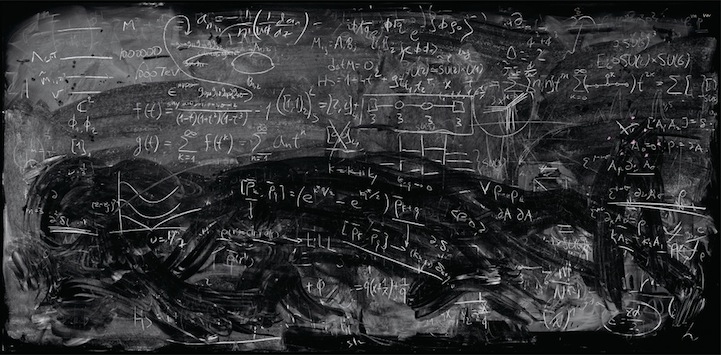
Stanford

Cambridge
“Since 2010, Spanish artist Alejandro Guijarro has been traveling to several Quantum Mechanics institutions across the globe. He photographs their blackboards that are filled with the mathematical scribblings of some of the greatest minds in the world. The photographer walks into each facility’s lecture halls and proceeds to snap shots of the blackboards without modifying the board or interfering with the original arrangement of the space. The ongoing series titled Momentum presents an honest look at the intellectual scrawls, some of which have been wiped away.”
By Alejandro Guijarro. Text by My Modern Met, via Stacy Thinx.
Wow. This is pretty amazing…


“Ink Calendar” make use the timed pace of the ink spreading on the paper to indicate time. The ink is absorbed slowly, and the numbers in the calendar are “printed” daily. One a day, they are filled with ink until the end of the month. A calendar self-updated, which enhances the perception of time passing and not only signaling it.
By Oscar Diaz
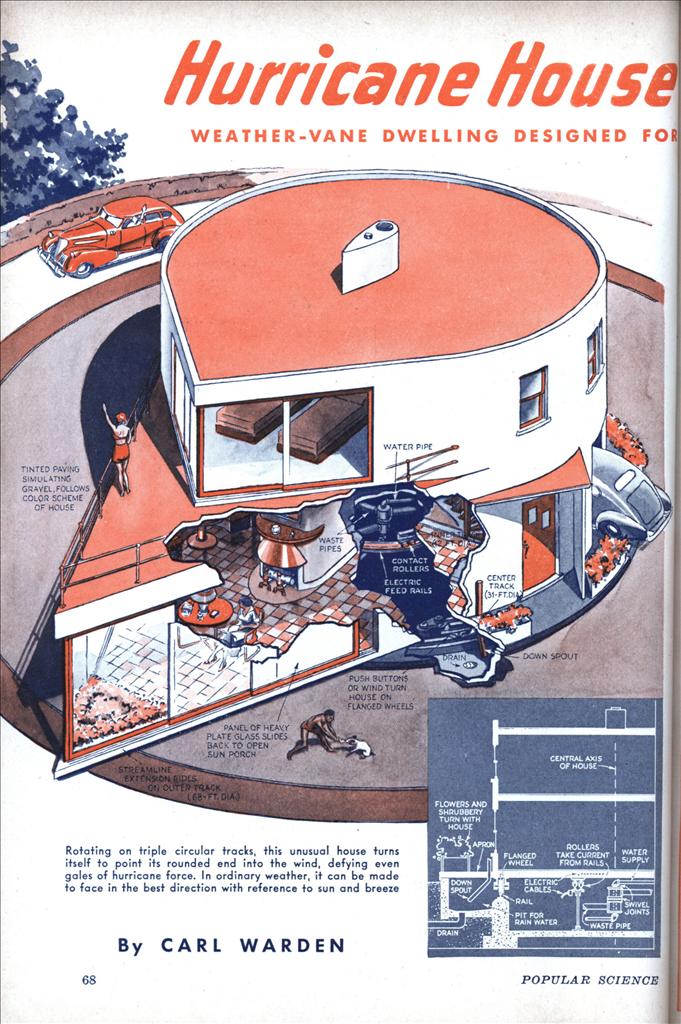
“New York architect Edwin Koch had a brainstorm in 1939 — he proposed a teardrop-shaped “hurricane house” that could rotate like a weather vane. “This amazing dwelling would revolve automatically to face into the oncoming storm, meeting it like the wing of an airplane and passing it smoothly around its curving sides toward its pointed tip,” explained Popular Science.”
Idea from Edwin Koch, text from Futility Closet.

Source unknown. Via Fresh Photons.
Really nicely done.
Via @veritasium.



 popperfont.net