.

Tag: microbiology

Crapbook: social networking via the microbial profile found in your feces

Julian Davies, a colleague of mine at UBC, coined the term “crapbook” in a lecture today. He was talking about a site called “My.Microbe” and, well, I had to check it out.

“The non-profit programme MyMicrobes, launched today, is inviting people to have their gut bacteria sequenced for about €1,500 (US$2,100). Acting as both social network and DNA database, the website offers a place for people to share diet tips, stories and gastrointestinal woes with one another. In exchange, researchers hope to gather a wealth of data about the bacteria living in people’s guts.” (From Nature – link)

Kind of wierd, actually. And expensive too!

(Link to My.Microbe)

San Diego Waves Glow in the Dark

“When jostled, each organism (warmwater phytoplankton Lingulodinium polyedrum) will give off a flash of blue light created by a chemical reaction within the cell. When billions and billions of cells are jostled — say, by a breaking wave — you get a seriously spectacular flash of light. ~Professor Peter J. Franks of the Scripps Institution of Oceanography”

Via Scuttlefish.

Microbiological laboratory hazard of bearded men.

Barbeito, MS; Mathews, CT; Taylor, LA (1967). “Microbiological laboratory hazard of bearded men”. Applied microbiology 15 (4): 899–906. PMID 4963447

“An investigation was conducted to evaluate the hypothesis that a bearded man subjects his family and friends to risk of infection if his beard is contaminated by infectious microorganisms while he is working in a microbiological laboratory. Bearded and unbearded men were tested with Serratia marcescens and Bacillus subtilis var. niger.Contact aerosol transmission from a contaminated beard on a mannequin to a suitable host was evaluated with both Newcastle disease virus and Clostridium botulinum toxin, type A. The experiments showed that beards retained microorganisms and toxin despite washing with soap and water. Although washing reduced the amount of virus or toxin,a sufficient amount remained to produce disease upon contact with a suitable host.”

Pdf of first page of article
Link to journal article

Assorted awesome figures below:

The microbiology of the five second rule.

“The first test involved E. coli bacteria, ceramic tiles, and gummy bears. It was a simple timed test to see if the gummy bears had picked up any bacteria at all after five seconds. They had. But was the relatively short time they’d been exposed to the bacteria a mitigating factor? What if they’d been on the floor an hour? A second series of tests picked up were the first left off. This one used slices of bread on surfaces contaminated with salmonella. Five seconds of exposure left the bread with between 150 and 8,000 bacteria. A minute left them with about ten times as much. So overall, there is value in snatching a piece of food off the floor as quickly as possible. Still, a minute is twelve times as long as five second, while the food had only picked up ten times the bacteria. Clearly there was a rush of bacteria the moment the food hit the floor.”

From io9.com.

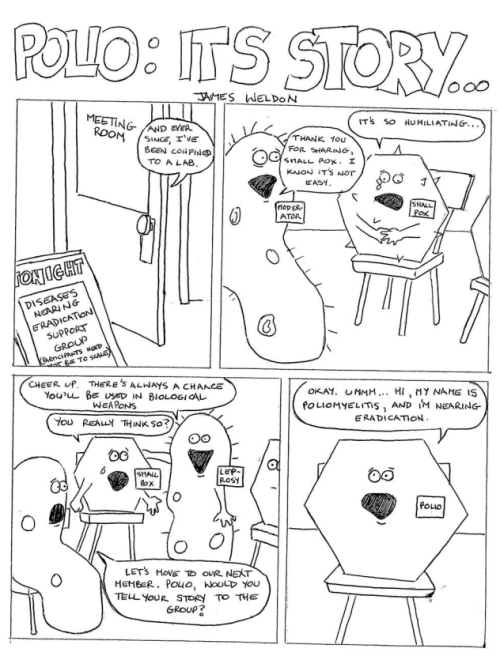
Polio: The Graphic Novella

Normally, I don’t feel sorry for viruses (sic?), but this little comic does cry for a little empathy. Plus, it’s pretty funny…

Read the whole thing at the SCQ.