.

Tag: medicine

Dr. Sara Baker: as interpreted by Kate Beaton #publichealth #funny

Dr. Sara Josephine Baker: look her up. Under her watch the infant mortality rate in New York city went from being one of the worst possible to one of the most enviable, and her ideas on public health and preventative care spread far and wide. She swam against the stream her entire life and she saved thousands of people, what more do you want in a hero?

By Kate Beaton. More on Dr. Baker at wiki.

When Zombies Attack! Math and medicine (and zombies) combine for interesting epidemiology paper.

– – –

Title: WHEN ZOMBIES ATTACK!: MATHEMATICAL MODELLING OF AN OUTBREAK OF ZOMBIE INFECTION

Authors: Philip Munz, Ioan Hudea, Joe Imad, Robert J. Smith.

Reference: Infectious Disease Modelling Research Progress, Chapter 4. Editors: J.M. Tchuenche and C. Chiyaka, pp. 133-150. ISBN 978-1-60741-347-9. c 2009 Nova Science Publishers, Inc.

Abstract: Zombies are a popular figure in pop culture/entertainment and they are usually portrayed as being brought about through an outbreak or epidemic. Consequently, we model a zombie attack, using biological assumptions based on popular zombie movies. We introduce a basic model for zombie infection, determine equilibria and their stability, and illustrate the outcome with numerical solutions. We then refine the model to introduce a latent period of zombification, whereby humans are infected, but not infectious, before becoming undead. We then modify the model to include the effects of possible quarantine or a cure. Finally, we examine the impact of regular, impulsive reductions in the number of zombies and derive conditions under which eradication can occur. We show that only quick, aggressive attacks can stave off the doomsday scenario: the collapse of society as zombies overtake us all.

Link to full paper – here.

Best sperm documentary EVER!


.
Just watch until you get to about a minute and 8 seconds. You won’t regret it.

Via National Geographic (?), hat tip to @sciencecomedian.

Human anatomical cross-sections made with paper. #beautiful

Art by Lisa Nilsson, via thisiscolossal, via Drawn.

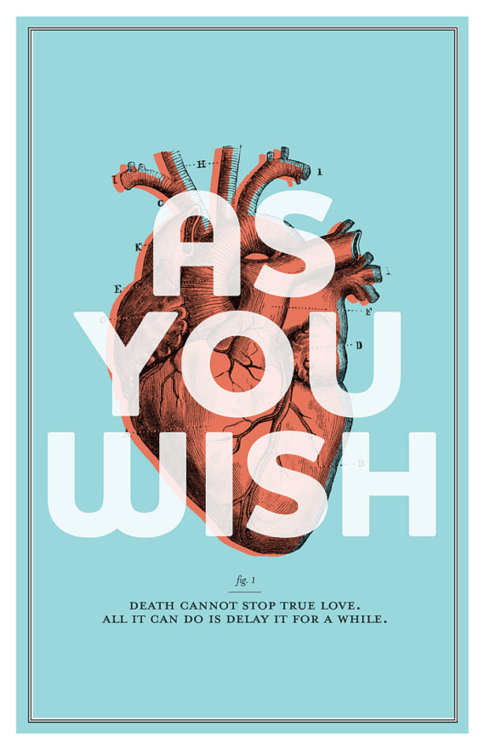
Lovely heart graphic (with cool Princess Bride tie-in)

The Princess Bride illustrated by Amy McAdams and available at etsy.com. (via Hey Oscar Wilde!)

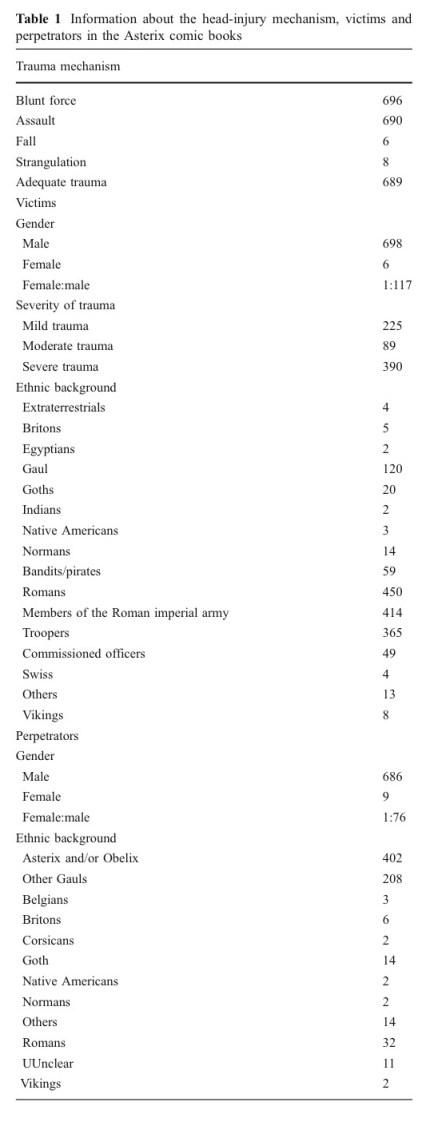
Epidemiology of traumatic head injury in Asterix and Obelix comics.

Title:
Traumatic brain injuries in illustrated literature: experience from a series of over 700 head injuries in the Asterix comic books (pdf of first page)

Reference:
Marcel A. Kamp, Philipp Slotty, Sevgi Sarikaya-Seiwert, Hans-Jakob Steiger and Daniel Hänggi. ACTA NEUROCHIRURGICA. Volume 153, Number 6, 1351-1355, DOI: 10.1007/s00701-011-0993-6

Abstract:
Background
The goal of the present study was to analyze the epidemiology and specific risk factors of traumatic brain injury (TBI) in the Asterix illustrated comic books. Among the illustrated literature, TBI is a predominating injury pattern.

Methods
A retrospective analysis of TBI in all 34 Asterix comic books was performed by examining the initial neurological status and signs of TBI. Clinical data were correlated to information regarding the trauma mechanism, the sociocultural background of victims and offenders, and the circumstances of the traumata, to identify specific risk factors.

Results
Seven hundred and four TBIs were identified. The majority of persons involved were adult and male. The major cause of trauma was assault (98.8%). Traumata were classified to be severe in over 50% (GCS 3–8). Different neurological deficits and signs of basal skull fractures were identified. Although over half of head-injury victims had a severe initial impairment of consciousness, no case of death or permanent neurological deficit was found. The largest group of head-injured characters was constituted by Romans (63.9%), while Gauls caused nearly 90% of the TBIs. A helmet had been worn by 70.5% of victims but had been lost in the vast majority of cases (87.7%). In 83% of cases, TBIs were caused under the influence of a doping agent called “the magic potion”.

Conclusions
Although over half of patients had an initially severe impairment of consciousness after TBI, no permanent deficit could be found. Roman nationality, hypoglossal paresis, lost helmet, and ingestion of the magic potion were significantly correlated with severe initial impairment of consciousness (p ≤ 0.05).

Sample Data:

Scientific journal format on how to make a baby (with a cute face).

From boingboing.net.

Torso complete with internal organs, origami style!

By Horst Kiechle via Flickr.

Bring in the nurse, I’m ready to begin. Love this vintage comic panel!

Via Fresh Photons.

A Scientific Proposal to the Executive Program Directors of the ABC, CBS, Fox, and NBC Networks

By DAVID NG

Dear Sirs,

I know an omen when I see one, and it needn’t even involve a two-headed goat. As a scientist with a background in cancer research, the revelation I’m referring to is a bit of homework I did on the average yearly amount of money spent on programming by your television networks (about $1.5 billion). A number which strangely mirrors the average amount of money given last year to each of the 18 institutes within the National Institutes of Health, an organization that is the U.S.’s backbone of publicly driven medical research. Clearly, this is a call to merge the two enterprises together. So in the interest of public health, and given the pervasiveness of reality TV, I wish to expound to you four possible examples that demonstrate the feasibility of this union.

i. Real Science, Real People:
In the early 90s, studies were conducted whereby a single male mouse was presented with a plethora of different female mice. What was discovered was that the most desirable females had immune system genes that were most distinct from the male suitor. In other words, the female picked had a particular genetic background. Such a mechanism of mate selection would please Darwin since the offspring produced would inadvertently benefit from the most diverse, or most advantageous, immune system. More pressing, however, is the question of whether this decidedly unromantic notion pertains to mate choice in humans? Fortunately, we can now answer this question by asking the participants of programs like The Bachelor or The Bachelorette to provide a blood sample along with their video profile. This way, research can finally circumvent the sticky ethics of conducting such experiments on humans. On the plus side, this research opportunity should also generate its own built-in funding infrastructure as it can be easily applied to beat Vegas odds.

ii. Save Money:
Currently, every drug used for medicinal purposes in the United States needs to navigate through the strict and often precarious guidelines imposed by the Food and Drug Administration. This is an extremely long and expensive process, averaging 15 years and upward of $300 million in financing from discovery to product. Inevitably, most of this arduous process is due to the proper design and delivery of human clinical trials that examine drug efficacy and safety. Why not incorporate these trials into television shows like Fear Factor or Survivor? If contestants are willing to drink the seminal fluids of cattle or eat squirming maggots the size of your thumb, wouldn’t these same individuals revel in an opportunity to eat untested drugs? We could even have a “totally untested” and a safer “well, the mice survived” version of the same contest! In any event, millions of dollars would be saved.

iii. Promote Technology Development:
Medical research is largely driven these days by the ingenious design of equipment that can do new things or do old things better, faster, bigger, cheaper, safer. This to me is an invitation to incorporate medical technology development into reality TV. Why can’t Junkyard Wars showcase a competition to build the fastest DNA sequencer. Or viewers watch an episode of BattleBots that pits equipment used for insulin production. If Extreme Home Makeover can build a whole new environment in seven days, then why can’t you “fix that genetic mutation” in the same seven days. It’s no surprise that ingenuity often percolates under tough situations, and I can think of no tougher than a scenario where contestants only have 48 hours and a $1000 budget to meet their objective.

iv. Fostering Interest in Science Careers:
If we can have programming that features Donald Trump searching for a skilled apprentice, why can’t we use the same template to attract top graduate students. It should be simple enough to invite a feisty Nobel Laureate with an ego big enough to oversee the process. Just think of the entertainment value generated by having a team of young researchers told “Your project is to work together and come up with a cure for cancer in three days. And don’t forget—if you fail, you will meet me in the seminar room where somebody will be fired!” I mean, really—this stuff sells itself!

To conclude, I hope these four simple examples illustrate the opportunity at stake. It would be a great shame to not utilize these two great charges for the benefit of all. Now if we can only get the Food Network on board—maybe an episode of The Iron Chef with two-headed goats as the special ingredient?

Sincerely,
Dr. David Ng

Via Yankee Pot Roast, 2005.

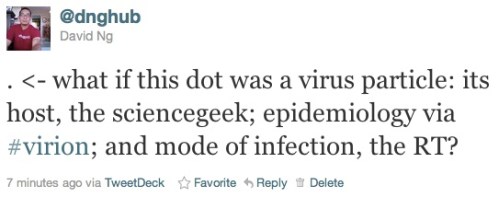
A social media experiment: Can we use twitter to produce an interesting analogy on the subject of viruses?

This may crash and burn, but might also be interesting. Extra coolness, if the tweet mutates somewhere along the line (although it’s also obvious that it would take a lot to reach the necessary “viral load” to see the tweet propagate – maybe instead of a dot, a star would be better?).

Anyway, if it sounds like fun, you can RT by visiting the link of the original tweet.

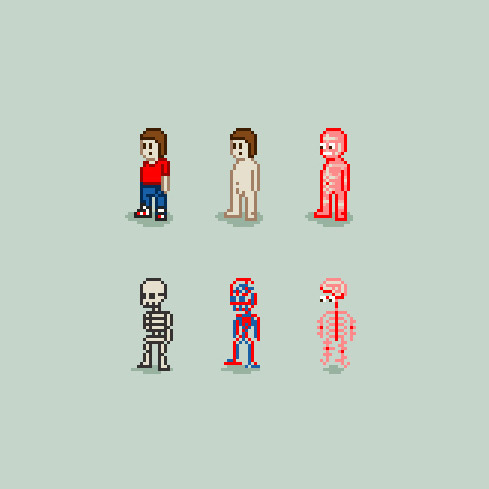
8 Bit Anatomy.

By Diego B. via Hey Oscar Wilde!

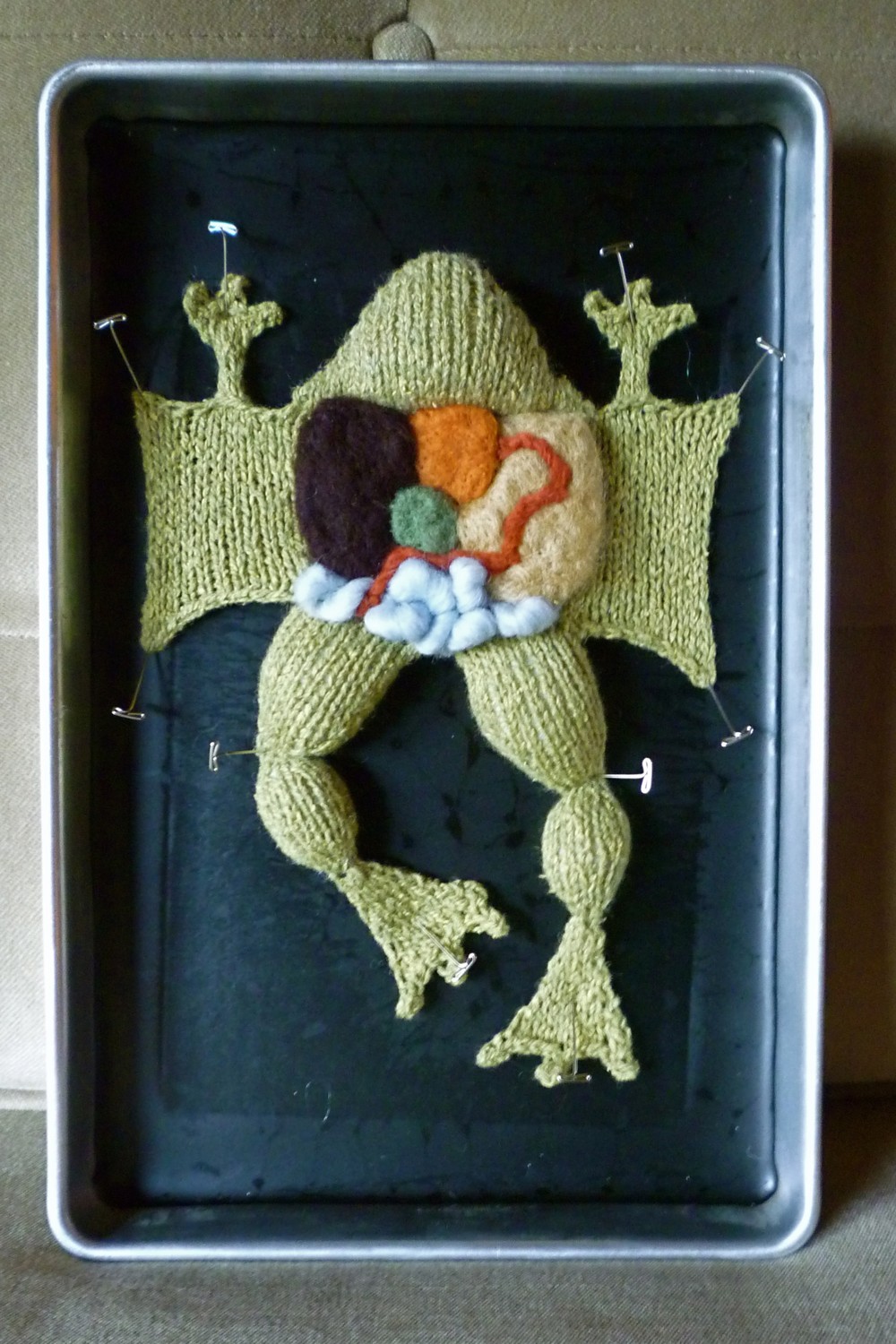
Knitting Anatomy 101 (aliens and frogs!)

First the Alien autopsy. I’m sure this could be used as a slide on the subject of anatomy, surgery, etc.

Then, of course, there is the classic frog dissection.

Best of all, both of these are available as knitting kits. From the talented Emily Stoneking (alien | frog). Via @kpwerker.

The “face” of testicular pain.

“A scrotal ultrasound scan of a patient with a painful inflammatory mass surprisingly revealed a face in the image, which looked like a man experiencing painful stimuli.”

Article abstract (with links to full text paper – if you have access) here.

The N.I.H. rejects Dr. Phil

By DAVID NG

Dear Dr. Phil,

Thank you for submitting your application for the director’s position at the National Institutes of Health. As the N.I.H. is the principal force guiding America’s efforts in medical research, we have strived to consider every candidate’s application seriously.

Our first impression was not a good one. You have a loud and exuberant manner that is an oddity in our network of colleagues, and for the duration of the interview process, you were physically sitting on top of Dr. James Watson (a man considerably smaller than you), oblivious to his muffled and strained murmurs beneath you. We found this quite distracting and wonder what this reflects of your character. Furthermore, although he has only a minor role in the selection process, the Nobel laureate was quite put out. As the conversation continued, we found other characteristics that troubled us. Your commitment to, as you call it, “big ideas,” whilst commendable, seemed a tad impetuous. Your mention of using your television program or perhaps “your good friend” Oprah’s television program to (in your own words) “GIVE FREE GENE THERAPY TO EACH AND EVERY MEMBER OF THE AUDIENCE!” is frankly very unsettling to us.

In truth, we fear that your celebrity status may ultimately impede our principal mandate of excellence in health research. Although some of our members thought it wonderful that you have a Muppet in your likeness on “Sesame Street,” your list of other references (e.g., “I drink scotch with Kelsey Grammer on a regular basis”) hardly elicits confidence. To be blunt, your scientific C.V. is poor and your repeated attempts to demonstrate your scientific prowess were laughable at best. (Adjusting the pH in your hot tub does not count, nor does your vasectomy.)

Finally, we found your tendency to talk in meaningless, corny phrases very irritating. Responses like “Sometimes you just got to give yourself what you wish someone else would give you” or “You’re only lonely if you’re not there for you” are very confusing, to say the least. In fact, our members felt that overall you were even more irritating than the applicant who used the word “testicular” 67 times in his interview. One member of our hiring committee actually wrote the comment “Who the [expletive] is this guy—Foghorn Leghorn doing Yoda?”

Consequently, the hiring committee regrets to inform you that your application has not been shortlisted for further consideration at this time. Please tell Ms. Winfrey to stop bothering us.

Yours sincerely,

Dr. Paul Batley Johnson
Hiring Committee
National Institutes of Health

(One of my older humour pieces – original link here)

Not exactly what to think of this: Growing sphincters in petri dishes.

“Eyes, sperm, you name it: these days, chances are someone’s cooking it up on a little slab of agar and gearing up to graft/sew/implant it in anything that comes near. Today’s body part is the anal sphincter, that handy little ring of muscle that maintains the separation between your insides and your outsides. Researchers grew them from cells, implanted them in mice, and compared the new sphincters’ function with the animals’, ah, native orifices. And apparently, they were quite satisfactory.”

(via Discover)