.

Tag: evolution

Ways Charles Darwin Could Jump the Shark

By DAVID NG

He makes exploitative
prime-time-television cameos

Darwin appears as the “man in need of a haircut” in an episode of Gossip Girl, and is the first contestant voted off Survivor: Galápagos. Eventually makes Barbara Walters’s list of most fascinating people of the year. Cries during interview.

He sells Darwinian fashion accessories

Darwin takes advantage of the current interest in natural fashion products. Begins marketing items like organic-cotton neckties and honey-flavored lip gloss. Darwin-sanctioned “stylish feces beads” appear soon after.

Reviews movies

Darwin becomes a staff writer at Rolling Stone. Is asked to critique animal-related movies. Loses credibility when caught gushing over Catwoman.

Hosts free holiday cruises

Moonlighting as an authority on nature and boats, Darwin takes advantage of free holiday cruises. His cruise talks are very successful and Darwin becomes the No. 1 hit when Googling the words “lido deck.”

Guest-stars on The Dog Whisperer

Memos to the effect of “He sailed on a boat called the Beagle. Isn’t a beagle a dog?” begin to circulate. Capitalizing on this attention, Darwin joins The Dog Whisperer as a dog-anatomy expert. Wins Emmy for segment on comparative dog-tail structure. In acceptance speech, cites the fact that “dog” spelled backward is “god” as evidence of a Christian conspiracy.

Joins the Ice Capades

Darwin is hired for small part in a Lion King–themed ice show. Takes skating lessons and practices hard. Soon nails both the triple axel and the triple lutz. Is fired from the show when he tests positive for performance-enhancing drugs.

Loses his mind

Darwin endorses Scientology.

Dresses up as Santa Claus during holidays

Sporting his full white beard, Darwin is hired to impersonate Santa Claus at the local mall. He initially does well in this job, looking the part, being punctual, amicable, and knowledgeable about reindeer. However, he soon begins to insist on teaching children words like “invertebrate.” He also starts giving out stylish feces beads instead of candy canes. Later, he gets in an argument with another Santa Claus in another mall over biologically sound explanations for Rudolph’s glowing nose. The “Darwin vs. Santa Claus” fistfight goes viral on YouTube.

(Originally published at McSweeney’s for Darwin’s bicentennary)

When dinosaurs adapt (or maybe more of a Voltron dinosaur thing). Either way, it’s awesome.

I love this picture. I also have it as an art card from Carded!

By Tony Cliff, via drawn.ca

Wonders of Evolution: The Newly Discovered “Sporked-Tongued” Lizard of South Eastern England

By Gemma Correll.

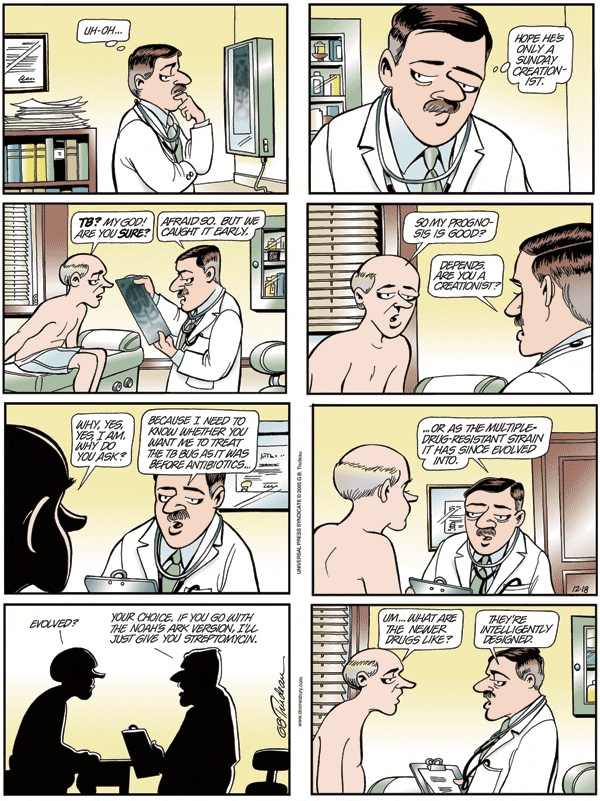
Doonesbury, TB, and creationism.

By Garry Trudeau, Dec 18, 2005.

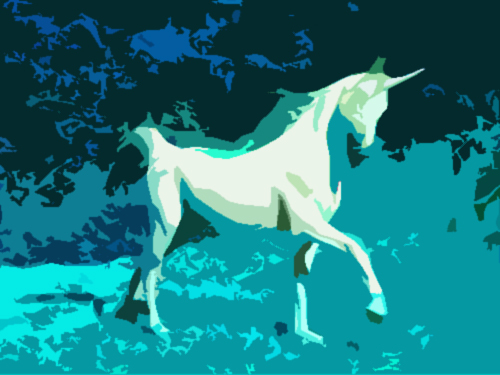
The Evolutionary Biology of the Unicorn.

By DAVID NG

Unicorns are great. Seriously.

And here I’m going to think out loud and think of them in a conventional biology sort of way. You know – have a little fun evolution wise.

In many respects (except for the magical powers bit) I don’t think this is necessarily too hard to do. i.e. you have something that looks like a horse, but hey what’s this – there’s also a horn there.

I guess the question I’m pondering is whether a unicorn could occur from a realistic evolutionary biology point of view – you know, given the right circumstances and the right timescale. And if so, exactly what sort of things, biologically and genetically, would need to happen?

Anyway, here’s a couple options to sift through.

One possible way to get the whole horn thing started on a poor horse is through a condition known as “cutaneous horn” formation. In this situation, you essentially have an abnormal, sometimes cancerous growth, that results in a keratin structure protruding from the skin.

(Here’s a picture of a cutaneous horn – it’s kind of ugly)

“Cutaneous horns usually arise on sun-exposed skin but can occur even in sun-protected areas. The hyperkeratosis that results in horn formation develops over the surface of a hyperproliferative lesion. Most often, this is a benign verruca or seborrheic keratosis; or it could be a premalignant actinic keratosis. A malignancy has been reported at the base of a cutaneous horn in up to 20% of lesions. More than half of all cutaneous horns are benign.Benign lesions associated with cutaneous horns include angiokeratoma, angioma, benign lichenoid keratosis, cutaneous leishmaniasis, dermatofibroma, discoid lupus, infundibular cyst, epidermal nevus, epidermolytic acanthoma, fibroma, granular cell tumor, inverted follicular keratosis, keratotic and micaceous pseudoepitheliomatous balanitis, organoid nevus, prurigo nodularis, pyogenic granuloma, sebaceous adenoma, seborrheic keratosis, trichilemmoma, and verruca vulgaris. Lesions with premalignant or malignant potential that may give rise to cutaneous horns include adenoacanthoma, actinic keratosis, arsenical keratosis, basal cell carcinoma, Bowen’s disease, Kaposi sarcoma, keratoacanthoma, Paget’s disease, renal cell carcinoma, sebaceous carcinoma, solar keratosis, and squamous cell carcinoma.” (From eMedicine)

So you have something producing horn-like features, and whilst not exactly common, is still within the realm of possibility.

However, this possibility of unicorn evolution is kind of weak, because often the base of the “horn” structure is not at all stable, and in fact it looks like these horn structures can often be quite easily removed surgically. As well, this is not really a heritable trait in the usual sense – i.e. normally these structures are formed due to abnormal growth coming from a one cell, possibly mutated from exposure to a some mutagen (the sun is often sited for example). In other words, whilst susceptibility to the abnormal growth is likely genetic, the act of it always occuring on the horses head is less so (or something like that).

In other words, let’s move on.

One thing I can say is that it’s interesting to note that both the horse ((Equus ferus caballus) and the rhino (Rhinocerotidae) both belong to the Perissodactyla order, also often termed the odd-toed ungulates. This suggests that in the grand scheme of things, these two types of creatures are not so far apart. Whilst obviously interbreeding isn’t an option (since the species barrier would presumably be more than sufficient to disallow the formation, as well as the propagation, of hybrids unicorn like rhino-horses), it does present the idea that however the horn formed on the rhino, this could still be in the realm of reality with something like a horse.

Which actually makes all the more sense when you look through a paper published in the Journal of Morphology in 2006, which did CT scanning of rhinoceros’ horns to get a better sense of their anatomy. Here, the suggestion is that the horn of rhinos are markedly different from a horn of, say, a sheep. Specifically:

“The horns of most animals have a bony core covered by a thin sheath of keratin, the same substance as hair and nails. Rhino horns are unique, however, because they are composed entirely of keratin.”

This might fit a little with the “cutaneous horn” angle, but then another observation came about from the CT scans. The lead authors goes on to say that:

“The horns most closely resemble the structure of horses’ hoofs, turtle beaks and cockatoo bills. This might be related to the strength of these materials, although more research is needed in this area.”

And this nugget of information brings up a delicious possibility.

That is – maybe a unicorn could develop initially from a mutation within a hox gene, resulting in a hoof like structure coming out of the animal’s head. And in case, you’re wondering what a hox gene is all about, it’s essentially:

(From wiki) “A group of related genes that specify the anterior-posterior axis and segment identity of metazoan organisms during early embryonic development. These genes are critical for the proper number and placement of embryonic segment structures (such as legs, antennae, and eyes).”

In plain speak, this simply means that the hox family of genes are the grand controllers of body architecture – as in your arms go here, your head here, and this is about right for your big toes.  In other words, for our unicorn, we really just need a mutational event where something meant to be coming out at the limbs is inadvertently coming out of the wrong part of the general body plan.

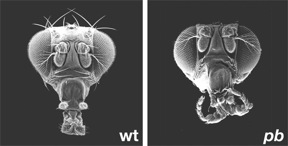
Classic examples of hox mutants occur in fly embryogenesis, and here are two of many examples of mutations that result in something along the lines of a foot/leg like structure coming out of the head area.

This is an image of a fly with a mutated proboscipedia gene: basically the labium develops into a pair of legs (image link)

Here’s another:
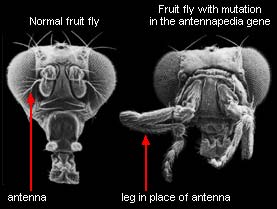
(Image link)

All to say that I’m wondering if the hox idea might actually have some (pardon the pun) legs to it.

Of course, even so, the hox idea would only be part of the story. Natural selection and the whole epic time scale stuff would still need to do its thing. Here, I must admit that I am curious to see what readers would think are the best environmental conditions (serious and funny ones) to produce the right selecting pressures for unicorn morphology. Maybe a few suggestions in the comments section would be cool?

And what about those magical powers? Well, how about we let the Intelligent Design folks debate over that one…

We’re cousins? Well that’s kind of gross… #evolution

By Pencils At Dawn.

“Pilot Evolution” the cartoon. #awesome

From Boolab.

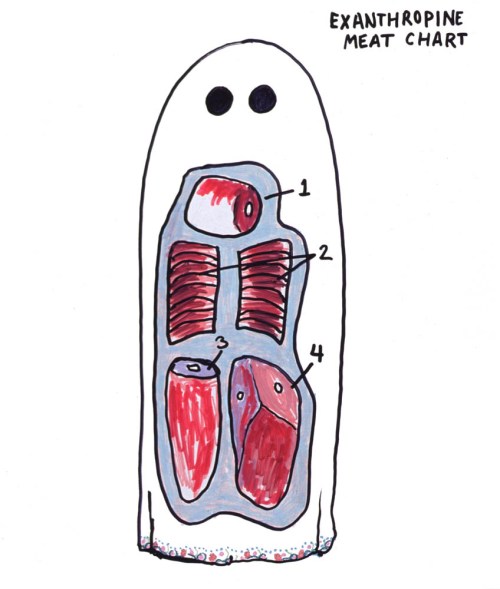
Anatomical meat charts of fantastical organisms

I can see this as useful for slides on general anatomy or maybe even comparitive physiology.

By Nathan Shafer.

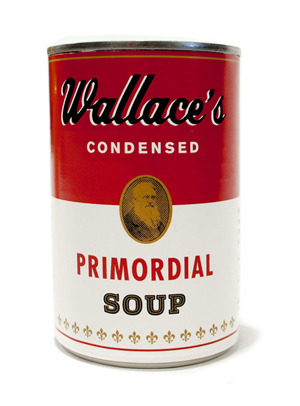
Wallace’s Condensed Primordial Soup – no artificial life, no MSG added, no cholesterol and no regrets.

Wallace’s Condensed Primordial Soup is made from Earth-grown organic ooze and a special blend of prebiotic compounds. For four billion years Wallace’s recipe has remained the same with hundreds of amino acids, no artificial life, no MSG added, no cholesterol and no regrets. Later life forms love it!

For sale and via 826DC. Note that Wallace is in reference to Alfred Russel Wallace.

You know it’s a good morning when you get science geek toast for breakfast.

Toast by Tibi Tibi Neuspiel, via Magic Pony Shop. Hat tip to Fresh Photons.

Is it really so difficult to believe we came out from the sea millions and millions of years ago?

“With all the recent, fiery controversy between evolution, creationism, intelligent design, science, religion, the political left, right, etc., I thought it might be provocative to throw my visual two-cents into the ring. The images beg the question, is it really so difficult to believe we came out from the sea millions and millions of years ago?”

By Ted Sabarese, via behance.net.

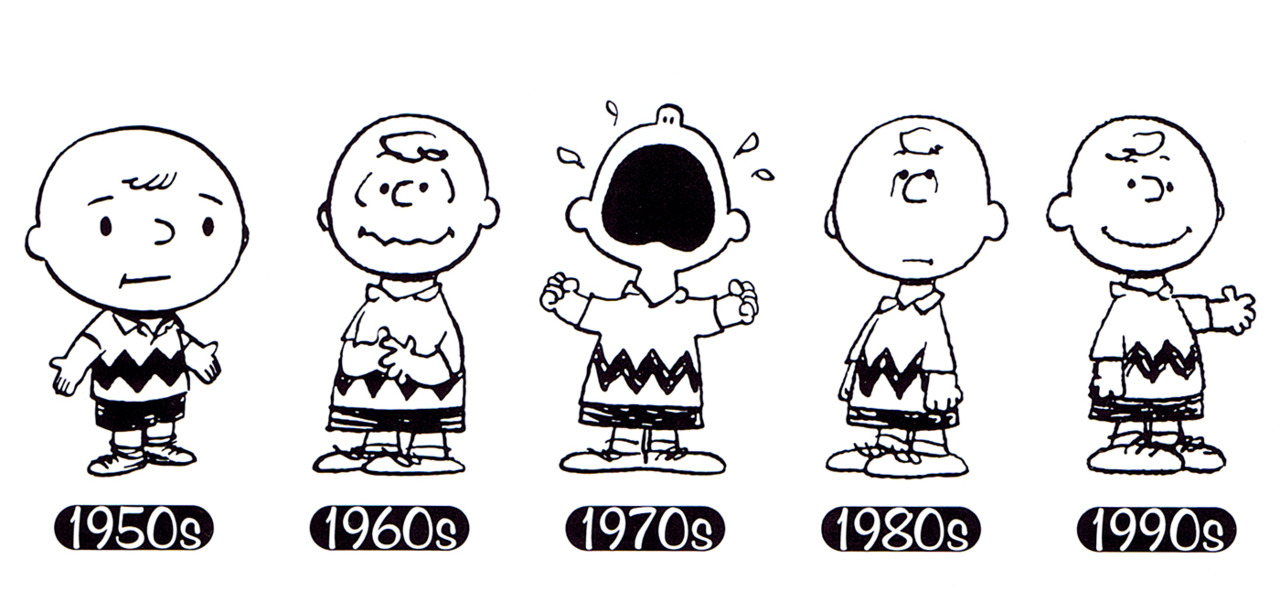
Rapid mutations in the 1950s? The evolution of Charlie Brown.

But what exactly was responsible for this drastic change? Maybe there’s evidence out there for a punctuated equilibrium effect?

Illustrated by Charles Schulz, scanned from The Peanuts Collection (Little, Brown and Company, 2010), via Hey Oscar Wilde!

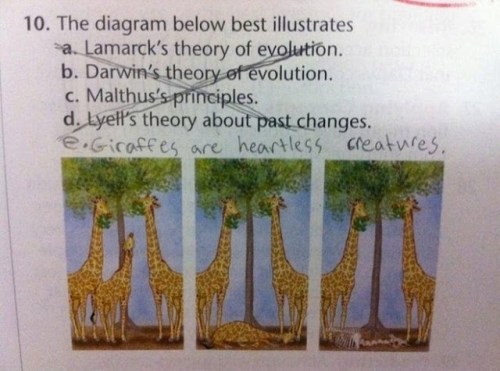
Evolutionary biology meets nasty mean giraffes.

Via tumblr tag science. Original source unknown.

An Intelligent Designer on the Cow

By DAVID NG

Today, I feel like doing a plant – no, an animal. Yes, today, I am going to make an animal. And it will be a masterpiece. I shall call it the…. No wait! Maybe I should think of the name later. Yes, you should always name your pieces after you have completed them. Better that way.

OK then. An animal it is. More specifically, a vertebrate. Large body, four legs, one tail, one head, usual stuff on the head – i.e., let’s just follow the standard animalia rubric. Nothing exciting there. Not yet anyway. So let’s give it an armored tail, with poisonous tendrils and a stink that can kill. Oooh, I like that – but maybe it’s too much. Why such a fancy tail? Maybe the tendrils can come out of its nostrils (note to self: Have I designed nostrils yet?). And the stink can come from the body itself.

But it doesn’t quite feel right. Feels forced. No matter, I suppose I can simply start over. Besides, I did the poisonous tendrils last week. But keep the stink? Yes, let’s keep that.

I know. How about we give it three, no eleven, no four stomachs! Four stomachs! For the efficient eating, of the grass. I am truly inspired! Don’t stop there. How’s this? This animal should urinate milk. From its groin, no less. From little appendages which I will humbly call teats that collectively, communally, reside on a mound of tissue I will call a brother.

Now I am on a roll. Milk will flow from the teats of this animal’s brother.

No wait, I cannot call it a brother. This animal has no lips – don’t want it to have lips – too common a thing for a masterpiece. Seen that, done that, yesterday’s news. But you can’t say the word “brother” without lips. Poor animal, that would be cruel. Instead, let’s call it an udder. Yes, an udder – that’s much better.

Now, of course, I need to work in a clown somehow. I love clowns. In truth, clowns are my all-time favorite design. How will I do this? Perhaps give the animal a raucous and overt sense of humor? Make it wear funny shoes? Make it scare the shit out of young children? No, not subtle enough – I want this animal to be so much deeper than that.

What if, and I’m just saying things as they come to me, this animal-can-be-ground-and-shaped-into-a-meat-patty- which-can-be-mass-produced-and-fried-on-heating-elements, and-then-sold-by-a-corporate-entity-bent-on-feeding-the-obesity-line-to-young-children -by-using-as-their-public-representation-and-symbol, a-clown, whom-we-shall-call-Jesus (no-wait,-let’s-save-that-one-for-later), whom-we-shall-call-Ronald-McDonald, and-these-meat-patties, which-will-be-inexplicably-and-mysteriously-called-hamburgers -after-a-completely-different-animal-I-haven’t-created-yet, will-also-be-considered-sacrilegious-by-fully-one-sixth-of-the-world’s-population, and-oh-oh-why-is-it-that-the-numbers-0157-cry-out-to-me? because-OH-MY-GOODNESS-I-can’t-believe-it, but-this-stuff-is-just-so-brilliant!

Take a breath. WHheeeew-hooooooo. Calm down. That’s pretty good. But maybe just think about some of the simple things now. Like color. Yes, color is good. And easy – let’s go with the rustic look, plus spots. Et voilà. We have finished yet another creation, which for some reason, I feel inclined to call a cow. Hold on, one last thing. It shall go “moo” when it speaks. Yes, that’s a nice touch, even if I do say so myself. People are sure to talk about that one, maybe even create a song or two.

Originally published at Inkling Magazine.

Evolution of a (certain corporate) mouse.

By William Stout and Jim Steinmeyer, via Fresh Photons, via Jimmy Tyler.

What if Smurfs were real? Presumably the systematic biology folks would have some words.

What if Smurfs were real? The Smurf is actually the result of a symbiotic relationship between two organisms. We believe that Smurfs put their ’embryos’ in the button of a developing mushroom. From a distance, Smurfs seem like they are wearing a hat and pants but as you can see this is a fallacy. The fungus provides camouflage and protective epidermal layers for the creature, while the creature provides nutrients and mobility for the spreading of spores.

Via Nate Ethallinan.

Words I See When I Read The Phrase “Intelligent Design” While Squinting

By DAVID NG

Interior Design

Bullshit

– – –
(Originally published at McSweeney’s)