Minimalist Zoo.

Beautifully done by Carlos Díaz, via flickr.com and Hey Oscar Wilde.

Beautifully done by Carlos Díaz, via flickr.com and Hey Oscar Wilde.

.
Since submarines began roaming the depths in World War I, sailors and oceanographers, who use sonar technology to map seafloor topography and identify ocean life, have regularly run into “acoustic ghosts”—inexplicable bodies of movable mass that sometimes rivaled the size of a city—writes ocean engineering professor Nicholas Makris in IEEE Spectrum(Aug. 2011). Affectionately called UFOs (unidentified floating objects), these sonar readings were blamed on factors as various as deep-ocean mountains and changes in water temperature. Every time a theory emerged to explain the phenomenon, however, it was quickly shot down.
In 2003 Makris and fellow scientists aboard a research vessel just south of Long Island, New York, discovered that the UFOs were composed of hundreds of millions of fish—massive gatherings on a scale never before documented.
Image by Wayne Levin. Article at UTNE.

Specifically, this stuff by Chris Sasaki. Chris if you’re reading, check out the Phylo project – a Pixar-ish deck would be very very cool.

Brilliant image by Andrew Shek!
By DAVID NG
(I always thought that this piece would have been great as a pictorial. First published at McSweeney’s)
– – –
1.
Hydrochloric-Acid-Filled Piñatas
Good: Have the sturdy construction required to ensure no unintended leakage of contents.
Bad: Possible severe burning. Brings the party down.
2.
Endangered-Animal Piñatas
Good: Kids love animals. High potential for very cute-looking piñatas, like baby seals, for instance.
Bad: Beating with a stick sort of sends the wrong message.
3.
Particle-Accelerator Piñatas
Good: Built full-scale and often several miles in dimension. Therefore, young children find them easy to hit.
Bad: Each one worth several billion dollars. Parents generally not keen on damaging them.
4.
Smallpox (Variola major) Piñatas
Good: Cool virus shape.
Bad: Highly contagious and high mortality rate. Would also bring party down—as well as everyone else within a 100-mile radius.
5.
Infinity-Symbol Piñatas
Good: Possibly a way to address the often reported decline of mathematics education.
Bad: Thinking about infinity makes my head hurt. Now imagine having to explain it to a child over and over again.
6.
Piñatas in the Shape of the USA and Filled
With the Greenhouse Gas Carbon Dioxide
Good: Sort of works as a metaphor for the United States’ role in the global-warming crisis.
Bad: Unfortunately, the irony would be totally wasted on a 5-year-old.
.
This video is amazing… Come on people, do the right thing…
Shark Song by Whitehouse Content, via @DrMRFrancis.

By Isaac Fresia in Halifax. Via wwf.tumblr.com.
“As we express our gratitude, we must never forget that the highest appreciation is not to utter words, but to live by them.”
-John Fitzgerald Kennedy
.

This is specifically an Oriental Poppy (Papaver orientale). Image by David J. Bookbinder.
First the Alien autopsy. I’m sure this could be used as a slide on the subject of anatomy, surgery, etc.

Then, of course, there is the classic frog dissection.
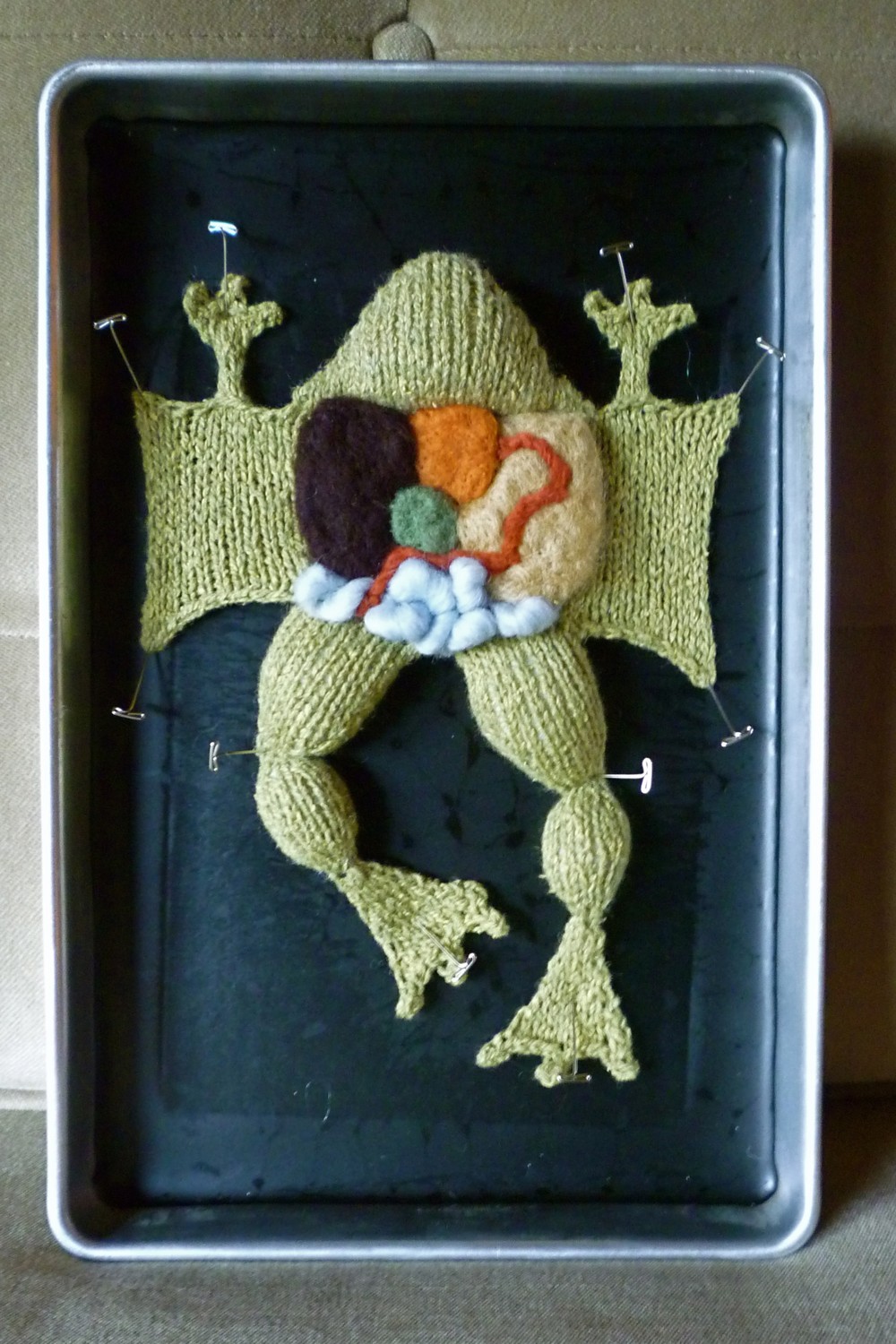
Best of all, both of these are available as knitting kits. From the talented Emily Stoneking (alien | frog). Via @kpwerker.





 popperfont.net