
.


February 25, 2014
Heading to #scio14: a short to-do list.

Things have been pretty busy of late, but I’m looking forward to heading out to my third Science Online (or Science Online Together) conference. Like last year, there are a few things on my “to do” list.
If you aren’t already aware, this conference represents one of the best places to network and mingle with like minded science communication, education folks – more so if you have a mind on exploring new projects and new collaborations. As a personal example, my discussions with folks last year, led to a variety of new projects, most notably this one (on gaming) and this big one (on impressions around science and creativity). Furthermore, it has led to a number of great new contacts, many of which I now consider colleagues and friends.
Anyway, without further ado. Here’s my “to do” list below, and do say hello even if the below doesn’t strike your fancy. I’m always game to geek it up!
 Most pressing of my duties is prepping for my “What is Science Literacy?” session. This will be held on Thursday at 12pm in room 2B. (sched link | forum link | #scioscilit).
In brief, the description reads:
This session aims to explore “scientific literacy,” and how this concept can inform science communication efforts. It atempts to address the challenges that come with a term that inherently sounds vague. Part of this is due to the concept itself being always in a state of relentless change – which has a lot to do with differing opinions from academics and on-the-ground experts; as well as the current information ecosystem, with its media challenges, a shifting science culture, and also (unfortunately) because of the subversive activities from the likes of L.P.W.L.T.B.L.’s (loud people who like to be loud), P.W.S.P.O.M.I.’s (people with strong political or monetary interests), and of course, the D.C.D.s (dangerously clueless douchebags). In all, I’m hoping the session will provide a guided outlet for folks to share their opinions and expertise on this topic, and whether such techniques are useful (or not) in a variety of settings (i.e. journalism, education, PR, advocacy, policy).
General plan goes as follows…
12:05 – 12:10
Short introduction by way of Petcha Kutcha (Yes! this forces me to only spend about 6 minutes on the intro) format. This will essentially be a rapid fire overview of some of the most commonly discussed themes when considering what it means to be scientifically literate (with reference to the secret keyword: “unicorn”).
Note that generally speaking, this usually defers to three areas: (1) knowledge of the scientific process, (2) context driven knowledge of a subset of scientific/technical facts (see session 3D); and (3) appreciation of science culture and how it interacts with other cultural perspectives (see session 2D, 3A, 5D).
12:10 – 12:55
Which begs a number of interesting questions that hopefully the audience will engage in (I’ve also tried to link to other sessions that would broach similar themes):
1. As a science communicator, journalist, educator – do you see merit in framing your translation of a science story by way of “increasing scientific literacy?” (Yes – go to 2) (No – go to 3)
2. If you do see merit in this mode of thinking (and even practice it), is there a sweet spot of content delivery that you find works well? (see session 7D, 9F) In the same vein, what are the inherent challenges associated with finding or being able to deliver this sweet spot (see session 4D). For instance, as it pertains to general media constraints. (Go to 2A)
2A. Is there a particular area of scientific literacy that is missing in general science public discourse? Why is this? How problematic (from, say a civics point of view) is this? Is there a way to circumvent this? (see session 2A, 3G, 4G)
3. If you don’t communicate science with a strategic view to “increase scientific literacy”, why not? What might be the detrimental effects of overanalyzing this facet of science content delivery? When is it a useful framework, and when is it unnecessary?
4. How does the literature in PUS (public understanding of science – hands down worse acronym EVER by the way) help you become a better communicator? Or does it even (i.e. PUS* thinking shouldn’t always win)? How does it compare to other tactical devices (for instance psychology of motivation. See session 4E). Are there defined metrics (possibly adapted from PUS* work) that allow analysis of the utility in different scientific communication methods? (see sessions 6A, 7A)
5. At what point does considering scientific literacy become a stepping stone towards science advocacy? Is this a bad thing? Or, in other words, is it for everyone? Should it be for everyone?
12:55 – 1:00
Wrapping up…
(* told you it is the worst academic acronym ever).
I’ve also prepared a questionnaire form for folks to fill out (if they so desire). This is to see if we can capture additional, and possibly more thought out responses to the questions brought up in the session. As a bit of a bait, I’m offering some geeky science game cards as prizes for those who participate (and note, you can fill this out before, after, and even in lieu of attending the session). Click here for more details and to go to the questionnaire!
 Have any of you heard of the AWESOME FOUNDATION? This is essentially an ad hoc funding agency, that usually exists city by city. The basic premise is to find 10 folks who can each contribute $1000 towards a central pot of funding. This money (a total of $10000), in turn, is then used to provide small grants to fund small projects (where a project application generally needs $1000) – this, of course, is all deliberated by the 10 individuals involved.
I always thought it would be cool to set up a SCIENCE IS AWESOME FOUNDATION where we can do the same thing but with an emphasis on funding science outreach projects. Anyway, my lab is game to be one of the 10 involved – I might see if there’s general interest in this fun idea within the larger #scio14 community.
 And last but not least… I’m always on the hunt for artistic types to get involved with the Phylo project, as well as natural history museums types that think their institution may want a go at a Phylo deck! Give me a shout if you want to learn more. (see http://phylogame.org)
February 25, 2014
When you’re upset, think of a T. Rex making a bed…

Via everywhere on the internet…
February 24, 2014
This: with the science. How to Make a Hairless Wookiee.

And in case, you’re wondering what a hairless wookiee looks like…

Full details (including full text and/or pdf of the scientific paper) can be found at The Science Creative Quarterly.



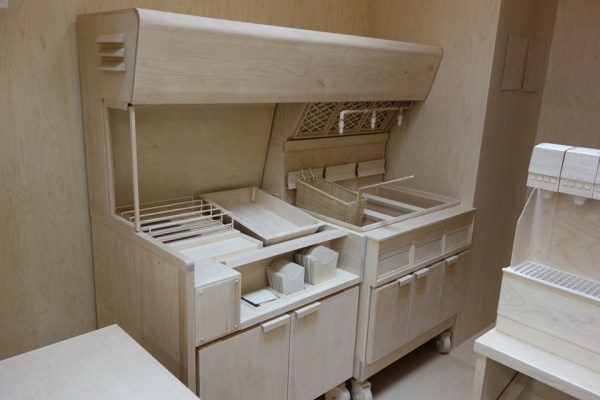
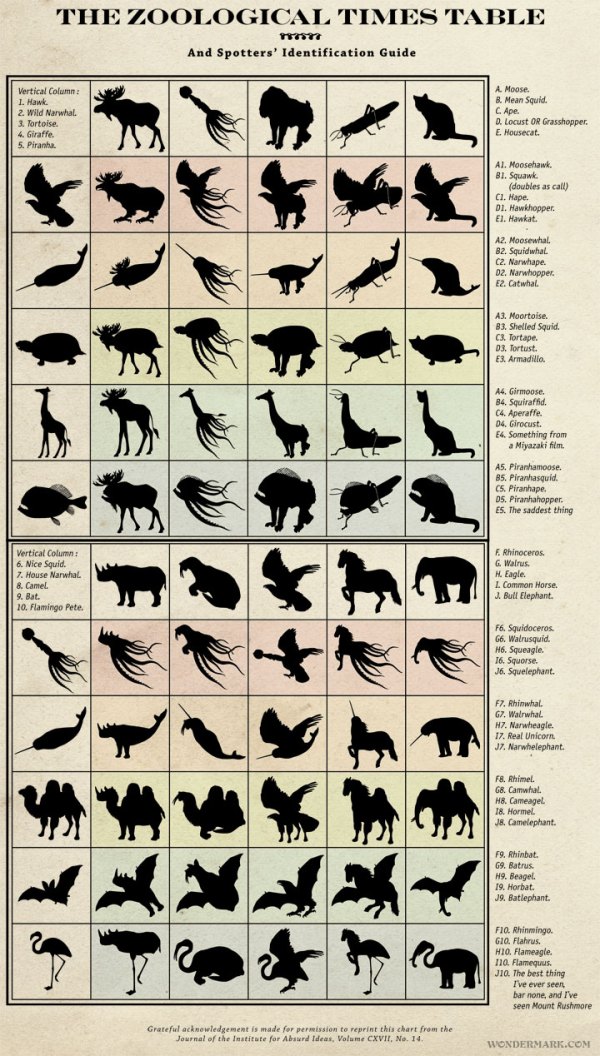

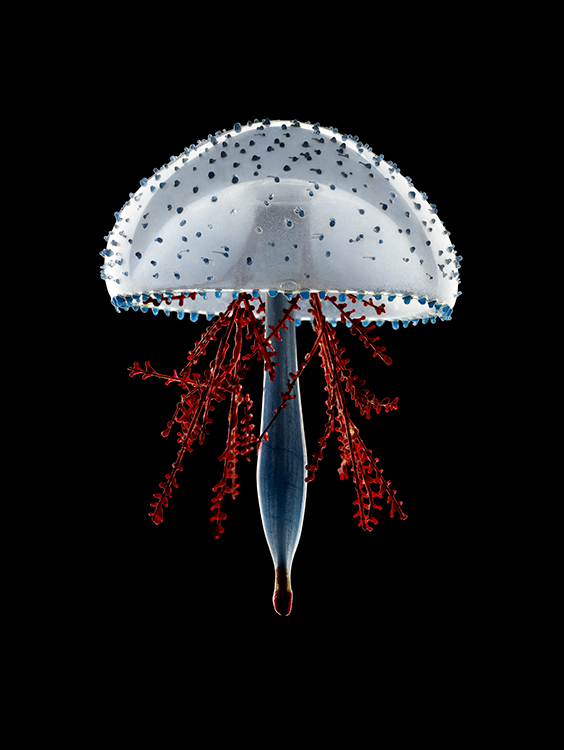


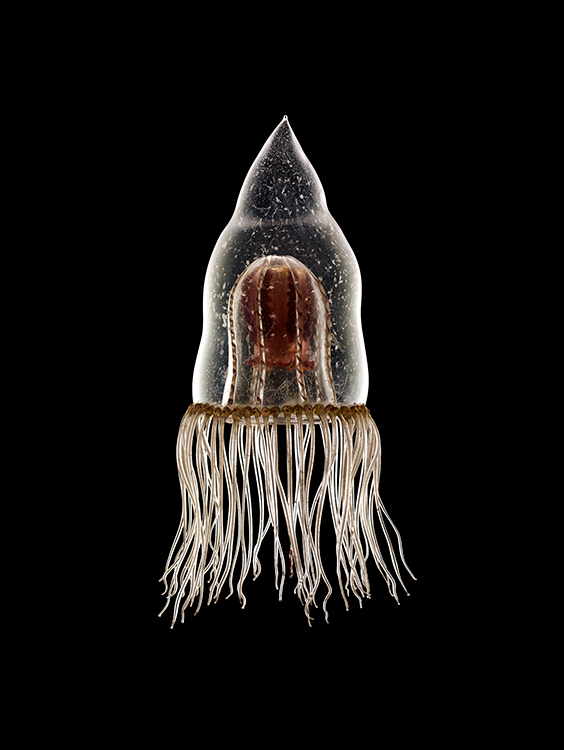


February 1, 2014
First scientifically authentic (albeit fabricated) paper on #wookiee genetics. #chewbaccaFTW
In which we compare the common Wookiee with a newly discovered cave dwelling (pseudo albino) Wookiee species, and note a number of interesting gene expression differences.

From the Journal of Praetachoral Mechanics/Science Creative Quarterly. Link to full text and full pdf article here.
February 1, 2014
Pixies – Dig For Fire #classic #song4mixtape
Heading to a Pixies concert in a few weeks, and reliving some (good) memories.
By the Pixies.
January 30, 2014
January 30, 2014
Some people think scientists exclaim “EUREKA,” but… #truth #funny (by @Twisteddoodles)
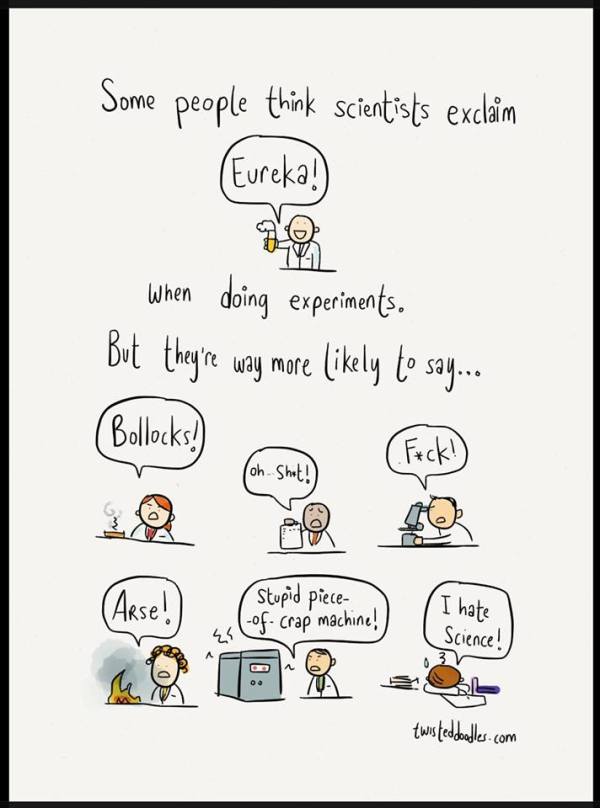
By twisteddoodles, available for purchase here.


January 29, 2014
I suspect the I.P.C.C. report might be more effective if it went with acronyms that were more narrative in nature.
By DAVID NG
The IPCC report1
The STWBTIPCCFARCC2013TPSB report2
The OWCGWIPCCFR report3
The YIACCAYII report4
The OKSILTRIWSHAGTATTSAAEOTSOCC report5
The BTESCCIRINAGTAAIPOF report6
The OKTIA95LTIOFBTB100ITKOATIPITSR report7
The IOWSAACASCBAT report8
The MYCSTW100CITPRBWAKHTKOSTTTO report9
The SIATITRBYKSIW report10
The FFSJRTGROALTTRACNPOI report11
The ABCIDMOLPCOAGWFDOEICFFIIFFATL report12
The SCTINFSC report13
The AAYWWMLBGOTKOSMTIIBOLWLOMMOTOACISFMAOGEOCI report14
The ASTTQIAYOBWWTIPCCIS report15
The BIYTWTFJGALBB report16
The INWTTARSIIFHSLCHUMCPBTLUIPHBSWGTGWA95CTYCAYCCAGTBMTALDWY report17
– – –
1. Intergovernmental Panel on Climate Change
2. Specifically, this would be the Intergovernmental Panel on Climate Change, Fifth Assessment Report Climate Change 2013: The Physical Science Basis
3. Or we could go with Intergovernmental Panel on Climate Change For Realz
4. Yes, it’s about climate change, and yes, it’s important.
5. O.K. So it’s like this report is where several hundred academics get together and try to summarize all available evidence on the science of climate change.
6. Basically the evidence says: climate change is real, it’s not a good thing; and also, it’s partly our fault.
7. O.K. Technically, it’s a 95% likelihood that it’s our fault, but that’s because 100% is the kind of assessment that isn’t possible in the scientific realm.
8. In other words: scientists are as certain as scientists can be about this.
9. Maybe you can say things with 100% certainty in the political realm, but we all know how those kinds of statements tend to turn out.
10. Seriously, it’s all there in the report. Because, you know… Science, it WORKS.
11. For fuck’s sake, just read the goddam report! Or at least try to read a credible news piece on it.
12. And by credible, I don’t mean outlets, lobbyists, political commentary or advocacy groups where funding directly or even indirectly comes from folks invested in fossil fuels and the like.
13. Scientific conspiracy? There is no fucking scientific conspiracy.
14. Also, ask yourself: who would most likely be guilty of that kind of spin? Messaging that is influenced by oil lobbyists with lots of marketing money? Or thousands of academics conspiring in secret faculty meetings and organizing grand exchanges of covert information?
15. Anyway, screw this. The question is, are you on board with what the IPCC is saying?
16. Because if yes, then wonderful! The future just got a little bit better…
17. If no? Well then, that’s a real shame. Isn’t it funny how scientific laws can help us make climatology predictions, but they’re less useful in predicting human behavior? Still, we’re going to go with a 95% certainty that your children and your children’s children are going to be more than a little disappointed with you.
(Originally published at the Science Creative Quarterly)


 popperfont.net