Now THAT is a pretty bacterial plate.

Via Geneticist.tumblr.com. Source: star.tau.ac.il/~eshel/.


By Luke Jerram: go here to see more of this collection. Note, I’ve written about Luke’s work previously in Seed.
By DAVID NG
Often I get asked to attend artistic events because apparently word has gotten out that my lab does a fair amount of work within the creative arts. Whilst this is true (my lab does have a number of projects that interact with the creative writing and visual art community), and I am always honored to be included, the reality is that I often feel very out of place when I go to these things. The cultures embedded within these scenes—a poetry reading, an art exhibition, or a theatrical production—are just so very different from my own scientific setting. It’s as if I know there is beauty in what I am experiencing, but still I can’t help but feel a certain sense of awkwardness. That maybe I shouldn’t be there in the first place, at this strange intersection between the arts and the sciences.
Of course, this interplay is awkward, and I say awkward out of courtesy. Sometimes, it can feel downright foreign. Which is understandable since, as we’ve all been told, beauty is in the eye of the beholder, and at last count, there are almost 7 billion beholders out there on this planet, most of them foreigners to us.
We all see things differently. Take viruses as an example: Objects that serve as a baseline for subsistence, almost cheating their way into the world of the living. Most scientists see beauty in these forms, not necessarily because they are aesthetically pretty to look at, but because there is elegance in the way they function with so little, in the way they survive, in the way they be. To people like me, it feels like a small miracle that they can even exist in the first place.
But when I take a look at Luke Jerram’s marvelous virus sculptures, it shows a different perspective. (See Seed’sprofile of Jerram’s work.) Not only it is intriguing to view these structures, but there is a new appreciation for the subject. They appear intricate, venerated, and yes, even pretty. Best of all, these sculptures make viruses feel strangely more real. This, I’ll warrant, is a form of beauty that will register better to certain beholders, more so than genetic sequences and infection processes.
And this is nice. It allows a wider audience to immerse themselves in a topic. It gives others a chance to provide an opinion, contribute a perspective. It provides a place for the artist and the scientist to come together, to dialogue, and by doing so, to break the awkwardness a little. I can speak from my own experience. When I do go to an artistic event, I’ve discovered that it’s always better to wear my scientist label—in fact, it gives me a stronger voice. People are curious about my views, and the conversation in my mind becomes less about me versus them, but more about “what do you see?”
It’s when I go to these events, or when I explore pieces by artists such as Jerram, that I quickly realize that it’s not really about two cultures, those two distance columns of knowledge representing art and science. It’s just about “people liking different things:” Many people are frustrated by this, but many people celebrate it. Perhaps most importantly, everybody knows this to be true already. Consequently, I think there’s a lot of bottled wisdom in that old saying, especially when it comes to bridging disciplines, fostering respect for artistic and scientific literacy. It’s something worth holding onto when you go outside your comfortable setting or when you share your perspective, your opinion, your knowledge to others. It makes you realize that maybe there should be more opportunities for the artist and the scientist to converge. In this light, awkwardness seems rather natural, and maybe is not such a bad first step after all.
Originally published at Seed, October 15, 2009
Just saying that biodiversity isn’t all about beauty and things being cute and cuddly.
These cards at the Phylogame website rock! And in case, you’re new to the Phylomon idea, it’s basically a crowdsourced art, science and gaming project that revolves around the reality of children knowing WAY more about Pokemon than they do about the flora and fauna around them. This, of course, is problematic since one might suggest that it’s not a bad thing for children to also know a little more about the real environment around them (a more detailed description of the project can be found here).

This is also a post to say that I’m on the lookout for artists to contribute to special Phylomon “decks.” In particular, we’ve got funding to seek out art contributions at about $200 per image, with a preference of hiring each artist to contribute at least 5 or so images at a time. Image copyright would remain with the artist, but we ask that the phylo project is allowed to showcase them online in card format in a non-derivative, attribution, non-commercial manner; as well as allow non-profits, museums, educational institutions to use the image (but only in the form of phylo cards) in physical decks that may be sold only for agreed upon outreach project fund raising purposes.
Anyway, if you’re a freelance artist and the project (and the pay) sounds interesting to you, then please do leave your portfolio website in the comments below (we’re also going to contact a few artists who have already so nicely allowed us to use existing art). As well, just so you know, we’re actually looking for art that veers a bit away from the usual conservative realistic type of animal art (i.e. character design buffs are welcome!). Ultimately, we’re looking for art that might actually be considered a bit Pokemon-ish but with details that reflect the real-life organisms.
Oh… And if you want to see more of our existing catalog of cards, then just go to http://phylogame.org/cards. You can also print more, by just hitting “select” on any cards you like – there’s about 300 to choose from, as well as about 500 DIY cards that kids have drawn. When you do this, the card should appear in the “selected cards” shopping basket. When you’re finished, just click on the “Selected Cards” link and it’ll just show you just the ones you’ve picked (6 at a time).
The best part is that you can just print that webpage (i.e. what you see there), and it’ll automatically produce a printout of just the cards (6 at a time) and at print quality resolution.
Game on!
Dave Ng

Paper link: (E. B. Kim et al. Nature doi:10.1038/nature10533;2011)
“The naked mole rat is one of Mother Nature’s great survivors. The busy underground lairs in which the animals live almost always run low on oxygen and high on carbon dioxide. Steady subterranean temperatures have sapped the creatures’ ability to regulate their body temperature. Yet what they sacrifice in quality of life they more than make up for in extraordinary quantity. Comfortably the longest-living rodent, naked mole rats can live for more than 30 years. They seem impervious to cancer and do not feel some types of pain.
All of which means that the frankly ugly naked mole rat could prove a sight for sore eyes in the biomedical community. The information published on its genome and transcriptome has already revealed patterns of gene expression different from those in humans, mice and rats, and this may underlie its longevity. With further study, mechanisms of ageing, genetic regulation of lifespan, adaption to extreme environments, low-oxygen tolerance, cancer resistance, sexual development and hormonal regulation are up for grabs.”
Via Nature. Image from Livescience.com.
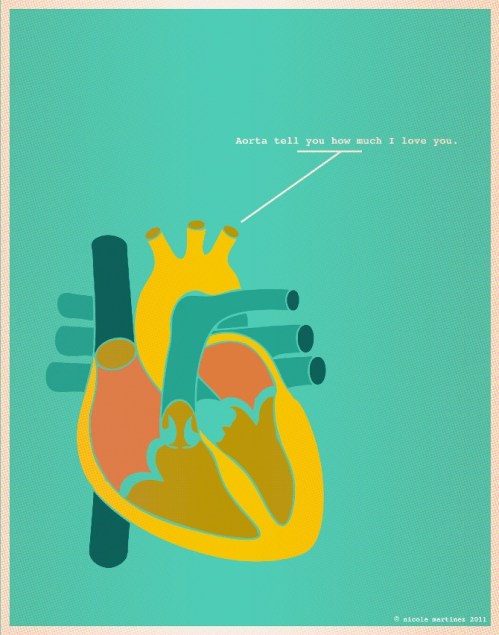
From a collection called “Nerdy Dirty” by Nicole Martinez. There’s a few of them, and they’re all very nice. Check them out at this link. For now, the one below has a little anatomy…

Apparently real. As in some of these suckers have been synthesized and reported in Nature – link.

Awesome. Via Velica DeviantArt page, hat tip to Fresh Photons.
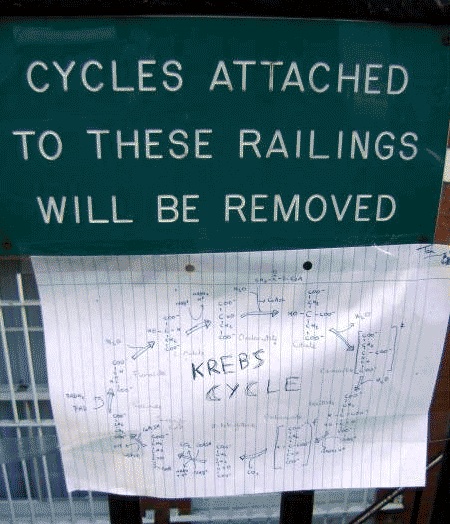
Via tumblr, biology tag but found all over the place. i.e. can’t find original source.
Here’s the start:
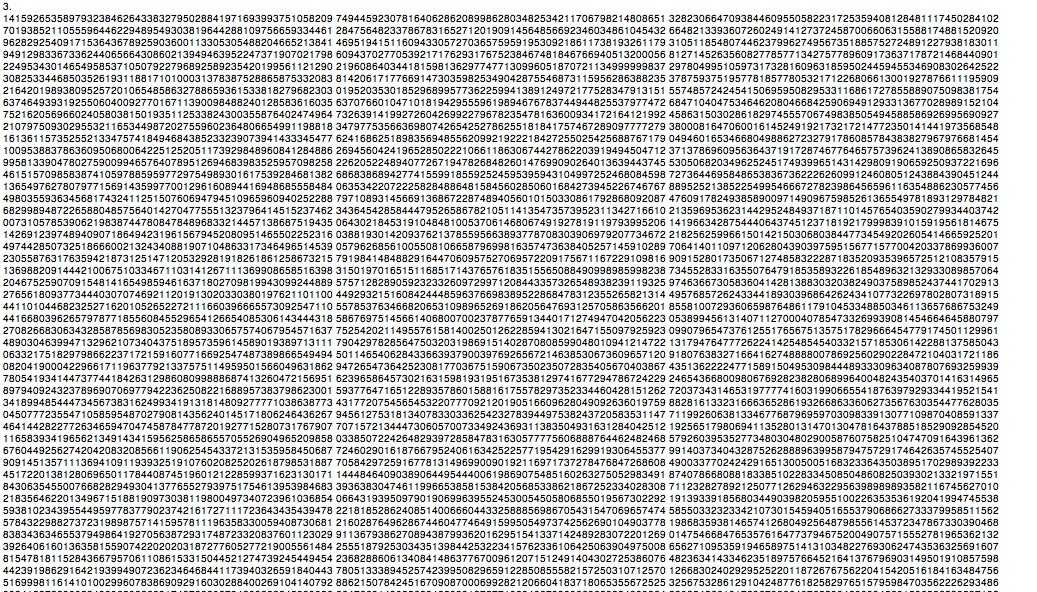
And to see it all in its one million glory, then just click here. (From Piday.org)
Great graphic from the City of Muenster; Germany’s bicycle capital. Yes, yes, we can wax rhetoric about the fact that four people can fit in a single car – but really now, how often does that actually happen?

I remember seeing this in elementary school and thinking, “Whoa…” The remarkable thing is that it is still awesome.
Julian Davies, a colleague of mine at UBC, coined the term “crapbook” in a lecture today. He was talking about a site called “My.Microbe” and, well, I had to check it out.
“The non-profit programme MyMicrobes, launched today, is inviting people to have their gut bacteria sequenced for about €1,500 (US$2,100). Acting as both social network and DNA database, the website offers a place for people to share diet tips, stories and gastrointestinal woes with one another. In exchange, researchers hope to gather a wealth of data about the bacteria living in people’s guts.” (From Nature – link)
Kind of wierd, actually. And expensive too!
Saw this earlier, but only just getting to it now. Tagged because this might come in useful for discussions on whether science can empirically analyse something like aesthetics. i.e. if we can code brain activity for what you see, can we code brain activity for how we “feel” about what we see…
Abstract goes:
“Quantitative modeling of human brain activity can provide crucial insights about cortical representations and can form the basis for brain decoding devices. Recent functional magnetic resonance imaging (fMRI) studies have modeled brain activity elicited by static visual patterns and have reconstructed these patterns from brain activity. However, blood oxygen level-dependent (BOLD) signals measured via fMRI are very slow, so it has been difficult to model brain activity elicited by dynamic stimuli such as natural movies. Here we present a new motion-energy encoding model that largely overcomes this limitation. The model describes fast visual information and slow hemodynamics by separate components. We recorded BOLD signals in occipitotemporal visual cortex of human subjects who watched natural movies and fit the model separately to individual voxels. Visualization of the fit models reveals how early visual areas represent the information in movies. To demonstrate the power of our approach, we also constructed a Bayesian decoder by combining estimated encoding models with a sampled natural movie prior. The decoder provides remarkable reconstructions of the viewed movies. These results demonstrate that dynamic brain activity measured under naturalistic conditions can be decoded using current fMRI technology.”
Gallant’s lab page has a great summary, and link to abstract and article can be found here.


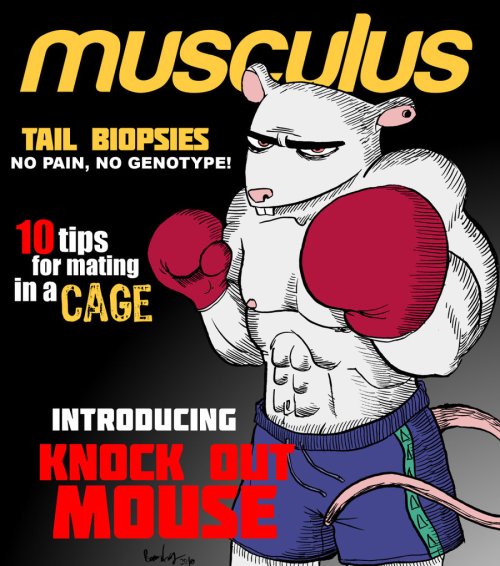
 popperfont.net
