Poster series on unusual wildlife activity in NYC #beautiful
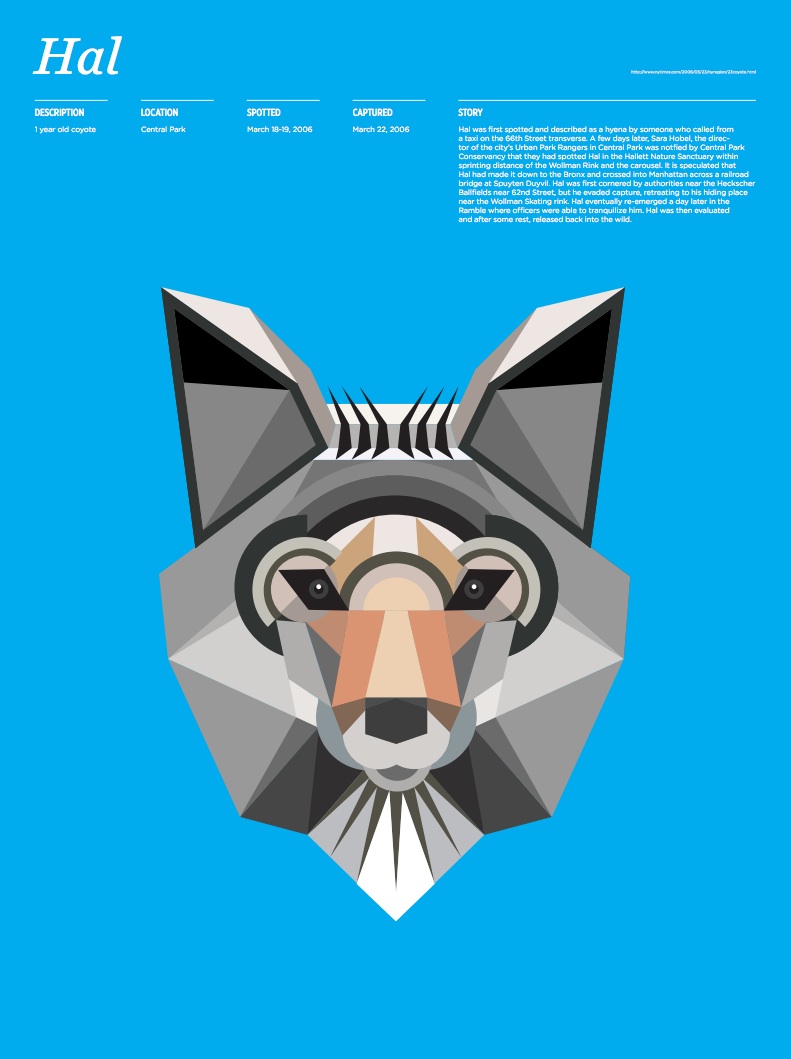
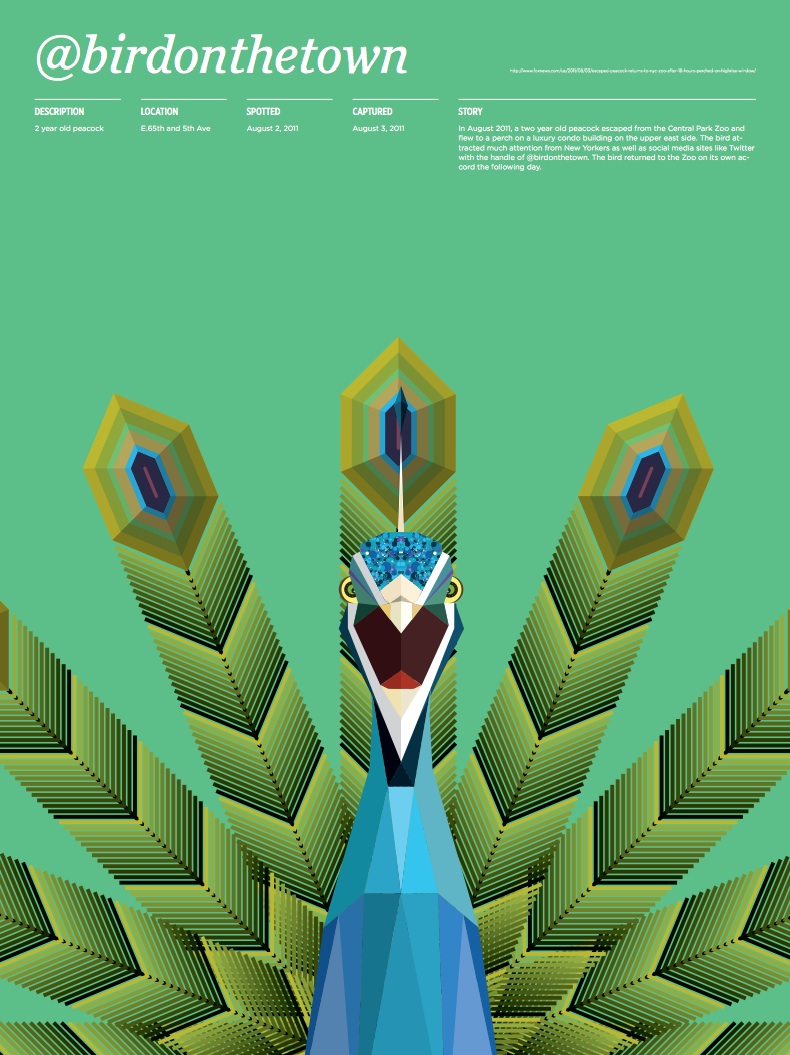
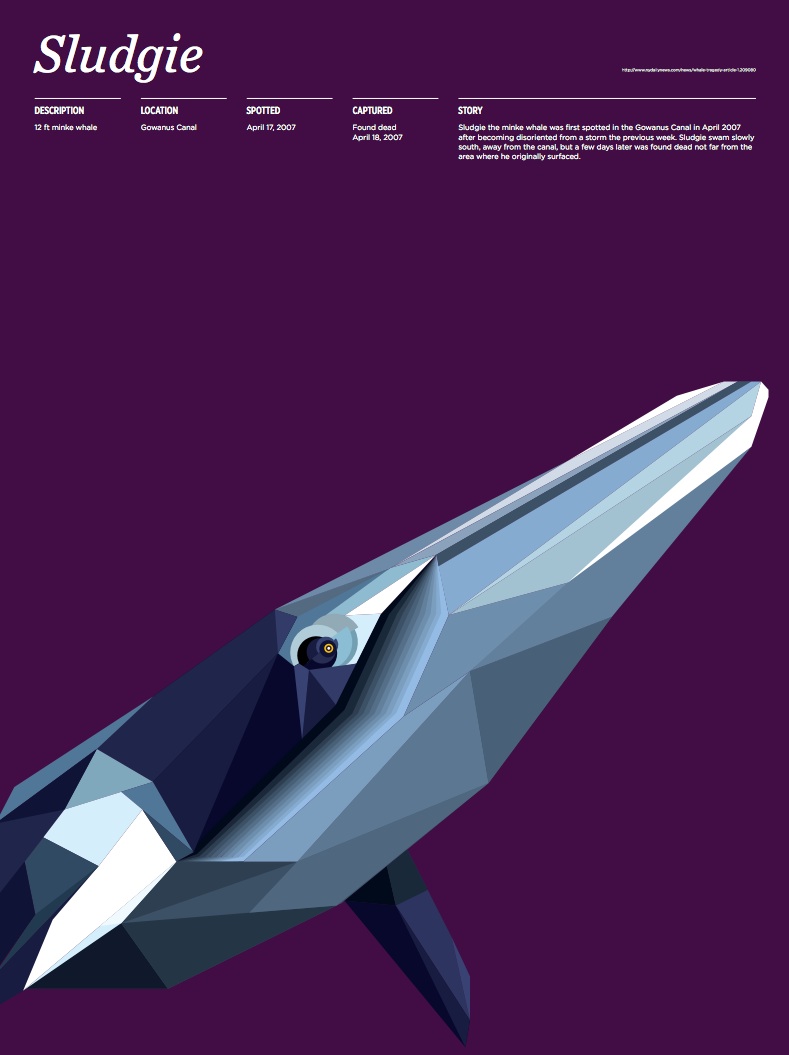
Hal’s story | @birdonthetown’s story | Sludgie’s story
By Thomas Wilder from MGMT. pdf available here. Via Notcot.org

Hal’s story | @birdonthetown’s story | Sludgie’s story
By Thomas Wilder from MGMT. pdf available here. Via Notcot.org
More on Said the Whale here.
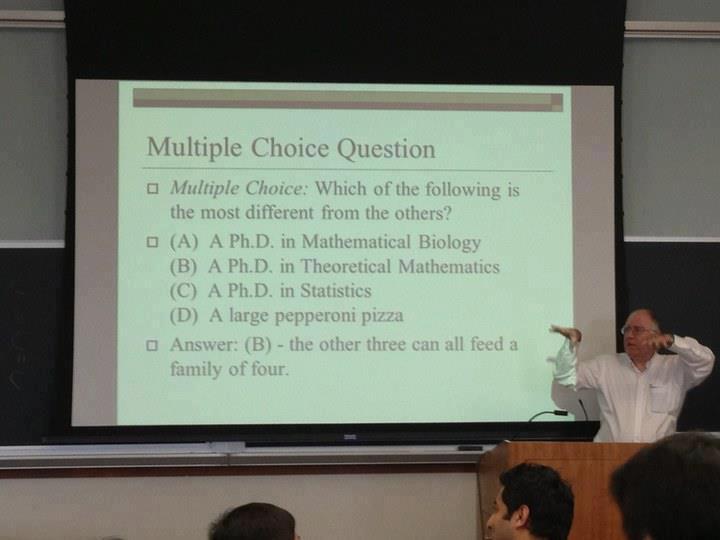
Via IFLS (no source provided – please let me know if you know where this came from)
From the BBC One show ‘Funny Talking Animals – Walk On The Wild Side’
More on the Weaver Bird here.
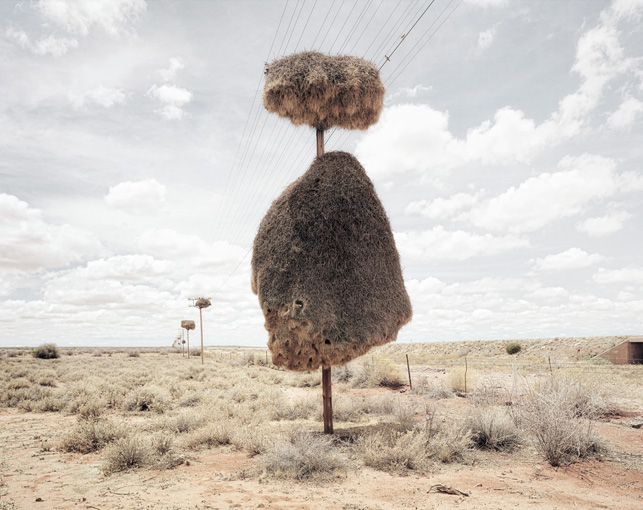



“In the vast barren landscapes of the southern Kalahari, Sociable Weaver Birds assume ownership of the telephone poles that cut across their habitat.Their burgeoning nests are at once inertly statuesque and teeming with life. The twigs and grass collected to build these nests combine to give strangely recognisable personalities to the otherwise inanimate poles.”
By Dillon Marsh, via Notcot.org
“My idea was to create a film, that fills up the metropolis New York with vegetation, that adapts to the straightness of the technology and the given situation. This happens through the assimilation of structures and forms. These biotopes are shaped by the existing living environment, but in turn also shape the newly developed living environment by their presence. In other words, a symbiotically coexistence begins.”
By Lena Steinkühler, via Notcot.org
I bet those 7 minutes must have been terrifying. Oh, and science FTW!!!
Via @BenLillie
“I sat there a long time,” he said, “but no one came.”
These were words that Stephen Hawking uttered upon observing an apparent no show of time travellers to his “time traveler party.” This was held on June 28, 2009, although the event was only advertised after this date (of course). As well, this sort of counts as indirect evidence against time traveling in general…
Via Futility Closet

It (hypothetically*) goes like this:

* Like all good science, this needs some testing…
– – –
When news hit that Disney bought the rights to Star Wars, and that J.J. Abrams would be manning the first movie of a new trilogy, my inner geek went into giddy overdrive. This was because it gave me a chance to revisited my bucket list, which had previously scratched off “be an extra in a Star Wars movie” as something that was unattainable having presumed the prequels were my last chance. But now, there is (literally), A NEW HOPE. Even better, is the fact that my kids are old enough to also want this.
And so, being a science-y sort and all, I figured the first step would be to actually try and come up with a way to calculate the odds of such a thing happening, and hence you see the above – or what I have termed the Abrams’ Stormtrooper Axiom. In effect, this is an equation that aims to calculates the odds of you (or anyone) being cast as a stormtrooper in one of these new movies1.
Here’s how it works. We’ll first look at (1) which expresses the equation in its most obvious form.

When you look at this equation, there are three main components: two in the numerator: WkSblaster and bmiopthopt
And one in the denominator: 5.4(1+bop+bow).
The denominator is an expression designed to address the likelihood of being cast, as having a dependence on the individual’s chance of contact with J.J. Abrams. Specifically, bop refers to the degrees of personal separation the individual is from the Director, whereas bow refers to the degrees of internet separation the individual is from the Director. The base of the exponential relationship is, of course, the standard May The Force Be With You Constant (or 5.4).
All told, if you have very little connection to the director, your odds can dwindle significantly, about 5.4(1+6+6) times, or roughly one in 3.3 billion! It also infers that even if you know JJ Abrams personally, it does not guarantee being cast – mathematically, the closest association would still work out to 5.4(1+1+1), or roughly a chance of one in 158. This is because there are other factors that need to come into play when determining whether an individual is right for a stormtrooper part.
Which is where the numerator expressions exert their influence. We can first begin with the bmiopthopt element, which essentially considers the physicality of the individual vying for a stormtrooper part. The bmi portion considers body shape, whereas the h portion considers height.
Each element can be further derived as:

Where (2) calculates divergence from an average body type (as expressed by an individual’s body mass index with m equals to the individual’s weight in kilograms, and h is equal to the individual’s height in metres). You’ll note that the more you veer away from an “average” body type, the greater the modification of the bmiopt number to a number less than one (and therefore further lowering your odds).
In the same manner, (3) calculates divergence from an optimal height (deemed 1.8 metres as determined from casual examination of Star Wars’ trivia – i.e. calculating Mark Hamill‘s height and noting the “Aren’t you a little short to be a Stormtrooper?” comment). Like the BMI calculation, the more you deviate from the optimal height, the greater the modification of the hopt number to a number less than one (and therefore further lowering your odds).
Note that both (2) and (3) are included in the overall equation for pragmatic prop design reasons (not every extra can have a custom made set of armour, so it makes sense if casting aimed for similar body types). Then, of course, there is the whole clone army narrative which might also presume the troops having similar physical features. (Also note that in case you weren’t familiar with the symbol, the straight up and down lines enclose a value where you only use the absolute number – i.e. remove the plus or minus sign).
Anyway, when you put it all together you get the expression (4).

Which only leaves Wk and Sblaster to be defined. Here, these two variables relate to two specific personality traits that are deemed important for the stormtrooper casting decision.
For instance, I don’t think I’m the only Star Wars fan who notices the incredibly poor marksmanship exhibited by the stormtroopers. There are many instances in the movies where there are many of them (with their weapons – presumably high tech in nature), in close proximity to the target, and yet, they still always fail to hit their target. The below video is one of many classic examples where you can see this:
Given this observation, I’m left to assume that Stormtroopers, as a whole, have a deep distrust of guns, and with that discomfort tend to misfire (perhaps subconsciously). This also leads me to hypothesize that not only are they not very skilled, but that they are probably the sort that are not at all familiar with gun culture in their private lives.
Consequently, Sblaster is a number assigned to measure the individual’s relative experience wth guns, whereby a value of 1.0 represents full disconnect from the use of guns in their personal lives, and a number closer to zero represents an individual who is very familiar with gun culture.
Of course, perhaps the most important tangible characteristic (that could translate to a positive casting decision) is relative fandom itself. In other words, casting may be partly governed by how “into Star Wars” an individual is. Here, and in honor of Chewbacca’s reference of “pulling arms out of their sockets when they lose,” I’ve decided to use Wookie knowledge, or Wk as an indicator that can further increase casting chances. Essentially, this is a scale that ranges from 1 to 10, whereby 10 represents fanatical knowledge on all things Wookie, and 1 represents no knowledge at all. In effect, if you’re nuts about Star Wars (and wookies specifically), you can increase your chances of being cast by 10 fold.
In conclusion, I want to stress that this is the Abrams’ Stormtrooper Axiom, and by its very definition, an axiom is just a starting point. This means the equation will need more work, and it would be great suggestions to make it better. As it stands, it works as a general guideline using a number of test values2. As well, there is also the very real caveat of whether J.J. Abrams will even have stormtroopers in the new movies – never mind the fact that if he does, they may come in a different size, or be better at shooting, etc. In some respects, this reminds me a little of Schrödinger’s cat (we can call our version Abrams’ Stormtrooper): we won’t really know what he has in mind until he lets us open the box.
– – –
Footnotes
1. In general, I’ve used information from the original trilogy for points of reference.
2. For instance, an individual with no connection at all will result in a number that works against the backdrop of the total human population numbers. For J.J. Abrams, himself, where bop and bow are equal to zero, and his Wk is likely quite high, the equation would further calculate that he has practically perfect odds of being cast as a stormtrooper (which makes sense given his role in the movie). For the sake of comparison, I’ve calculated my own odds to be approximately: 0.00000519 or about one in 19,000.
Is it bad that I want my own?


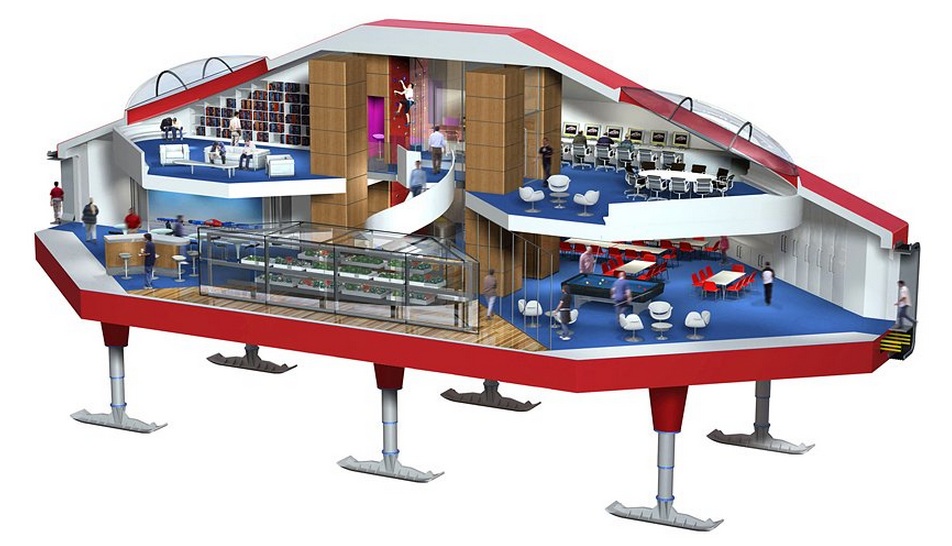
Designed by Hugh Broughton Architects for the British Antarctic Survey. Via Notcot.org.
Note that this essay is in regards to this.

The session began with a bit about inflatable pools: although here, a little context might help.
In the summer of 2009, my hometown of Vancouver experienced a small heat wave. It got very hot and humid, unbearable even, and not surprisingly my two young kids (Hannah and Ben) were quite miserable. Consequently, to led to the very popular idea of getting an inflatable pool for our backyard, which to all intents and purposes, appeared to be a genius move. And so before we knew it, we were suddenly on the hunt.
This naturally led us to a local toy store, where lo and behold, marketing geniuses that they are, the store had conveniently placed all of their pools front and centre. Here, we were confronted with the pool that you see in the picture above (on the left).
It looked, quite frankly, awesome, and, if you can believe it, it was also priced at only thirty dollars. Needless to say, we bought it immediately and full of excitement, took it home to set up. It was here that something odd happened. In essence, when the pool was inflated, it looked a little different from the box (see image on right).
Of course, being a scientist and all, my rational mind was racing and trying its hardest to come up with hypotheses that could explain what was going on. Why did the pool look so tiny?
Did I not blow hard enough and inflate it properly?
Was the photograph on the box taken in a land of small hobbit-like people?
Were my children, unbeknownst to me, massive?
It was all very bizarre, but at the end of the day, the explanation was quite simple. Apparently, in the world of advertising, it is permissible to use misleading images so long as there was some presence of text that exposed the reality of the product. For instance, the object’s dimensions are clearly printed on the box, or a statement such as “object in box may not be as appears” is included.
For our session at Science Online 2013, this silly anecdote served as a sort of meta-example of what we were hoping to talk about: That is, how do we talk science to folks who don’t necessarily care about science? How do we preach outside the proverbial choir, or go “beyond the choir,” or delve into things that are praeterchoral if you will. And perhaps more importantly, what are the tensions associated with trying to do this? Should there be important things to consider, say for the public good? And do such things even work (or how would we even know)? In effect, the two images represent the “truth,” and how the “truth” might come across when communicated. They are meant to represent a literate form of science communication, and a form that is not quite accurate but might be easier for the general public to engage in. In other words, we were wondering whether there is a cost to translating science in this way.
Looking at the two inflatable pool images, I can think of a number of potential problems. For instance, when using more creative methods, perhaps one will inadvertently dilute, distort, or even get the “truth” or the science wrong. Or maybe it’s not even a case of being scientifically sloppy, but rather one paints a slanted version of science culture by consistently focusing on the stuff that is deem interesting, strange, entertaining, or dramatic – we leave out the boring bits, which arguably present a more accurate portrait of science. As well, a lot of the science used to capture interest, might not be the sort of science that is quote-unquote “important,” or at least important in terms of civics and public good (yes, a narrative about an inflatable pool is charming, but shouldn’t we talk about climate change or gun control for instance?) Even worse, maybe in my zeal to be entertaining, funny, and/or quirky (never mind finding a way to show off my kids), I actually created a situation where clarity was lost in the discussion.
All to say that the act of preaching outside the choir has many nuances. Certainly enough to warrant an extensive list of things to think about: a list that Gertrude Stein might even approve of. Which was why Tom (@TomLevenson) provided a tour of such a list of considerations, prefaced by the dying words of Stein and made all the more pertinent because it was quite likely that the inflatable pool meta-example had failed (which you could say was sneakily deliberate – a meta-meta-example? – or a consequence of my not getting enough sleep and perhaps being too glib and overconfident in my ad-libbing speaking skills*)
In any event, this list (which can be seen in full here) was aimed at provoking the audience and included important questions such as: “Should we first ask: why do we want to engage such audiences (the uninterested)?”, “Where do notions of Civic Duty/Need (Proselytizing!) and/or Self-interest fit in?”, and “Does entertainment even work?” And in the end, this dialogue culminated in three simple queries: WHY, WHO and HOW?
Which worked well, because the audience took to the list and responded in wonderful and thoughtful ways. In particular, the discussion appeared to categorize itself into three particular trends.
Firstly, many of the comments showcased intriguing examples that took advantage of an unconventional pairing – for instance, the case presented by Chad Orzel (@orzelc) of connecting a narrative between the National Football League and the neuroscience of concussion effects. Along similar lines, there were also many examples where some facet of art was combined with the act of translating science. This included discussions around the use of aesthetics in artwork, comics, animation, video, or the importance of theatrical elements or story telling as a form of engaging narrative (@Indrevis, @BenLillie, @Beatricebiology). In particular, I remember Jennifer Ouellette (@JenLucPiquant) describing some of the mandates around her role as Director of The Science and Entertainment Exchange. This was great stuff, and really this should all be archived somewhere someday (maybe here even?).
As well, there was a category of stirring conversations which tended to be the ones that considered the motivations involved – as in, why do the people in the room do what they do. Here, we heard many comments around the simple idea of sharing one’s passion, and to hope that in doing this, one will engage someone to look a little deeper. Or better yet, a science communicator who wants to move outside the classroom mentality is doing this because they are, in effect, saying that “this is my view of science culture and I think that you might find it interesting too…” In other words, it’s not necessarily about being strategic or attempting to fix science literacy issues en mass but simply doing your part, in the context of whatever reach you can muster. I quite like this sentiment, especially when expressed with eloquence and passion by individuals like Danielle Lee (@DNLee5) and Annalee Newitz (@Annaleen). It feels right and, if I can be honest, it’s also downright inspiring.
Except that none of it feels very scientific, which presents a delicious sort of irony and also our third and final stream of commentary. More to the point, this discussion addressed whether any of our preaching outside the choir was actually working. Are our efforts for naught, or are we, as a roomful of passionate science communicators, actually changing societal impressions, views, and opinions around science? Anecdotally, yes, but can we call ourselves successful when applying a more rigorous scientific rubric.
This, to me, is an important question, but it’s also a question that might not have easy answers. In fact, Ben Lillie (@BenLillie) very nicely expressed this conundrum, so much so as to suggest that maybe it’s not something that can be measured – and I think there’s some merit to this train of thought. How do we evaluate such things, this talking science to the uninterested, and in any case, how confident would we be with this evaluation, knowing that it is likely a caveat laden process? It reminds me a little of a recent chat I had with a theatre academic – he told me his colleagues were constantly wrestling with the following question – “how exactly does one measure the value of art?”
Still, that doesn’t make it a pointless question, and certainly not one that shouldn’t be explored. Indeed, Science Online was wonderful because others were interested in this challenge, and I’ve even managed to embark upon a research initiative with Marie-Claire Shannahan** (@mcshanahan) to hopefully capture a glimpse of what an answer might look like. It’s funny: This science communication business is all a little mysterious when you think about it, but upon reflection, I find it comforting to realize that this isn’t so different from the awesomeness of science itself.
– – –
* It was the latter by the way. This is why theatre is always workshopped, and I should’ve known better!
** More on this later. For now, we have both agreed to present this research process in a completely open manner. Right now, we’re stuck on the name of the blog where we would real-time share our discussions, processes and results.










 popperfont.net