
.
Category: *




July 13, 2012
And this is what dinosaur sex looks like…
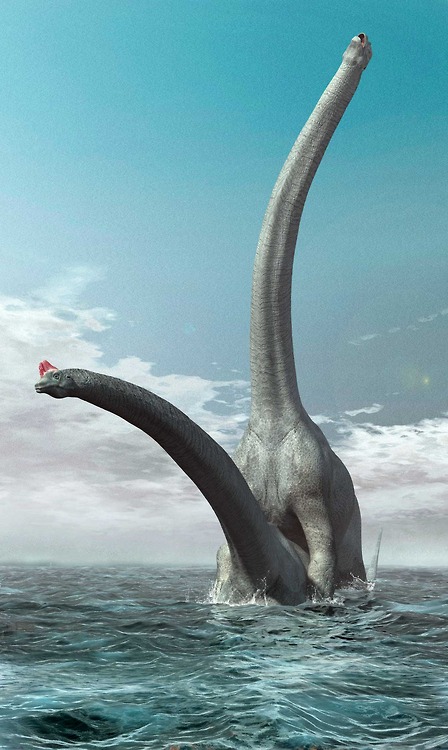
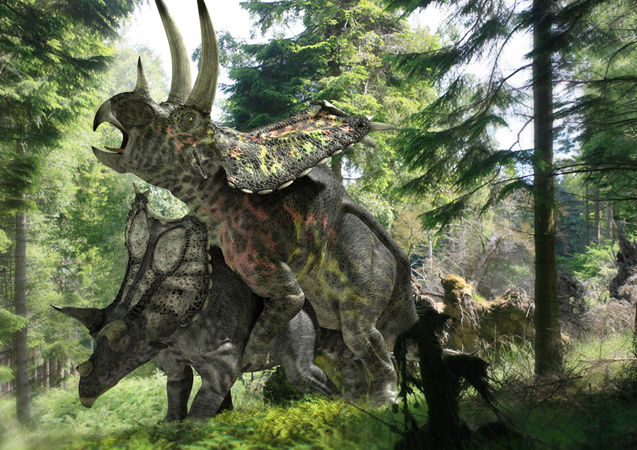
Not sure who the illustrator is, but it is someone who collaborated with Beverly Halstead. Via The Daily.
July 12, 2012
Quite possibly the most complicated (and therefore awesome) Venn Diagram ever!

The figure legend reads:
Figure 4: Six-way Venn diagram showing the distribution of shared gene families (sequence clusters) among M. acuminata, P. dactylifera, Arabidopsis thaliana, Oryza sativa, Sorghum bicolor and Brachypodium distachyon genomes.
In case it wasn’t obvious, M. acuminata is the banana plant.
Full paper on the draft genomic sequence of the banana, and the info this divulged regarding its evolution is available for free downloading at Nature.
REF: The banana (Musa acuminata) genome and the evolution of monocotyledonous plants. Angélique D’Hont, France Denoeud, et al. Nature (2012) doi:10.1038 / nature11241 (published online July 11, 2012)
July 12, 2012
Large particle accelerators are the gothic cathedrals of our time. #lovelymetaphor
From the NYT piece by Lawrence M. Krauss.
“The physicist Victor F. Weisskopf — the colorful director in the early 1960s of CERN, the European Organization for Nuclear Research, which operates the collider — once described large particle accelerators as the gothic cathedrals of our time. Like those beautiful remnants of antiquity, accelerators require the cutting edge of technology, they take decades or more to build, and they require the concerted efforts of thousands of craftsmen and women. At CERN, each of the mammoth detectors used to study collisions requires the work of thousands of physicists, from scores of countries, speaking several dozen languages.”
Read the rest of the article here.
July 11, 2012
Wonderful artwork in this brilliant history of organic chemistry slideshow.
Download the full presentation here (pdf).

“Vladimir Markovnikov,a chemist and political progressive, was outmaneuvered by the crafty and conservative Aleksandr Zaitsev. Both men would go on to fame as discoverers of significant trends in chemical reactivity and organic chemistry students today still learn “Zaitsev’s Rule” and “Markovnikov’s Rule.”

“So, organic chemistry has come a long way from its early days. It might have reached its peak,in a certain sense, around 1972, when Robert Woodward of Harvard and Albert Eschenmoser of the Swiss Institute of Technology synthesized the very complex molecule we know as vitamin B-12. Ever since, it has been widely accepted that organic chemists can make pretty much any molecule that occurs in nature. That is really something!”
By David B. Cordes, via Fresh Photons.
July 11, 2012
Earliest Human Relatives by Hiroshi Sugimoto. Dioramas photographed a certain way suddenly look very very real.

“Upon first arriving in New York in 1974, I did the tourist thing. Eventually I visited the Natural History Museum, where I made a curious discovery: the stuffed animals positioned before painted backdrops looked utterly fake, yet by taking a quick peek with one eye closed, all perspective vanished, and suddenly they looked very real. I’d found a way to see the world as a camera does. However fake the subject, once photographed, it’s as good as real.
By Hiroshi Sugimoto.
July 11, 2012
Dark Side of the Loom #greatvisual #optics
What a great visual! Handy for all sorts of discussions on optics and light in general.

July 10, 2012
Happy Birthday! Nikola Tesla turns 156.
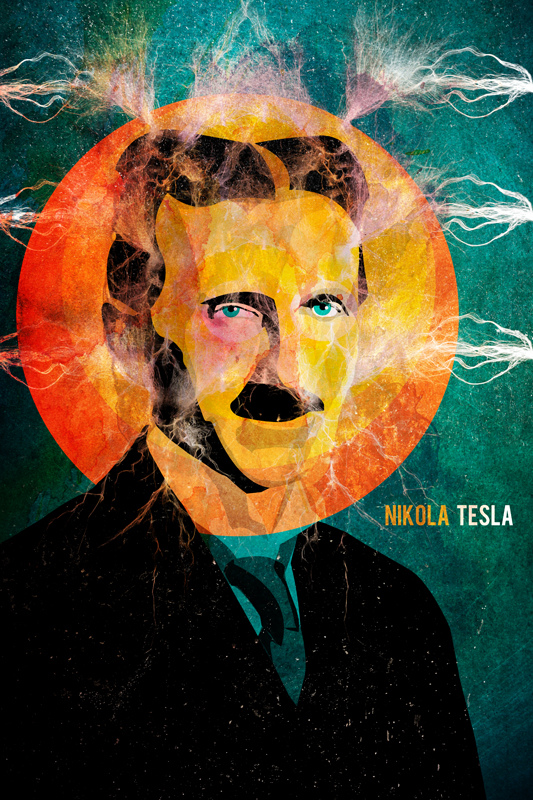
Lovely art by Alvaro Tapia, via Hey Oscar Wilde!
More from Tesla’s wikipedia page here.
Awesome, and of note, on this site:
July 10, 2012
Artwork of beautiful (though impossible) radiation absorption patterns (a.k.a cool shadows).
At least, I’m pretty sure it would be impossible. Would make a lovely graphic (I think) when discussing electromagnetic radiation, particularly those relating to visible range and absorption concepts.


By Jason Ratliff, via The Visual News.

July 10, 2012
Here’s one way to adapt to climate change: Build underground ski resorts.

“In order to simulate actual outdoor skiing conditions, provisions are made to vary the steepness of the slope from place to place. In addition, facilities are provided to produce random simulated moguls or an entire mogul field. Thus, during one run of the slope, most, if not all, of the conditions encountered on natural outdoor slopes may be simulated and incorporated into the run”
By Nobuyuki Matsui, via Google Patents, via Futility Closet.

July 9, 2012
Grant writers: On discussing the applied benefits of funding lightsaber research…
…Please watch this video. Note the research benefits are twofold. First, the obvious fact that lightsaber would be real; and second, the fact that that birdie must be damn near indestructible!
Inspired by the fact that we just bought one of those cheap badminton set-ups and the kids think it is an AWESOME way to spend your summer days in your backyard (especially when you make lightsaber and/or Kung Fu sounds whilst playing).
Also, what other applications would go into this grant?
July 9, 2012
Power transmission towers that look like giant human figures

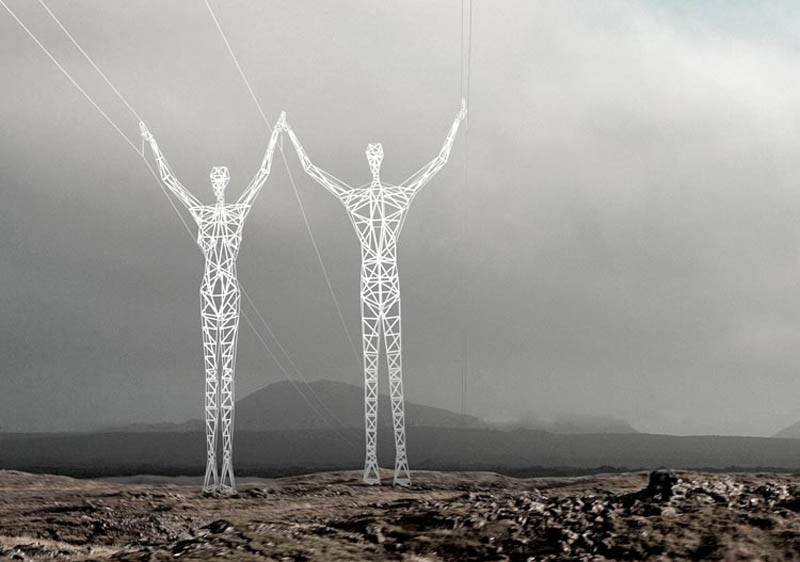
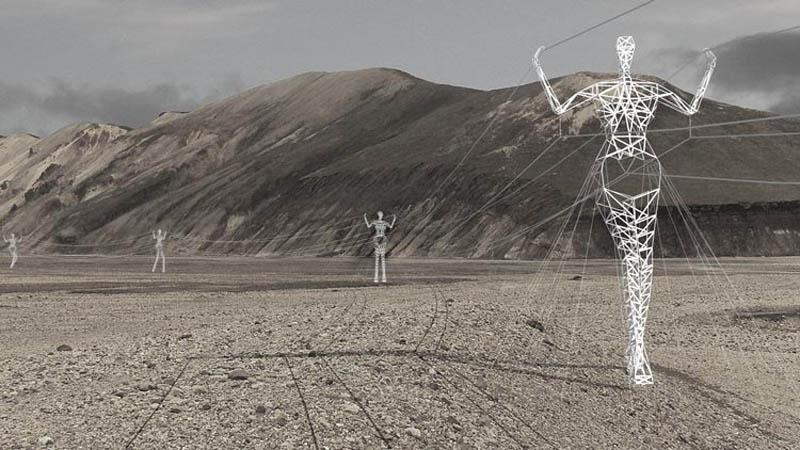
“If we have to live with them, why not turn them into something both functional and artistic? This was the sentiment of American design firm Choi+Shine Architects, who submitted the concept to Iceland’s ‘High-Voltage Electrical Pylon International Design Competition.” The concept, dubbed ‘The Land of Giants‘, sought to transform mundane transmission towers into statues on the Icelandic landscape by making only small alterations to existing pylon design.”
Via Twisted Sifter







July 6, 2012
Not “Snakes on a Plane,” but rather, “Salt on a Plane”…
…looks like this.

“…a grain of sodium sulfate and sodium chloride (salt) while researching jet turbine safety. Jet turbines become very hot when in use and are also exposed to the atmosphere. This combination can lead to compounds such as salt encrusting the turbines. Rosier and her colleagues reproduced and photographed one such salt grain in the laboratory.”
Image by Hollie Rosier of Swansea University, Winner of the 2012 2012 Research as Art competition. Via Live Science.
 popperfont.net