
For my Dad
by David Ng
– – –
“My Dad beat up Bruce Lee…”
This, actually, is a true statement.
O.K., technically, the statement is mostly true – because depending on which of my Dad’s friends you ask, you might learn that it’s probably better to say that he “pushed Bruce Lee around” as oppose to “beat him up.” Still, regardless of which version you believe, it all sounds pretty impressive. Until, of course, you learn that my Dad was 10 at the time, whereas Bruce was about 8 years old.
This is why I often use this statement when I give talks about science and society. It nicely encapsulates the weaknesses behind describing things (such as science things) with only a soundbite – without the full context in place. The fact that my father beat up Bruce Lee has two completely different interpretations depending on your knowledge, or lack of knowledge, of that additional piece of context.
Secretly however, I also use the statement because I happen to think that it does make my Dad sound incredibly impressive (even if it does imply that he might have been a bit of a bully – although also possibly the true reason why Bruce Lee went on to become an expert in Kung Fu).
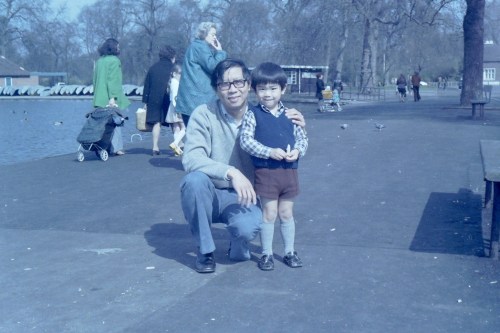
But that is because I know that my Dad was incredibly impressive. He had led a full and interesting life – a life that enriched others. Often, I’d hear stories of his youth, where he’d tell us that he was a stellar basketball player winning many school games. He would tell me that his favourite book as a child was The Jungle Book by Rudyard Kipling, which may of had something to do with being an avid boy scout. Indeed, he even rose to the ranks of Queen Scout (sort of like the Jedi of all scout ranks), and once got to shake the Queen’s hand. You should also know that my father was also a skilled civil engineer – so much so, that I’ll bet he was main reason why his particular track of Vancouver’s Skytrain is especially quiet and efficient. Finally, there is the story of when he was sick and admitted into a hospital in Hong Kong. Here, he was treated by a pretty nurse – a nurse he would return to and ask out, a nurse he would later date, marry, and begin that family life he so cherished.
These details would only skim the surface of why I consider him an inspiration. All told, he was a formidable engineer, a loving husband, a brilliant father and a great granddad. Quite simply, he was a truly wonderful human being.
Unfortunately, his life wasn’t always so wonderful. In fact, during the last ten or so years, life was quite rough. In 2000, he was formally diagnosed with Spinocerebellar Ataxia (SCA3), a neurodegenerative genetic disease that affects certain coordination abilities, often in a slow but drastic fashion. Over the years, there was a gradual but noticeable decline in his health. First, he would be wobbly, then he would need a cane, next a walker, and finally a wheelchair. It would become a challenge to write, speak, eat, even sit straight. It was, needless to say, heartbreaking for us all to see this unfold.
When Dad first learnt of his condition, it came to pass that I would also need to get tested for SCA3. This was because this particular disease is classified as an autosomal dominant, which meant that there was a 50% chance of Dad passing the defective gene to me. Furthermore, this test would also divulge my own fate in this matter. Essentially, by agreeing to such a test, I could find out whether I had received the good or defective copy.
During this whole episode, I remember thinking that this was, in a way, strangely fortuitous. Here I was, a geneticist, who revels in science education, and I had actually been granted an opportunity to experience firsthand that most iconic of all science ethics lessons – the genetic test. I even distinctly remember saying to myself, “This is so cool,” and saying this even before I found out that I had tested negative for the disease.
But nowadays, I don’t feel the same way. During those last few years, seeing what my Dad had to suffer through, has made me seriously re-evaluate that original sentiment. It certainly didn’t seem so cool anymore. Which again demonstrates how perspective truly is king. Indeed, depending on my mood, I might feel all sorts of different things.
I might be frustrated by the glacial pace of scientific research, and the challenges of various medical support systems. Or sometimes, I would feel real anger at the political and cultural backdrops that have stalled certain scientific discoveries, the kind that could have helped find treatments and/or helped increase comfort levels. Here, I know that SCA3 falls under similar pathologies to other CAG repeat neurodegenerative diseases, and as such, is a prime beneficiary of what some view as contentious stem cell research. But even in these dark moments, mostly, I feel like the best reaction is one of bitter inspiration, a kind of relentless feistiness that I need to compel me to do justice to my father’s memory. Something to fuel my heart to do something, anything that my father would deem worthy.
Of course, sometimes it’s just nice to feel nostalgic. To think of my Dad when he was able to walk and run and dance and hold us up. I don’t know why, but it’s strangely comforting to yearn for this better time, before the talk of tests, and before the genetic haunting. Fittingly, with these words from The Jungle Book, even Rudyard Kipling might agree:
“I will remember what I was, I am sick of rope and chains –
I will remember my old strength and all my forest affairs.
I will not sell my back to man for a bundle of sugar cane;
I will go out to my own kind, and the wood-folk in their lairs.
I will go out until the day, until the morning break –
Out to the wind’s untainted kiss, the water’s clean caress;
I will forget my ankle-ring and snap my picket stake.
I will revisit my lost love and playmates masterless!”
And although I’m not a religious type, I’d like to think that wherever Dad is now, he is walking again. This makes me feel a little bit better, but right now, truth be told, mostly I feel sadness.
.
Dad… I will love you always, and will be forever grateful for your presence in my life.
I will miss you terribly.
Your son, David.
– – –
John Kar Kee Ng, born March 8th, 1935, passed away on February 10th, 2012. May he rest in peace.
You can make a donation to the BC Ataxia Society using this online donation form (there is a field on the online form to make the donation in memory of John Ng)
 popperfont.net